
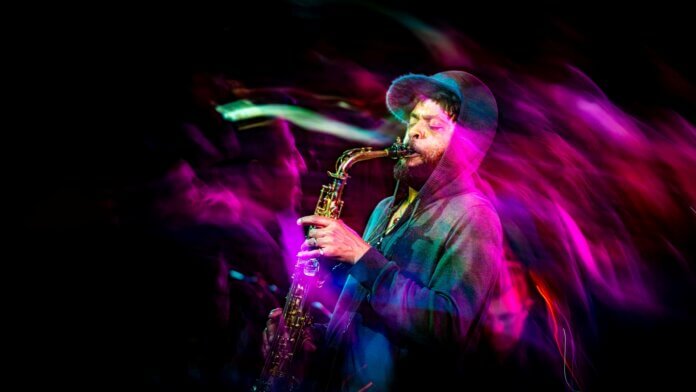


Logan Richardson belongs to that category of musicians who move through their instrument as if it were a living territory, layered, dense with memory and future. His alto saxophone is not merely a means of expression, but a vehicle of identity, a carrier of history, a resonant body breathing within a Black line that has never been broken, but has changed shape, language and grammar.
Born in Kansas City – a city that, in jazz, is not so much a geography as a pulse – Richardson grew up within a tradition that never imposes itself as a museum, but rather as pressure. The same pressure one feels in Charlie Parker’s recordings, where every phrase is an act of survival, and which later becomes cosmic expansion with John Coltrane, before reaching the elliptical, visionary writing of Wayne Shorter.
Richardson does not quote these names. He absorbs them. He lets them settle into his own sound until they become something else, something no longer recognisable as heritage, but as an active present. To listen to him is to enter a substance that is at once lyrical and nervous, disciplined and unstable. His phrasing does not seek approval. It cuts, diverts, builds and destroys in the same gesture.
Jazz is there, of course, but so is the contemporary city – made of concrete, deep bass and digital frequencies – and above all the awareness that today Black music can no longer afford to be a closed category, but a mobile condition, an expanding grammar. It is here that the saxophonist ceases to be simply a great musician and becomes a figure of contemporary Blackness. Not in the most obvious rhetorical or identity-based sense, but in a subtler one: that of someone who embodies a transition.
His music lives in a space where jazz dialogues naturally with hip-hop, with electronics, with a certain post-urban aesthetic that owes as much to producers such as J Dilla or Flying Lotus as it does to the great architects of twentieth-century acoustic sound. It is no coincidence that in his most recent projects one senses an almost cinematic tension. As if each composition were a scene, and each improvisation a long shot over an inner landscape in constant transformation.
Yet, unlike much contemporary music that merely evokes atmospheres, Richardson constructs real narratives: wordless stories that speak of belonging, displacement, memory. His is a music that knows the weight of history, but at the same time refuses to be crushed by it. In this sense, Richardson is profoundly contemporary. He does not seek an impossible purity, but a personal truth within the noise that surrounds us. And that truth also passes through risk, error, through a certain urgency that becomes especially perceptible live, when sound turns physical, almost tactile.
In today’s landscape – often fragmented between nostalgia and superficial hybridisation – his voice stands out for a precise reason: because it does not need to declare what jazz is today. It simply demonstrates it by playing. And perhaps that is precisely the point. In an era in which identity is constantly negotiated, exposed and claimed, Logan Richardson embodies it without ever turning it into a slogan. His Blackness is not a theme, but a presence that resides in the sound, in his choice of collaborators, in the way he builds his records and brings them to the stage. And, above all, in that rare ability to hold together very deep roots and a radically open gaze.
This interview comes from an attempt to enter, if only for a moment, his narrative. Not to explain it – that would be pointless – but to listen to its trajectories, its visions. Because with Logan Richardson one does not speak only about music. One tries to understand in which direction a certain idea of freedom is moving today.
Your music seems to move between jazz spirituality and contemporary urban tension. When you compose, do you start more from a sonic image or from an emotional idea?
That is a wonderful question. The inspiration of the moment in which I compose is obviously very important. The day, the space I am in. There are days when I cannot find the right note or melody, and others when everything comes out spontaneously. My state of mind is important, whether I am relaxed or not, whether I am stressed or not. And the music is obviously affected by that. I prefer the moments in which I let myself go and the music guides me, leads me in a direction, rather than those in which I am the one dictating the rules.
Many listeners perceive in your playing a connection with the deepest African-American tradition. How important are figures such as John Coltrane or Wayne Shorter in your artistic journey?
Very much so. I would not know how to find the right words to answer this question, in the sense that they would be too few and inadequate to express the privilege and honour of being even minimally associated with musicians like them. It is truly an honour for me to think of being placed within the great tradition of Black music, even only in terms of continuity. In our music there is blood, life, breath, sacrifice: all characteristics that are present in what those two giants you mentioned did.
In contemporary jazz, the distinction between genres is increasingly blurred. Do you still feel inside the boundaries of jazz, or do you think of your music simply as an open form of expression?
Both. I like to think that I am part of the continuum of the African-American tradition and, at the same time, starting from that tradition, I like the idea of exploring and therefore cultivating what you call an “open form of expression”. I do not really know how to answer this question. I can say that today my music takes me into a personal space, one in which I feel comfortable, safer, artistically and musically, a space that at certain moments comes into resonance and aligns with that of other people with whom I am able to find a connection.
If you had to describe your evolution from the beginning to today, what was the moment when you realised that your language was truly changing?
I do not think I ever understood that moment. Everything that happened has always been very clear in my mind. I have done nothing but try to realise myself musically. And, in a certain sense, I still feel that I am at the beginning of my path, of my musical journey. But if I look back at how my music has changed over the last fifteen or twenty years, I really cannot fully understand what happened. I was not aware, not conscious, of this possible change. I have done nothing but try to learn more and more, to improve myself. And I continue to do so.
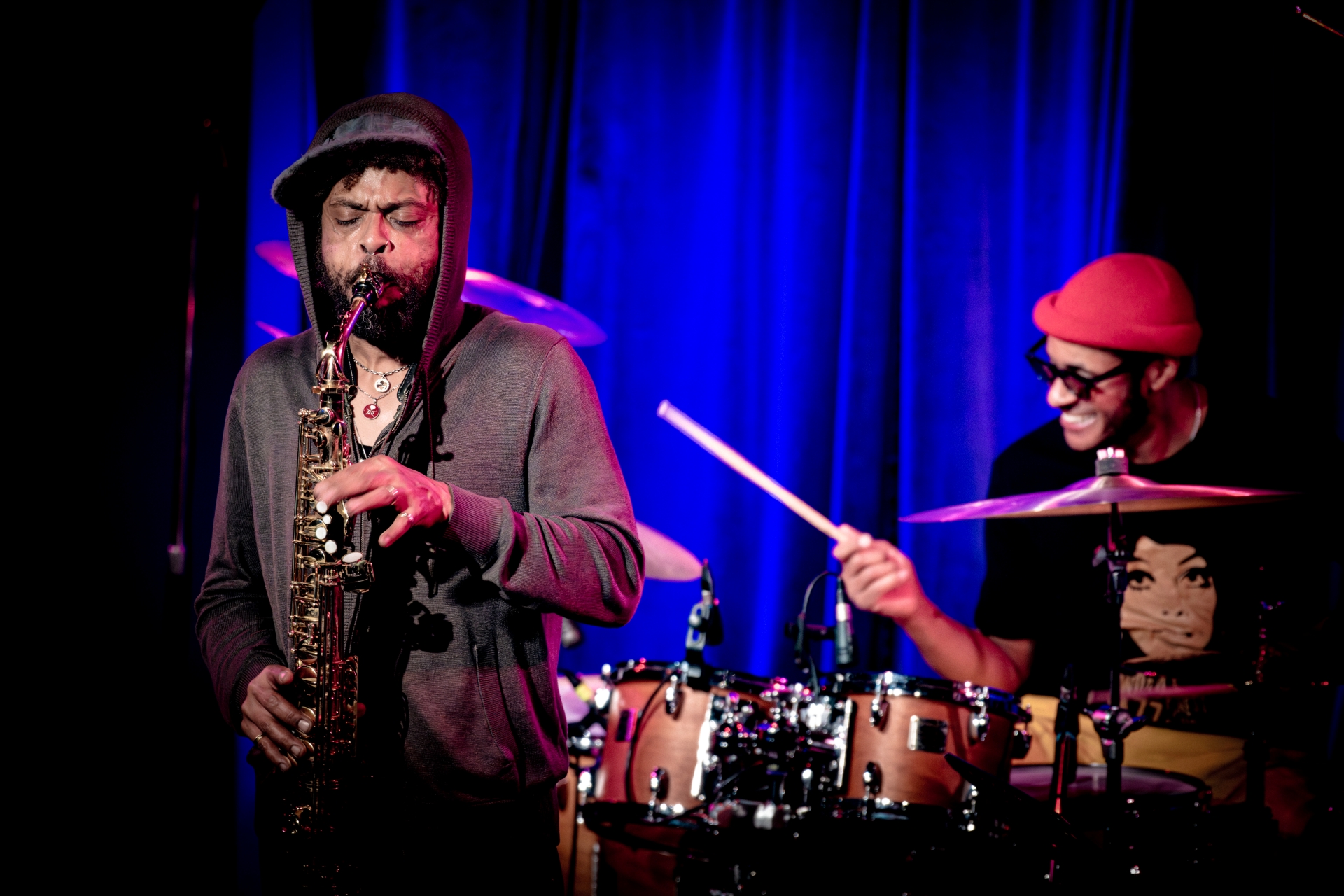
You have collaborated with very different musicians. How important is dialogue with others in defining the sound of a project?
It is very important, not only because collaboration, dialogue, is an enrichment, but also and above all because the relationship with others is usually a growth that happens spontaneously. It is something unexpected. And I have found many musicians who have contributed to this growth. I like collaborating with everyone, even with people I barely know. It helps me find myself. I consider myself a perpetual student, always ready to learn and taking nothing for granted.
There is often a cinematic, almost narrative dimension to your sound. When you write, do you ever think of music as a soundtrack for imaginary stories?
Not for imaginary stories. For real ones. If we are talking about a narrative dimension, I cannot say whether that music belongs to my seven-year-old self or to my twenty-seven-year-old self. I feel that my attempt to play – both what has already been done and what has yet to be done – is part of a way of conveying messages. I feel like an instrument, ready to immerse itself in unfamiliar situations that allow me to deepen my experience as a musician and pass it on to the listener. An instrument ready to communicate a conviction that enables everyone to reflect and engage in dialogue.
Many artists of your generation have a natural relationship with hip-hop and electronic music. How have these cultures influenced your phrasing or your approach to rhythm?
I was born in 1980 and grew up listening to a great deal of pop music influenced by jazz, such as Michael Jackson, Stevie Wonder and Prince. Those were the sounds of pop and electronic music that shaped my formative years. In that respect, the 1990s meant a great deal to me, whereas I cannot say the same about the early 2000s. I like Radiohead, the Fugees, Lauryn Hill and D’Angelo. His Voodoo is a perfect example of a successful combination of jazz, soul and R&B, an extraordinary record that embodies modernity in terms of phrasing and feeling. And then there are Earth, Wind & Fire and Weather Report. That music was the fuel of my adolescence.
The alto saxophone carries an enormous tradition. How does one build a personal voice on an instrument so deeply marked by history?
I am still trying to figure that out. I think every great artist who has played this instrument has lived such an intense and personal life, occupied such a unique artistic space, that it simply cannot be transferred to anyone else. Each one lived that experience in their own way. How can anyone fully answer a question like this? Everyone will answer differently. As for me, I try to tell my own story, the story of my life, through my instrument. That is the only way I can try – and I am still trying – to find my own voice. I could never be compared to Charlie Parker or Cannonball Adderley, two extraordinary voices of their generation, each with their own unique story. One thing I learned from all of them is their ability to tell the story of their lives through their instrument.
In contemporary music, people often speak about identity and roots. How important is the African-American cultural context in your music?
It is everything. You know, here in the United States we could never claim that we invented pasta. Many people can faithfully recreate something invented by someone else, but however faithful it may be, it will never be the same as the original.
The heart, the core of our music belongs to us. It comes from our lives and our suffering – music is an expression of life – and so, to answer your question, the African-American context is part of the genetic code of my music. I could not make music without understanding its roots. I am trying to add something to the great African-American experience, but it will always be a grain of sand compared with everything that has already been expressed.
And let me add this: only one of us can fully explore our own history. Let me explain. If I wanted to become an Italian opera tenor and I came from Kansas City, I would have to travel to Italy, study the language and study opera if I truly wanted to become one. I would have to devote myself completely to that culture. I could not call it “Black Italian opera”: its name is “Italian opera”. Period. I cannot rename it simply to create an identity for myself. Even though I am Black, if I want to define myself as an opera singer, I must become part of that culture.
That is why the cultural context in which a musician operates is everything. It is also why I dislike expressions such as “Chinese jazz”, “British jazz” or “European jazz”. We do not say “British R&B” or “Chinese rock”, and in any case I find those labels ridiculous. Perhaps only in rock can there be a distinction between what is made in the United States and what is played in England. Certainly, the Beatles’ rock is different from Jimi Hendrix’s, even though the roots are the same.
But as far as I am concerned, there is only one jazz. Every British or European jazz musician wants to listen to John Coltrane or Elvin Jones. What seems strange to me is seeing musicians behave as though they had created this music themselves. That is not the right attitude. It is not fair. This music comes from the experience of African Americans. Understanding the cultural context from which it comes is essential if you want to express yourself through it.
If you imagine the future of jazz over the next twenty years, do you think it will move closer to tradition or become increasingly intertwined with other musical forms?
I believe we will witness a revival of what happened in the 1980s. There will come a time when nobody will want to listen to fusion anymore. History teaches us that cycles repeat themselves, and the fusion bubble is no longer as attractive as it once was. There is a difference between the music of Weather Report or Earth, Wind & Fire and the crossover of the 1980s. Even Thelonious Monk, in some of the things he played, was funky and deeply connected to R&B. He was incredibly contemporary.
If we are talking about cross-pollination, I think we will continue to hear new things emerging from these combinations, which, not coincidentally, all belong to the great tree of Black music. At least, I hope so. Wayne Shorter added something to Weather Report that was different from what he had done with Miles Davis’s quintet. Many musicians today are trying to follow his example.
Which term do you prefer for African-American music: “jazz” or “BAM”?
Probably neither. If you think about it, there is nothing really new in the term BAM. Improvisation means connecting with yourself, with your own space, while at the same time existing alongside R&B and hip-hop. Yet all of this belongs to the same world: Black American Music.
So I would rather think about redefining the term, because it contains African-American art, funk, improvisation – an entire universe. Giving it a name means placing this music inside a box that does not belong to it. Better not to define it at all, because then it can become whatever people need it to be. Better to leave listeners free to define it in whatever way they feel is right.
When you think about Black Music, do you see it as music of resistance, music of beauty, or both?
Both. The two concepts are deeply connected. This music contains both hatred and love, and it is a gift that should be shared with everyone, always starting from one fundamental assumption – and I want to stress it once again – that it belongs to the experience of African Americans. That must be absolutely clear.
We would never say that the Colosseum belongs to the German experience. It was built by the Romans, not by Germans or Americans. Our Colosseum is our music. It can and should be enjoyed by everyone, but it belongs to our experience because it comes from it. That is not racism. Ultimately, it is simply a matter of respect and intellectual honesty.
Let me put it this way: anyone, regardless of the colour of their skin – Black people included – can experience the emotions this music offers, both as a listener and as a musician. But it must remain clear that it is part of the genetic code of African Americans. That is undeniable.
I only hope that the bad habits promoted by certain so-called specialist magazines – even respected ones – or by social media platforms such as Instagram and Facebook do not end up distorting such a simple concept, one that is nevertheless so often portrayed as divisive.
