
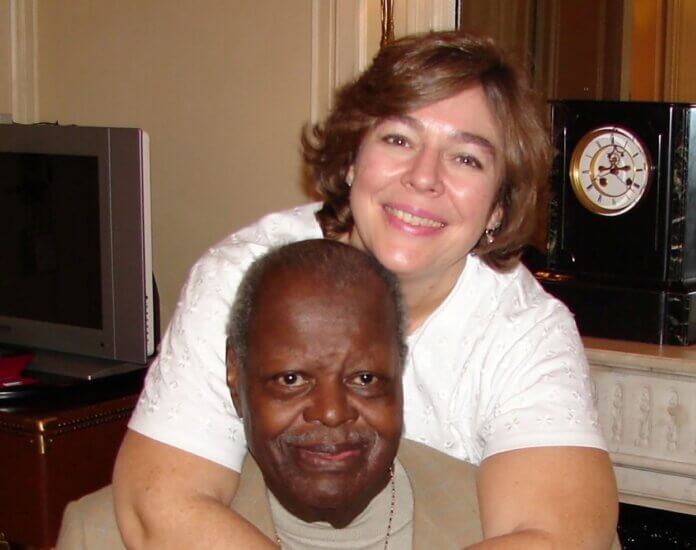


Ms Peterson, a few days ago I interviewed Mark Stryker, who wrote the liner notes for the new Verve release dedicated to Oscar Peterson. I’d like to ask you a few things about Oscar: you were his wife, and today you take care of his artistic legacy. How do you manage such an enormous legacy – a career spanning more than sixty years, a vast number of recordings and such a wide-ranging body of work?
It has been, and still is, a tremendous learning process. Ever since Oscar passed away, I’ve felt that taking proper care of his legacy is both a privilege and a responsibility. It means looking after it with the level of care and excellence that Oscar deserves, because Oscar always stood for excellence. He tried to improve with every concert: if he played well one night, the next day he wanted to play even better.
Of course, I don’t do everything on my own. I have help and support from many people. The musicians who loved him and worked with him continue to honour him in their own way, through their performances. Our daughter also does an enormous amount of work and is deeply committed to making sure her father is remembered and represented in the right way. Last year she presented many concerts in his honour, including two major events, one in Toronto and one in Montreal, featuring a great many artists. They were extraordinary, deeply moving evenings.
One of my goals, ever since Oscar passed away, has been to find ways of making the public more aware of Oscar as a composer. He wrote a great deal of music, but not everyone realised that. With that in mind, in 2015 I produced an album, Oscar, With Love. I made it independently because the record labels didn’t want to finance it – perhaps they felt it was too uncertain a project. The idea was to invite some of the world’s greatest jazz musicians to play Oscar’s compositions on his own piano.
About a year and a half after the album was released, I licensed it to Mack Avenue Records. That led to a collaboration that has allowed me to release live recordings from our archives. The concert at Baker’s Keyboard Lounge, for instance, had never been released before. I have archives of previously unreleased recordings, and we have begun making some of them available.
That gives me a great deal of joy, because I feel it is one of the ways I can honour Oscar: by bringing more of his music to his listeners, with care and precision, making sure that everything is presented as he would have wanted it.
Then there are the concerts, and also larger-scale works. Oscar composed his Africa Suite in the early 1980s, but he never performed it in its entirety. It has now finally been performed in full four times, which is very exciting, and I hope it will happen again.
Last year also marked the centenary of his birth, and there were many celebratory concerts. We also released a single LP of previously unreleased recordings, Oscar Peterson Around the World, which serves as a preview of a very special box set coming later, Oscar Peterson World Tour: six LPs, five complete concerts recorded in different parts of the world, and a fifty-page hardback book.
It is a project that has taken time, not least because of the physical production, because we wanted it to be done properly. But I feel truly privileged to be able to share sides of Oscar that the public might otherwise never know, and also to offer a little more insight into who he was as a person.
What are your thoughts on the new, previously unreleased recording?
I’m thrilled that it is finally available. The trio of Oscar, Ray Brown and Ed Thigpen is an iconic trio – I know that word is often overused, but in this case I think it is appropriate. They were at the height of their journey together and were playing incredibly well. It is wonderful to have this recording available today and to know that people can hear it.
How is Oscar Peterson regarded in Canada today – his country, and yours as well? Is he still a very popular figure?
Yes, he is. It is curious, though: Oscar was always better known in other parts of the world than he was in Canada. In Japan, for example, where there is an extraordinary jazz audience, he was – and still is – extremely well known. The same is true in the United States and in many European countries. Perhaps that also has something to do with the fact that Oscar toured Europe so extensively.
I live in Milan, but I’m originally from Florence. And it was in Florence that I met your husband in 1987: I organised that concert. I had the pleasure of meeting Oscar, Dave Young and Martin Drew. I spoke with your husband at some length and was deeply impressed by him. In all my years of being around musicians and writing about music, I have always remained convinced that Oscar Peterson was the most intelligent musician I ever met. He had an incredibly sharp mind: when he spoke about music, he went straight to the point, but always within a much broader cultural vision.
I’m very pleased to hear you say that, and I thank you. He really was like that: he had an extraordinarily brilliant mind. He was a genius, not only in music but in the very way he thought. I believe that is precisely why he was able to play and compose the way he did.
He always described jazz as “instant composition”: in a sense, he was composing all the time. Writing music in a more structured form was something else again.
I’m glad you had the opportunity to know him, because alongside that quickness of mind, that brilliant intellect, Oscar also had genuine warmth, a wonderful sense of humour and compassion for others. He cared about people. He cared about human rights. He was kind and welcoming, and he loved his fans.
I don’t remember that period very clearly – it was right at the beginning of my life with Oscar, and everything was new and happening very quickly – but I know that whenever anyone wanted to meet him after a concert, he would stay and sign autographs and talk to people for as long as there was someone there who wanted to say hello. That was a wonderful quality, because it showed the audience just how much he appreciated them.
Can you tell us something about Oscar as a husband, a father and a man away from the stage?
That is one of the things I have also tried to show in the book included in the box set coming out this year: who Oscar was away from the stage.
I often say that ours was a normal life. Of course, it wasn’t “normal” in the way most people would use that word, but when we were at home Oscar would spend time in his studio, study synthesizers and compose. After Céline was born, he spent time with her, played with her and simply enjoyed being with his daughter. Every now and then he cooked.
On summer evenings, we would go out for drives, just to feel the breeze and talk quietly. He loved teasing people and joking around – he was a great prankster. He was always interested in studying and learning, but he was also great fun.
That said, I sometimes say that Oscar took up a lot of space. I don’t mean physically: I mean that you felt his presence. He had an aura, a very particular essence. It was a privilege to be around him. And at the same time, he was a very down-to-earth person, someone you could talk to about anything, share your thoughts with, laugh with and enjoy simple moments with.
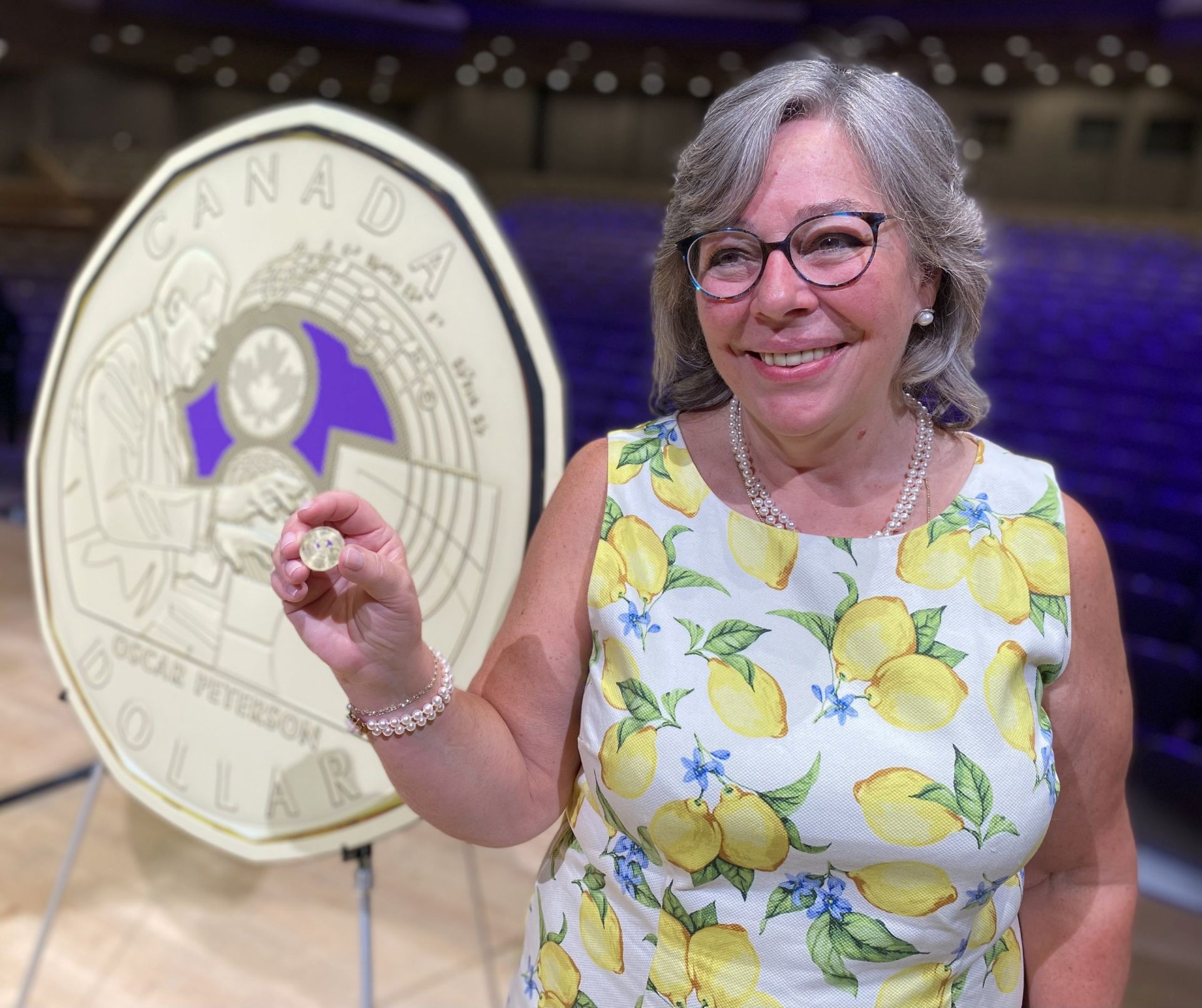
I remember him telling me that he was a great enthusiast of model railways. Is that right?
Yes, absolutely. His father worked on the railway as a porter, and Oscar always loved trains. I still have some of his collections.
Canada produced two of the world’s greatest pianists, Glenn Gould and Oscar Peterson. Did they know each other, as far as you know?
Yes, they knew each other. I don’t know how well they knew one another, but they did know each other. Glenn Gould died before I came into Oscar’s life, so I never met him. But Oscar had enormous respect for him: he regarded him as a brilliant artist and pianist.
What was Oscar’s relationship with the Canadian jazz scene? It seems to me that he didn’t play very often with Canadian musicians, at least as far as I know.
Not very often, that’s true. Of course, there was Dave Young. He played for several years with Lorne Lofsky, and also with Terry Clarke. But for the most part he worked with musicians from other countries.
He did, however, have a good relationship with Canadian musicians. Because he was touring so often, he wasn’t always in Canada, but we would sometimes go and hear musicians in clubs in Toronto, and he had a great deal of respect for a number of Canadian artists.
Do you think his Canadian roots were very strong?
Yes, certainly. He never moved away from Canada. There was a period when Norman Granz tried to persuade him to move to the United States, because he was working there so much and recording so extensively for Norman. But Oscar said no: “I live in Canada. I’m Canadian.”
What, in your view, makes the Canadian character different from the American one?
Canadians are perhaps more reluctant to celebrate their own talent. They are less inclined to put themselves forward or to elevate their great figures. Sometimes there is almost an implicit attitude that if someone is Canadian, perhaps they cannot really be as great as someone from elsewhere.
Oscar, of course, did not have that attitude, but there can be that tendency in Canada. I’m originally from the United States, and when I first came to Canada I thought the differences were not really that significant. Over time, however, I began to notice subtle differences in the culture.
Canada is certainly a more multicultural nation. The United States is, at least ideally, a melting pot, but in Canada I sense a greater degree of tolerance. I have to qualify that, though, because I believe that most Americans are tolerant. The problem is that, especially today, some of the loudest voices are the intolerant ones.
That breaks my heart, because it isn’t the America I grew up in or the America I believed in. I grew up during the civil rights era, with all the protests and all the work that was being done, but I still remember people communicating with one another, treating each other with respect and trying to be tolerant. Intolerance should have no place.
There are intolerant Canadians, of course, but overall I believe that in Canada, and in the United States as well, most people are capable of care, concern and a desire to do good for others. In that respect, we are alike. But Canada is certainly a distinct country, and I am proud to live here and now to be Canadian as well.
Do you think there is a Canadian influence in Peterson’s music as a composer? Not so much in what he played – standards and repertoire – but specifically in what he wrote.
Absolutely. The vastness of Canada, its land and landscape, had a very strong influence on him. I think of the Canadiana Suite and, later, the Trail of Dreams Suite: works in which he tried to express the beauty of the landscape through music.
But I also believe there were deeper influences, perhaps unconscious ones, connected with where and how he grew up: Montreal, the Little Burgundy neighbourhood, the experience of growing up as a young Black man in the 1920s and 1930s, in a time very different from our own.
He grew up in a poor family that had to struggle, but one that cared deeply for its children and always tried to do the best it could. His parents were determined to help their children have a better life.
Those deeply rooted values had an impact on his music. His music carried those values within it: the dedication to excellence, the constant desire to be the best he could possibly be. It all came from there, from within.
Earlier, you mentioned Oscar’s commitment to human rights. Could you tell us more about that?
Oscar was always an advocate for civil rights and human rights. He wrote “Hymn to Freedom” in 1962, and I don’t think he expected that piece to become so incredibly popular.
He was surprised when, in 2002, a choir director told him that the piece was constantly being performed by choirs all over the world. He was struck by the significance it had acquired. And yet there was a part of him that longed for the day when a piece like that would no longer be necessary.
I couldn’t quote his exact words, but there was something beautiful he used to say about music and civil rights. He said that musicians had always done this: this person with that person, this ethnic group with that ethnic group. We play together. The colour of your skin doesn’t matter, your religious faith doesn’t matter, none of those distinctions matter: we play together because we are playing music.
And he used to say that he liked to think of human beings not as races, not as colours, but as beings in search of beautiful melodies and harmonies. That, he believed, was how we should look at the world.
I’d like to ask you something about Oscar’s relationship with Norman Granz, a relationship that lasted for almost their entire lives.
From the moment they met, Oscar and Norman formed an immediate bond. They became best friends almost at once. They were both men of extraordinary intelligence, enormous integrity and very strong convictions.
They shared many of the same ideas: human rights, music, supporting music. Norman had extraordinary insight when it came to guiding Oscar’s career. Of course, Oscar’s talent would have taken him a long way in any case, but Norman knew how to guide him, promote him and protect him.
And Oscar always followed his advice, even when that meant not playing at a particular club for a year because Norman would say, “They don’t want to pay you what you’re worth, so don’t play there. Wait a year and then we’ll see.”
Oscar also learned that kind of professional awareness from Norman.
Then there was all the work they did on recordings, and Norman’s dedication to producing them. Even after he sold Verve, when for several years he wasn’t allowed to produce records, he continued to look after Oscar’s career. He told him that he had to keep recording, and steered him towards the recordings for MPS. He didn’t want years to go by without Oscar making records.
Their friendship was truly extraordinary. When I met Oscar, through him I met many famous people – great musicians, celebrities, wonderful artists. But the person I was most nervous about meeting was Norman Granz. I thought, “Oh God, if Norman doesn’t like me, I’m in trouble.”
Of course, it was very different for me because I was with Oscar. It is one thing to meet him in that context, and quite another to meet him as a concert promoter. He could be gruff and difficult, but he was a man of principle.
He and Oscar would talk on the telephone for hours, practically every day. From our house, a call would go out to – or come in from – Los Angeles, Geneva, London, wherever Norman happened to be. They would stay on the phone for at least an hour, often two or three, simply talking: stories, politics, music, anything at all.
When Norman Granz died, it was as though a part of Oscar died too. I knew it was going to be terribly hard for him, and it was. A part of his spirit and his light disappeared because he had lost his closest friend.
Ms Peterson, thank you so much. It has been a great pleasure speaking with you.
Thank you, Luca. It has been a pleasure. I’m very glad that you had the opportunity to meet Oscar and know him personally.
It was a great honour for me, and I still carry that memory with me.
That fills me with joy. I remember Italy with great affection. I think I was in Milan with Oscar perhaps once, maybe in 1987, and I loved the city. Florence too – such a beautiful city. Thank you for this conversation.
