


ARTIST
Gonzalo Rubalcaba
ALBUM TITLE
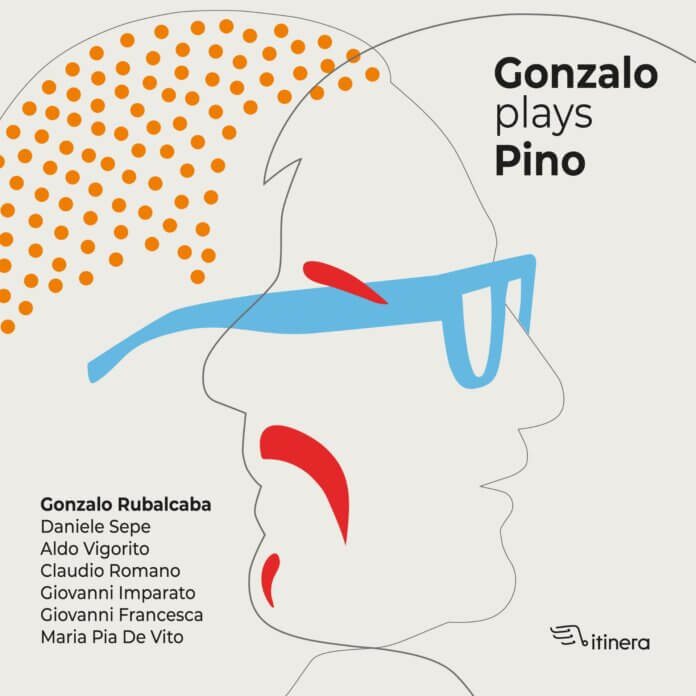
“Gonzalo Plays Pino”
LABEL
Itinera
______________________________________________________________
Lately, Pino Daniele has not been allowed to rest. His name is invoked with suspicious frequency, as though it were a kind of magic formula capable of legitimising any project, any stage, any recording venture. Stretched anniversaries, premature celebrations, tributes that quickly run out of breath – more than remembrance, it feels like a race for appropriation. A form of emotional opportunism, often well-intentioned, almost always short-sighted. Daniele has become a territory to be occupied, rather than an artist to be listened to.
It is within this climate that the present album arrives. And here the discourse becomes more complex, because we are not dealing with yet another hastily assembled or opportunistic product. Rubalcaba is a musician of immense stature, with a depth and authority that are beyond question. The musicians involved are all of a comparable level. The project is carefully conceived, thoughtfully executed, and impeccably performed. Precisely for this reason, however, it becomes legitimate – indeed necessary – to question not the quality of the execution, but the deeper meaning of such a reinterpretation.
The point is that Pino Daniele’s music resists translation. Playing it “in jazz” is already difficult – just as it is risky to “jazzify”, for want of a better term, figures such as Lucio Battisti or the Beatles: self-contained worlds, powerful poetics, fragile balances between melody, word, rhythm, and silence. To render it “in Latin jazz” is even more problematic. This is not a question of value, but of poetic incompatibility. Daniele’s relationship with the blues was not decorative or stylistic, but existential. His groove was rough-edged, restrained, often unresolved. It had more to do with silence than with exuberance – one need only listen to the otherwise commendable versions of “Sicily” and “Napule è” included here – more with the wound than with celebration.
Jazz, when approaching artistic figures of this kind, often assumes that it is sufficient to replace chords, shift the beat, “reharmonise” what was never meant to be treated in that way. Pino Daniele was not merely an interesting harmonic progression, nor a Mediterranean groove to be coloured with a touch of swing or a Latin tinge. His voice emerged from a city split in two, a language blending blues and dialect, anger and tenderness. It is a way of inhabiting the song that belongs to the street, the sea, the night.
Rubalcaba’s Latin approach – however refined, elegant, and irreproachable – shifts the axis of Daniele’s music and carries it towards an elsewhere that, for all its nobility, proves markedly disorienting. Curiously, no attempt is made here to revisit “Sotto ’o sole”, one of Daniele’s genuinely Latin pieces, which might have aligned more naturally with the Cuban pianist’s expressive world.
The issue, then, is not “how” the Neapolitan songwriter is performed, but “from where”. Rubalcaba approaches these songs from another history, another emotional geography. The rhythm opens up, becomes more fluid, more colourful. The piano dances, converses, breathes expansively. But Pino, more often than not, did not dance – he moved with a crooked gait. And in that uneven movement lay his truth. To transpose those melodies into a brighter, more fluid, more expansive dimension inevitably alters their inner tension.
The same applies to the presence – however valuable – of Maria Pia De Vito. Hers is a cultivated, deeply aware, profoundly expressive voice. A true musician, capable of engaging with any repertoire – such as the extraordinary work of Chico Buarque – without falling into mannerism. Yet here, too, a certain friction emerges, perhaps with the partial exception of her reading of “Gesù Gesù”. For Pino Daniele is not a songwriter to be “interpreted” in the conventional sense. His words were already interpreted, embodied, resolved within his own timbre. Each time someone else assumes them, the risk is not error, but displacement. And in this record that displacement does occur, leading towards a more abstract, perhaps more refined, certainly less grounded territory.
There is nothing intrinsically wrong in this, of course. Yet something remains unsettling. It is as though, once again, there were a need to “do something” with Pino Daniele, rather than leaving him as he was. To add, to reshape, to “have one’s say”. Even when undertaken with respect and competence, the result contributes to that overexposure which, in recent years, has turned the songwriter into a cultural object rather than a living artistic presence.
This is by no means a flawed record – it is not a caricature, nor a cynical operation, as so many others have unfortunately been. Yet it belongs to a broader issue: an inability to accept silence. Perhaps Pino Daniele simply needs to be left in peace for a while. To be listened to again in his own recordings, in his contradictions, in his shadows. Without filters, without translation, without reinterpretation.
At times, the most honest tribute is not to reinterpret, but to stop. To recognise that certain music does not call for new versions, but for time – time to settle, to withdraw from the surrounding noise, to return to “hurting” in the right way. This album, for all its undeniable musical quality, inadvertently reminds us of precisely this: that Pino Daniele does not need to be reinvented. He simply needs to be listened to.
Nicola Gaeta
DISTRIBUTED BY
Egea
LINEUP
Daniele Sepe (tenor sax), Gonzalo Rubalcaba (piano, keyboards), Giovanni Francesca (guitar), Aldo Vigorito (double bass), Claudio Romano (drums), Giovanni Imparato (percussion), Maria Pia De Vito (vocals).
RECORDING DATE
Naples, 2025
