
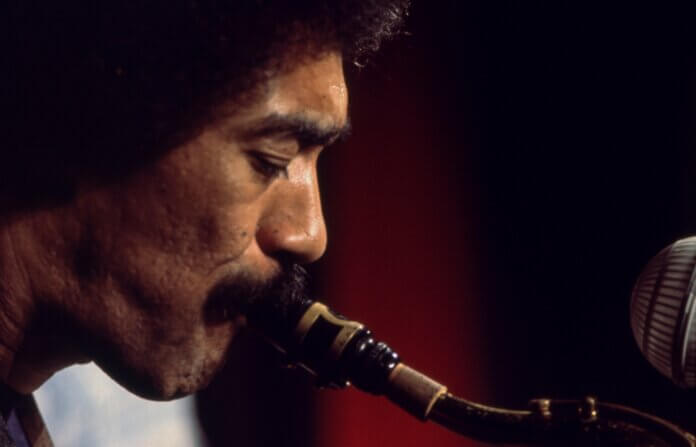


I still recall the sense of quiet astonishment I felt, as a teenager, on first hearing Eternal Caravan of Reincarnation, the opening track of Caravanserai, the fourth album by Santana. A modal construction that signalled the guitarist’s infatuation with the music of John Coltrane, and a prelude to his gradual embrace of a jazz–rock aesthetic. The piece unfolds through long, cavernous arcs of tenor saxophone, cutting across a backdrop of chirping crickets. The voice behind them was that of the little-known saxophonist Hadley Caliman (Idabel, 1932 – Seattle, 2010), also responsible – though uncredited in the liner notes – for a feral flute solo in Every Step of the Way, the extended instrumental written by drummer Michael Shrieve that closes the album.
Caliman had already crossed paths with Santana, appearing on Carlos Santana & Buddy Miles Live! (1972) and on For Those Who Chant (1971), a record by trumpeter Luis Gasca that also featured the Mexican guitarist alongside figures such as Joe Henderson, George Cables and Stanley Clarke. Yet Caliman’s biography reveals a musician of breadth and adaptability, active across multiple contexts – especially from the mid-1960s through the 1970s – whose career was repeatedly disrupted by severe drug addiction. In essence, he was what Americans would call a musicians’ musician.
Born in rural Oklahoma to an African American mother and a white father, Caliman entered a world where such a union still provoked scandal. The father’s family succeeded in having the marriage annulled, and the child was raised by his mother alone. In 1942, his father – a cook on long-distance trains and a passionate jazz devotee – was transferred to Los Angeles and took his son with him. There, the young Caliman immersed himself in the local scene, often hearing Duke Ellington’s orchestra and emerging saxophonists such as Johnny Griffin, who left a deep impression on him.
At Jefferson High School, where Art Farmer taught music, Caliman began studying saxophone with Dexter Gordon – his first major influence, and, tragically, also a model of addiction. In the early 1950s, amid repeated arrests for heroin use – which would eventually cost him four years in prison – he became a regular presence along Central Avenue, earning the nickname “Little Dex”. Comparisons with Gordon, and with Harold Land, were grounded in the roundness of his tone and the carefully structured, articulate nature of his phrasing. In his more mature work of the 1970s, one can also detect affinities with Henderson.
Between 1967 and 1969, Caliman was intensely active in large ensemble settings, most notably with Gerald Wilson on four albums for Pacific Jazz – Live and Swinging, California Soul, Everywhere and Eternal Equinox – all distinguished by the presence of musicians such as Charles Tolliver, Land, Anthony Ortega, Bill Perkins, Howard Johnson, Ernie Watts, Bobby Hutcherson, Joe Pass, Tommy Flanagan and George Duke.
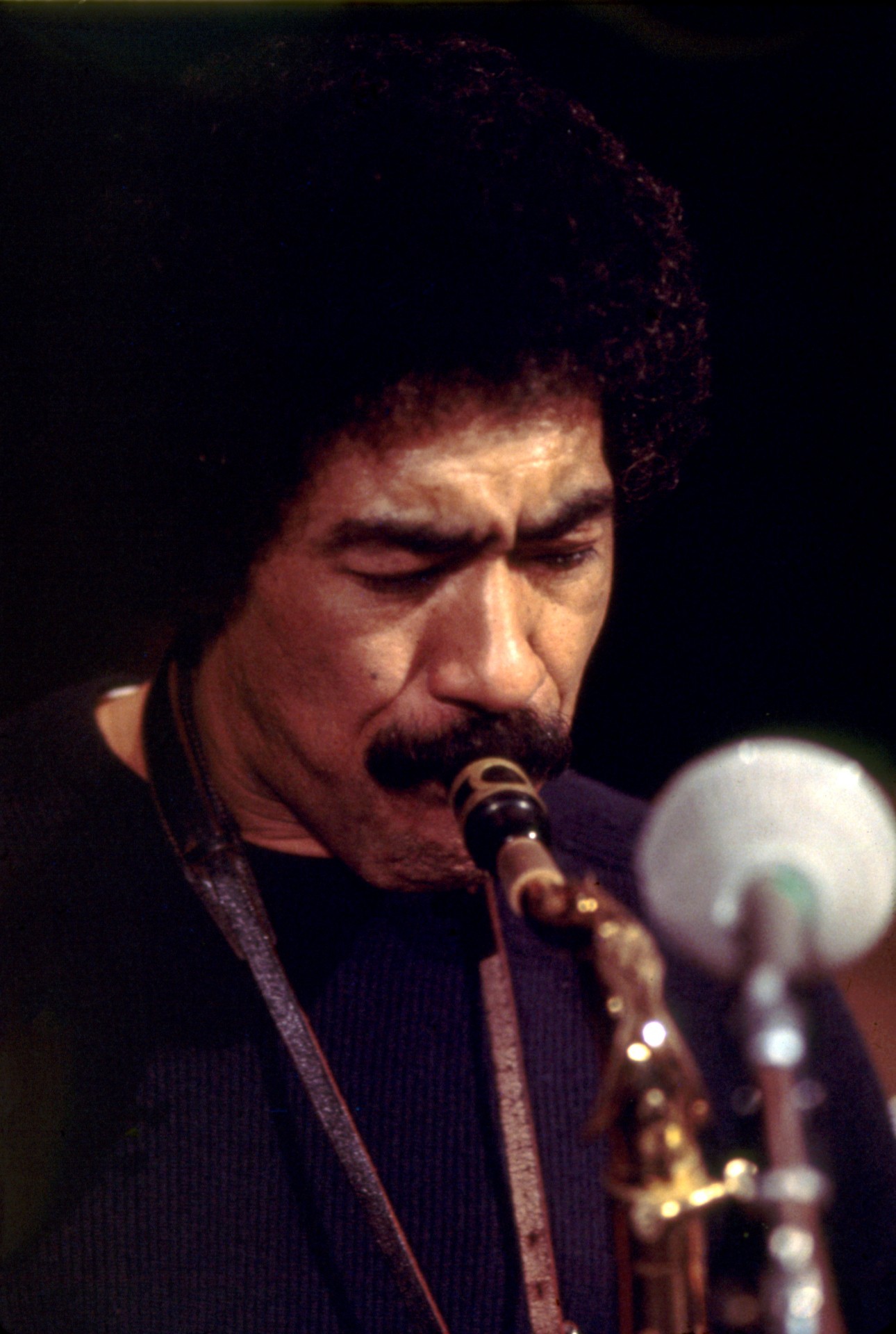
In 1969 he also contributed to The New Don Ellis Band Goes Underground, in which Don Ellis explored popular repertoire – arranging songs by Al Kooper, Harry Nilsson, Sly Stone and Laura Nyro – alongside complex odd metres derived from Balkan traditions. Bulgarian Bulge (in 33/16) reworks the traditional Sadovsko horo, introduced to Ellis by pianist Milcho Leviev. Caliman here formed part of a substantial reed section including John Klemmer and others.
Parallel to these orchestral experiences, he was also involved with a pioneering jazz–rock ensemble led by tubist Ray Draper, later known as Red Beans and Rice. The same year saw his collaboration with Cuban percussionist Mongo Santamaria on Stone Soul and Afro American Latin, recordings that featured soloists such as Sonny Fortune, Hubert Laws and Lew Soloff.
This intense and wide-ranging activity led to his first albums as a leader, recorded between 1971 and 1972 for Mainstream. The self-titled debut, in quintet with Larry Vuckovich, was followed by Iapetus, more assured in compositional terms and more clearly defined stylistically, with an expanded line-up including Gasca, Latin percussion and pianist Todd Cochran – later known as Bayeté Umbra Zindiko.
A more orthodox jazz orientation characterises the two albums he recorded for Catalyst between 1976 and 1977, Projecting and Celebration, in quartet with South African pianist Hotep Cecil Barnard and, on the latter, a rhythm section featuring David Williams and Elvin Jones.
Throughout the 1970s, Caliman was involved in numerous collaborations that testify both to his versatility and to the esteem in which he was held – among them work with Henderson (Canyon Lady, Black Miracle), Freddie Hubbard, Hampton Hawes, Eddie Henderson, Julian Priester, Hutcherson, Jon Hendricks and Flora Purim.
After this period, a long silence followed – more than two decades without recordings – during which Caliman devoted himself primarily to teaching, becoming a highly respected instructor at the Cornish College of the Arts in Seattle, the city where he would spend his final years and die in 2010 at the age of seventy-eight.
In the closing phase of his life, he returned to the studio, recording three albums for Origin, all in quintet: Gratitude, featuring Joe Locke and Joe La Barbera; Straight Ahead; and Reunion, alongside saxophonist Pete Christlieb, his companion from the Los Angeles years of the 1950s. A return to the West Coast jazz he had absorbed in his youth – and, in a sense, a symbolic closing of the circle.
