
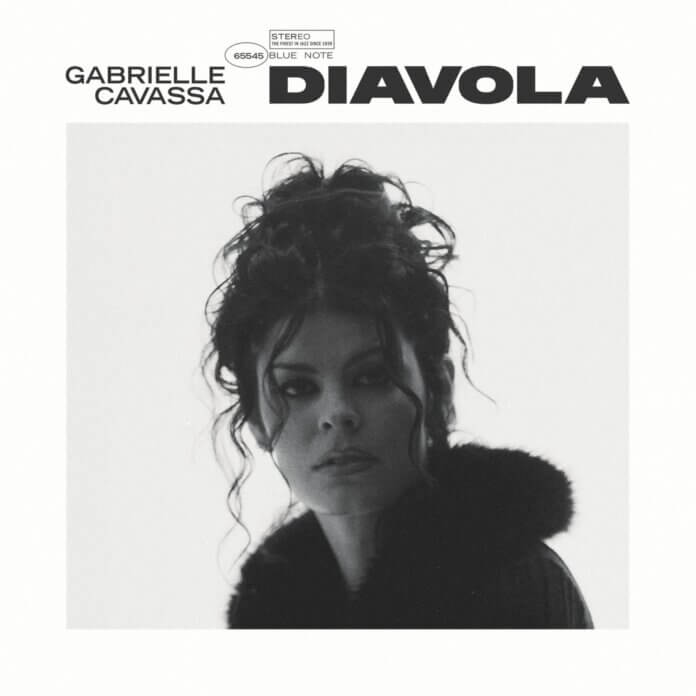


ARTIST
Gabrielle Cavassa
ALBUM TITLE
“Diavola”
LABEL
Blue Note
______________________________________________________________
Perhaps it is the oppressive heat that this music seems to evoke, or perhaps it has something to do with the fact that Cavassa, a California-born singer of Italian descent who was 32 at the time of the album’s release, has long made New Orleans her home. Whatever the reason, this surprising – not to say disconcerting – album evokes the languid, sticky atmosphere of certain Tennessee Williams plays or some of Daniel Woodrell’s novels, where the air is stagnant, yet we know something is about to happen. The result is insidiously ambiguous, constantly suggesting that beneath a calm, relaxed surface verging on easy listening, there may lurk considerable turmoil, not to mention a measure of treachery.
In 2020, Cavassa self-produced a (remarkable) album that has since gone out of print but remains available on streaming platforms. In 2021, she won the Sarah Vaughan International Jazz Vocal Competition, and shortly afterward caught the attention of Joshua Redman’s manager. She began working with the saxophonist and subsequently appeared on his albums Where Are We and Words Fall Short, both released on Blue Note. It is Redman and, notably, Don Was himself who produced the singer’s Blue Note debut – an indication of just how deeply the historic label invested itself in the project.
But was it worth it? We think so. The result is not flawless, but Gabrielle Cavassa is an artist who – unusually in this day and age – has ideas. Some are more successful than others, but they are almost invariably unexpected, when not bordering on outright recklessness. Such is her decision to sing no fewer than two songs in Italian (“Angelo” by Luigi Tenco and “La notte dell’addio,” written by Memo Remigi and Alberto Testa for Iva Zanicchi and subsequently revisited by Franco Battiato), deliberately embracing the risk of tackling a language she has yet to master fully.
The influence of Italian popular song, which Cavassa says she inherited from her grandparents, is far from merely decorative. On this album, Italy represents not an exotic repertoire but a way of conceiving melody. Even when singing American standards, Cavassa’s vocal lines tend to favor a cantabile quality and legato phrasing over the syncopated articulation characteristic of many jazz singers. Cavassa seems to have a remarkably elastic sense of time, and it is no coincidence that she cites the ill-fated Phyllis Hyman among her most direct influences. Like Hyman, she often comes in slightly behind the beat or stretches a syllable to the point where the phrase seems about to come to a standstill. It is a risky interpretive choice, one that requires musicians capable of breathing with her, and it is probably one of the reasons why her accompanying ensemble works so well. No one “pushes” the music: everyone seems content to wait for the phrase to ripen.
The perennial question of whether or not this is a jazz album becomes almost irrelevant. What is more interesting is the way Cavassa engages with the language of jazz without feeling obliged to demonstrate her allegiance to it at every turn. And in an age when young musicians are so fiercely committed to cramming as much as possible into their music, however interesting the results may be (the 2026 Blue Note release by DOMi and JD Beck, the very antithesis of this album, being a case in point), it is a pleasure to hear an artist equally determined to pursue the art of subtraction.
Luca Conti
DISTRIBUTED BY
Universal
LINEUP
Gabrielle Cavassa (vocals, guitar), Joshua Redman (tenor saxophone), Paul Cornish (piano), Jeff Parker (guitar), Larry Grenadier (double bass), Brian Blade (drums)
RECORDING DATE
Woodstock, February 2026; Los Angeles and New Orleans, dates unspecified
