
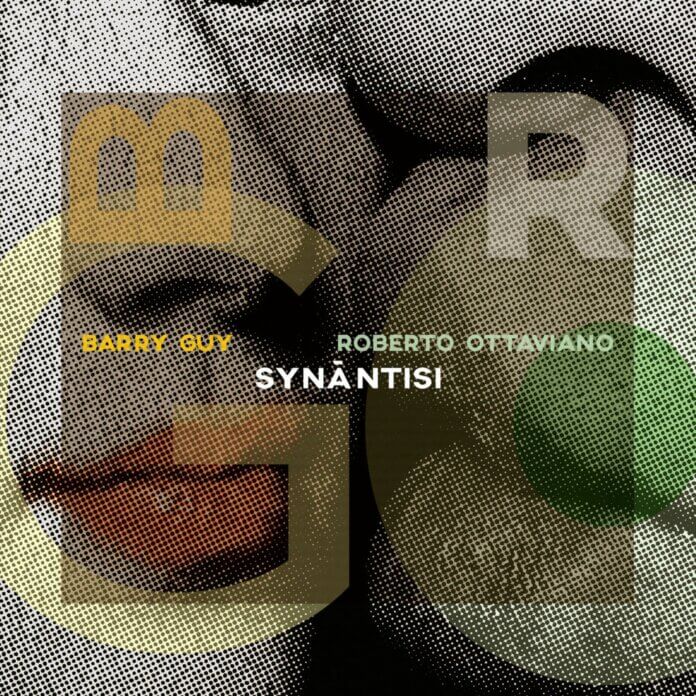


ARTIST
Barry Guy & Roberto Ottaviano
ALBUM TITLE
“Synāntisi”
LABEL
Fundacja Słuchaj Records
______________________________________________________________
Although Guy and Ottaviano had known each other for some time, they had never played or recorded together. In the brief liner notes accompanying the album, it is the saxophonist himself who places the recording under the sign of happenstance, describing it as a fruitful autumn encounter. We would prefer, however, to speak not so much of “happenstance” as of “fate.” This should not be dismissed as a needless semantic distinction: invoking the notion of fate allows us to emphasize that the essence of the encounter evoked by the album’s title lies not in chance but in predestination, in the convergence of trajectories long in the making, waiting to intersect. Histories, experiences, memories and affinities that may have remained dormant for years, or found expression in other ways and elsewhere, with other companions or through the exercise of thought and imagination. Both musicians are masters of the art of dialogue, of the practice of non-formation – a pas de deux that offers no solutions but poses a succession of puzzles. Both are passionate and erudite musicians, capable of layering ideas and fragments and fusing languages in defiance of the crisis of meaning. Both are artistic figures who inhabit the borderlands, perfectly embodying an approach that straddles different worlds: the written score and free improvisation, the jazz canon and its subversion, the classical tradition and new forms of academic music.
The album’s inner sleeve contains two acrostics devised by Evan Parker, who dedicated them to his two friends, assigning a word imbued with meaning to each letter of their first and last names. We will not deprive you of the pleasure of discovering them in full by revealing their contents, but suffice it to say that the first of the two t’s in Ottaviano is associated with the expression tac-au-tac. Borrowed from fencing, it describes with surgical precision the way the two musicians confront and accompany one another, alternately exposing themselves and withdrawing. Anyone with even a passing familiarity with improvisational practices – and here the art finds expression at its highest level – knows that the ultimate measure of success in such an undertaking lies in the communion of sound, hence in the relinquishment of every vestige of the ego, in the embrace of a dimension of nonduality and in the rejection of any hierarchical relationship that would inevitably arise from the mere positing of the “other” without welcoming that other through listening. In a duo such as this, it might seem almost natural to distinguish between the singing voice and its accompaniment, between sounds in the lower and upper registers. Here, however, these functions are constantly exchanged until they dissolve into one another.
Another quality that makes us love the music contained here – with the profound love reserved for manifestations of life itself – is its absolute essentiality. Everything that unfolds is stripped of the superfluous, reduced to the sheer necessity of human expression, without ostentation or the slightest trace of redundancy. When Ottaviano comes to use his voice, there is no calculation, simply the necessity of something coming into being (since “doing” would presuppose a degree of premeditation that may well be impossible here).
One of the recurring concerns of criticism when addressing works of this kind is the question of formal coherence. When we ask whether the musical discourse has achieved a sense of completion, we are in fact questioning the music’s capacity to generate a form. This line of reasoning is both true and false: a sense of completeness, when present, can be perceived but cannot be formally described. Within this paradox, the strongest possible assurance comes from Guy himself, who points out that the recorded encounter was preceded by no plan whatsoever, nor by any discussion of the length or character of the pieces. Paradoxically, this absence of premeditation constitutes the most rigorous and purest form of all: Peter Kowald was right, then, to speak of a “form that comes afterward.” That form is rooted in the act of listening, which is also an act of trust. Invest that trust in the human element: the enchantment of this wonderful, unmissable work will more than reward your commitment.
Sandro Cerini
DISTRIBUTED BY
fsrecords.net
LINEUP
Roberto Ottaviano (soprano saxophone, vocals), Barry Guy (double bass)
RECORDING DATE
Bari, October 31, 2025
