
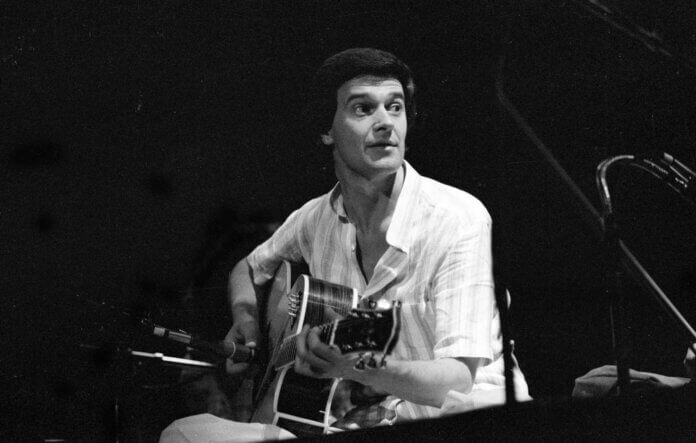


“In early 1970, I was in New York when John McLaughlin called me from Electric Ladyland Studios, where he was finishing the mix of his album Devotion, the first he had recorded in America. He told me excitedly, ‘Brian, come and listen to my record. I’m sure you’ll finally like my sound.’ Years earlier, when we played together on the US military base circuit, I was always asking John to turn up the volume. He had this little Gibson amp, and I could never hear him. As I recall, he was always very… distant. And I kept asking him, ‘Can you turn up the volume, John?’ I’d even ask him during ballads and slow songs. No way. He wouldn’t do it. He’d always reply, ‘No, no, no.’ And now here he was telling me, ‘Brian, come and listen to my sound.’ He had really piqued my curiosity, so I went to the studio, where they played ‘Dragon Song’ for me. I thought, ‘Yes, finally! This is it! What a great tune, this “Dragon Song.” I’ll have to record it with my band, Oblivion Express.’ While I was still there, a door opened and Jimi Hendrix walked in. He said, ‘Brian, how’s it going, man? It’s good to see you.’ Alan Douglas was there too, the guy producing and recording McLaughlin’s album. He had also produced some of Jimi’s work and, in theory, could have become the most famous record producer in the world if only he had understood how to handle, from a business standpoint, that legendary recording session that never happened. Six months earlier, it was supposed to bring together Miles Davis, Jimi Hendrix, Tony Williams and, believe it or not, Paul McCartney in a recording studio. It’s all documented, all true, but the whole thing fell through because Douglas couldn’t raise an adequate budget. Unbelievable. With those four names ready to record, he could have chosen among CBS, Warner, RCA, EMI, PolyGram and MCA. They were no longer grouped under the umbrella known as Tin Pan Alley, but that was just a detail. Blank checks would surely have appeared, and the famous phrase ‘You fill in the amount’ would have been heard more than once. At that point, negotiating with the majors would have been a walk in the park, or close to it. Unfortunately, Douglas tried to do everything on his own with his tiny label, and the whole thing blew up. Six months had passed since that weekend in October 1969, but there was still some hope of getting Miles and Jimi to play together. The idea was to have them perform live, onstage at a concert during the coming summer.
“Jimi’s arrival at the studio where Alan Douglas was finishing the mix of John McLaughlin’s album gave Douglas the opportunity to start needling Jimi in a truly unpleasant way. Pointing to McLaughlin, he said to Jimi, ‘You know you’re finished, right? This guy’s going to take your place.’ Brian Auger didn’t like that one bit and realized he had to step in to get Jimi out of the obnoxious Douglas’s clutches. Brian approached Jimi and said, ‘Let’s go outside and talk, man.’ So they went outside, and Brian saw the state Jimi was in. His skin was grayish, and his girlfriend was with him, looking just as bad. Jimi said, ‘Brian, can you stay and make an album with me right now?’ Brian asked, ‘Well, how long would it take?’ He was used to working quickly, as he had done with Streetnoise, an album recorded in two afternoons in the studio. Jimi said, ‘Three months.’ Brian replied, ‘No, I can’t do that because I’ve got a lot of things going on, and I have to get back to London. If I cancel those contracts, they’ll probably throw me in jail.’ Jimi pulled out a little silver foil packet and started snorting. Brian looked at him and said, ‘Jimi, you’ve got to stop doing this stuff. It’ll kill you.’ Jimi stopped and said something to Brian that stayed with him: ‘You know what, Brian? I could use a lot more people like you around me.’ Recalling that episode today, Brian comments, ‘We never saw each other again. An incredible talent, gone far too soon!’”
(Brian Auger, interviewed by Maurizio Comandini for All About Jazz, spring 2022)
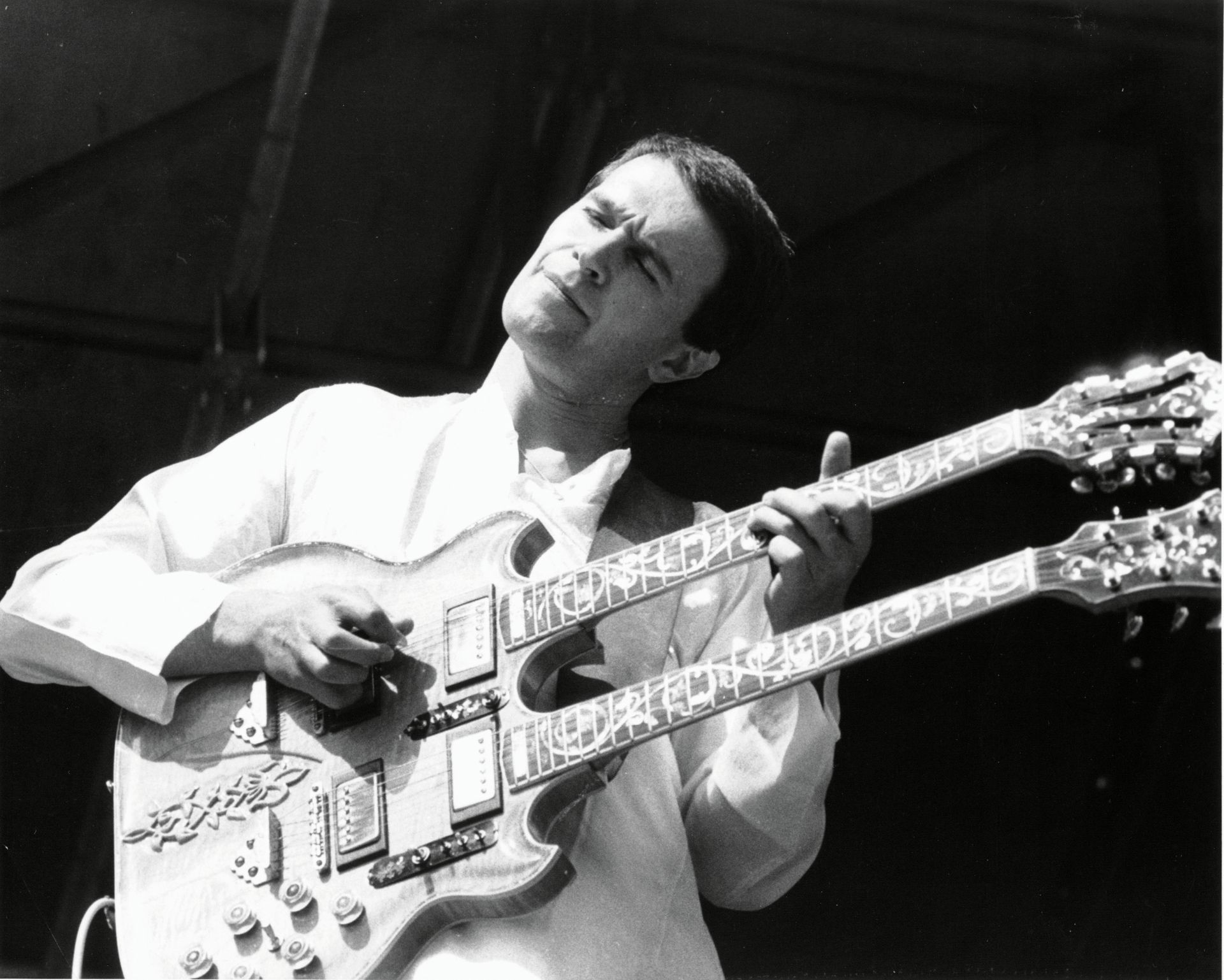
As we recounted in the second installment of the Seven Steps to Miles series, the circumstances that led to John McLaughlin and his acidic, aggressive guitar being brought into the second and third days of the recording sessions for Jack Bruce’s album Things We Like were entirely fortuitous. Certainly, beyond the days spent meditating alone on the beach at Whitley Bay, his encounters with European and American musicians played a crucial role in the extraordinary development of the young, short-haired guitarist’s personality. As did the arrival of Jimi Hendrix from Jupiter. This leap forward would allow him, just a few months later, to take center stage both in Miles’s court and in the explosive Tony Williams Lifetime.
Without that paradigm shift, which emerged from his encounters with the radical and heretical ideas of musicians who were also far more politically organized than he was, this solid new awareness would never have developed properly, and Johnny Mac would probably never have made it.
Even today, nearly sixty years after they were recorded, Things We Like and Extrapolation remain two virtually perfect albums. In particular, “Sam’s Sack” showcases McLaughlin’s dark-toned, explosive guitar in what we might interpret as the birth of the modern post-Hendrix electric guitar. Ask Nels Cline, Terje Rypdal, Fred Frith and a thousand others. Apparently, judging also by the information on the record label and cover, “Sam’s Sack” is a cover of a Milt Jackson composition. The piece appears on the album Bags Meets Wes!, released in 1962. It was recorded by the Milt Jackson and Wes Montgomery quintet, featuring a sumptuous rhythm section of Wynton Kelly, Sam Jones and Philly Joe Jones.
On Bags Meets Wes!, the composition written by Milt Jackson is titled “Sam Sack,” without the possessive apostrophe and s. A beautiful blues in F, with elegant solos that these musicians could seemingly produce without the slightest effort. So, everything’s clear, right? Not quite. In fact, there is a little mystery here that, apparently, no one except this writer has ever pointed out. All you have to do is start listening to “Sam’s Sack” (this time with the possessive apostrophe and s) on Jack Bruce’s album to discover that it has nothing in common with Milt Jackson’s composition (the one without the possessive).
The piece on Jack Bruce’s album is a somewhat unusual blues, built around a chromatic riff that develops alternately from B-flat and E-flat. The change in the underlying key, from F in “Sam Sack” to B-flat in “Sam’s Sack,” would not in itself be a significant enough reason to argue that these are two different compositions.
The riff that forms the backbone of “Sam’s Sack” on Jack Bruce’s album, however, has absolutely nothing in common with Milt Jackson’s elegant, enticing theme. Yet in both cases, the labels of the two records credit the composition to Milt Jackson. How strange. An error that no one ever noticed? We don’t know. What is certain is that nearly sixty years of copyright royalties make quite a difference.
Looking forward rather than backward, we might suggest that the solid, heavy chromatic riff on which “Sam’s Sack” is built would not have sounded out of place in the repertoires of Cream, Led Zeppelin or Ian Carr’s Nucleus.
For example, opening the second Nucleus album, We’ll Talk About It Later, we find “Song for the Bearded Lady,” featuring an exuberant Chris Spedding firing off a riff structurally similar to that of “Sam’s Sack.” While we’re at it, it’s worth pointing out that a few years later, the inimitable Karl Jenkins, who had moved from Nucleus to Soft Machine, took the riff from “Song for the Bearded Lady” with him, modified it just a little and renamed it “Hazard Profile.” He then made the most of it, building a five-part suite around that riff and stretching it across almost the entire first side of Soft Machine’s album Bundles. The guitar part originally played by Spedding was entrusted to Allan Holdsworth. Very different from one another, but both excellent guitarists.
On Things We Like, McLaughlin’s guitar stands out on practically every track recorded on August 24 and 25, 1968. After “Sam’s Sack,” we hear an extraordinarily modern version of a well-known ballad, “Born to Be Blue,” which the gifted Mel Tormé had written and made famous in the second half of the 1940s.
“HCKHH Blues” is a composition Jack Bruce wrote while he was still attending school in Scotland. A beautiful blues, decidedly angular in the call-and-response interplay of its thematic phrases, as taut as a rope winding itself around the ankles of anyone daring to approach. A blues that had been part of the repertoire of Graham Bond’s bands since the early 1960s.
Then comes another ballad, bitter and refined at the same time, “Ballad for Arthur,” which McLaughlin performs with the assurance of the leader he had yet to become. Things We Like closes with a short title track, a kind of final parade that begins slowly before accelerating almost to the point of frenzy. It anticipates “Those About to Die,” which would later close Colosseum’s debut album. Not coincidentally, that band was conceived and created primarily by Jon Hiseman and Dick Heckstall-Smith, who are here alongside Bruce and Johnny Mac.
The 2003 reissue also brought to light a previously unreleased track: a beautiful, wonderfully off-kilter blues written by Heckstall-Smith, in which the guitarist once again takes center stage, sweeping away whatever barriers between rock and jazz might still have remained. The title is rather amusing: “Ageing Jack Bruce, Three, From Scotland, England.” But if you want to hear what might be considered a prequel to Tony Williams Lifetime, this is inevitably where you have to start.
Allow me a little provocation: listen to “Sam’s Sack,” “HCKHH Blues” and “Ageing Jack Bruce” one after another, then immediately, without waiting even a tenth of a second, play the celebrated version of “Crossroads” recorded at the Winterland Ballroom in San Francisco on March 10, 1968, and included on Cream’s double album Wheels of Fire. What breaks in continuity do you imagine you’ll find? None whatsoever, believe me. This could have been one of those magical moments when sweeping changes emerge in an extraordinarily short space of time. Exactly the opposite of what usually happens. All of which makes the regret over the Robert Stigwood Organisation’s foolish decision not to release Things We Like in early December 1968 even greater. It would have created a perfect short circuit between rock and jazz, revealing just how naturally those two categories merged in Jack Bruce’s artistic vision. And such short circuits can cause the cultural interests of enormous numbers of people around the planet to shift simultaneously.
Between late August and early September, shortly after recording Things We Like, McLaughlin returned to Antwerp, where he had the opportunity to gain new experiences with musicians both famous and obscure. The Berlin festival in November 1968 gave him the chance to meet and play with Pharoah Sanders and Sonny Sharrock. Among European musicians, we have already noted the particularly close bond he developed with bassist Arjen Gorter, who would become an indispensable member of the celebrated Willem Breuker Kollektief from its inception.
Those months spent traveling through Northern Europe gave McLaughlin the opportunity for a kind of full immersion in the many varieties of free jazz being played on the Old Continent at the time. But they also helped him gain a clearer perspective on the guitarists of the generation preceding his own. Together with Stu Martin, an American drummer living in Europe, McLaughlin had the opportunity to meet and play with René Thomas, an outstanding jazz guitarist born in Liège in 1926. Between 1958 and 1962, Thomas had spent brief periods in the United States, playing in the bands of Sonny Rollins, Chet Baker, Stan Getz and others. He became one of McLaughlin’s sources of inspiration, alongside the well-known Tal Farlow, Kenny Burrell, Jimmy Raney and Jim Hall. Another, lesser-known source of inspiration had been Dave Goldberg, a Scottish guitarist born in 1922, gifted with excellent technique and the perfect link between Django Reinhardt’s Gypsy-inspired jazz guitar and Charlie Christian’s extraordinary dexterity in the bebop idiom. Dave Goldberg died of an overdose in London on August 21, 1969, three days after Woodstock. August 21, 1969, was also the third and final day of the Bitches Brew recording sessions in New York. A somewhat ironic and bitter coincidence. But as you have probably already realized, life is the sum of the coincidences that happen around us. Nothing more, nothing less.
Meanwhile, in London, producer Giorgio Gomelsky had asked Brian Auger for advice. Brian had recorded several excellent albums for Gomelsky’s Marmalade label, including the masterpiece Streetnoise, featuring the incomparable vocalist Julie Driscoll. Gomelsky told him that he had the opportunity to record and release one more jazz album to complete the Marmalade catalog before the label was absorbed by Polydor, and asked Brian to suggest the name of a jazz musician who deserved that opportunity. Auger replied immediately: “John McLaughlin.” A few years earlier, McLaughlin had played in Brian Auger’s quartet, and the two had remained good friends. Gomelsky trusted his judgment, and that suggestion produced a masterpiece that marked John McLaughlin’s definitive breakthrough.
Confirming that things were finally moving in an interesting and rewarding direction, John received a phone call from the United States shortly afterward. It was his friend Dave Holland, who had by then become a permanent member of Miles Davis’s quintet. After exchanging greetings and a few jokes about the old days, Holland handed the phone to Tony Williams, the drummer who had been a member of Miles Davis’s quintet for more than six years, having joined shortly after turning seventeen. Tony had decided that his brilliant adventure with Davis’s quintet would come to an end in a few months, and he was putting together a trio of his own. He had already chosen Larry Young as the organist and was looking for a guitarist capable of looking ahead.
Tony had discussed the idea with the other musicians he was playing with, including Dave Holland, who had arrived from London in mid-August to take Ron Carter’s place. Holland and McLaughlin knew each other very well. In fact, during those days between late July and early August, John was often a guest at Dave’s place. A few months earlier, the guitarist had moved to Antwerp, Belgium, where he lived in Günter Hampel’s house and commune. He frequently made short trips back to London, where he had session work and family ties to maintain. Since he was spending most of his time performing around Europe anyway, it was simpler and less expensive to use the Antwerp commune as his base than to keep renting an apartment in London. For this reason, during his brief returns to London, he slept wherever he could, relying on the hospitality and friendship of various London musicians, including Pete Brown and Dave Holland.
In the first installment, we described how Jack DeJohnette’s passion for electronics also entered into the equation that brought about Miles Davis’s transition from acoustic to electric jazz. DeJohnette had recently purchased one of the first portable tape recorders and was using it to record evening performances by the Bill Evans Trio at Ronnie Scott’s, in which he played drums. DeJohnette also used that recorder to capture a private afternoon jam session with Dave Holland and John McLaughlin in the basement of Ronnie Scott’s.
When Tony Williams mentioned that he was looking for a guitarist for his trio, Holland suggested that Williams listen to the tape of that afternoon jam session. Williams and DeJohnette were good friends, and somehow everyone knew that DeJohnette would eventually take Tony’s place in Davis’s quintet. DeJohnette had no reason to refuse Tony’s request. After listening to the tape, Tony asked Dave Holland if he could speak to John McLaughlin on the phone. Tony explained his plans to McLaughlin and invited the guitarist to New York. John accepted enthusiastically but pointed out that he could not leave immediately. For two reasons. First, he had already booked studio time in mid-January 1969 to record the album commissioned by Giorgio Gomelsky’s Marmalade label. It would be his first album under his own name, and John was determined to seize an opportunity that, until just a few weeks earlier, had seemed entirely out of reach. The other reason, as usual, was financial: installments to pay and a rather expensive plane ticket to buy. Tony reassured him, explaining that his departure from Miles’s quintet would not take place for another few months anyway.
I’ll venture a prediction: if that tape of DeJohnette, Holland and McLaughlin, recorded by the drummer in the basement of Ronnie Scott’s, should finally emerge from the archives still kept at DeJohnette’s home near Woodstock, I’m willing to bet that McLaughlin’s guitar sounded exactly the same that day as it would on August 24 and 25 during the recording sessions for Things We Like. In any case, that blessed tape proved decisive in Tony Williams’s decision, a couple of months later, to entrust McLaughlin with the role of evangelist for the new music he had in mind.
Meanwhile, in London, McLaughlin had the material ready for the recording of his first album. There was an initial exploratory session that produced no results. On January 16, 1969, the ten tracks that make up Extrapolation were recorded at Advision Studios in London. John had hoped to have Dave Holland on double bass, but he was unable to persuade him to return from New York. Bassist Brian Odgers was called in to replace him and did an excellent job. Saxophonist John Surman was the rising star of British jazz, and his baritone saxophone worked perfectly in the interplay with the guitar that McLaughlin’s compositions so often called for. Drummer Tony Oxley generally preferred to explore much more experimental territory in his own projects, but he had previously played and recorded with McLaughlin in the quartet led by pianist Gordon Beck, so he could hardly refuse the guitarist’s persistent invitation. McLaughlin knew how skilled the drummer was at handling the often unconventional time signatures that characterized the compositions he wanted to record. On paper, Oxley might have seemed likely to be a drummer who was insufficiently involved and therefore detached, but he turned out to be the exact opposite. A dynamo, always fully charged, capable of electrifying his three fellow musicians, who consistently sound exceptionally clearheaded and inventive. A true marvel. An extraordinarily refined construction held together by invisible bonds.
Judging by the results, we must acknowledge that the second half of 1968 was a period of extraordinarily intense creativity. There were other occasions on which McLaughlin distinguished himself, but essentially the two fundamental pillars are Things We Like, recorded in late August (although it would not be released until two years later), and Extrapolation, recorded in mid-January 1969 and released a few months afterward, which must be considered, in every respect, John McLaughlin’s first album as a leader. Magnificent then, it remains one of the finest albums in modern jazz to this day. In short, if you have a vintage 1968–69 Johnny Mac in your cellar, you can’t go wrong.
In the days immediately following the recording of Extrapolation, John had to find the money to buy a ticket and fly to New York. He had no specific deadline to meet (unlike Dave Holland), but he couldn’t wait to join Tony Williams and start playing with him. The February 8, 1969, issue of Melody Maker carried the news that Johnny McLaughlin was leaving for New York. We recently discovered that the very same issue of Melody Maker, in the section devoted to small classified advertisements for used musical instruments, contained a brief text ad placed by John McLaughlin himself, in which the guitarist offered his beloved Gibson L4C for sale, complete with a Charlie Christian pickup and case. He specified that it was a real bargain and concluded by providing his telephone number, so much for privacy. And indeed, the asking price of £200 does seem like a bargain. The advertisement immediately had the desired effect, and the guitar was sold almost at once. Even today, in a private email, McLaughlin confided to me that he regrets having had to sell that magnificent instrument, adding that when he returned to London a few years later, he tried to buy back “his” Gibson L4C but was unable to do so.
Johann Haidenbauer, the leading expert on McLaughlin’s discography and memorabilia, confirmed to me that this advertisement for the sale of the L4C, which I came across by chance while researching British newspapers of the period, had never previously been reported. It could prove useful in establishing more precisely the exact date of the guitarist’s arrival in New York.
It was almost mid-February, the coldest time of the year. On the flight to New York, Johnny Mac had with him the only guitar he had left: a beautiful Gibson Hummingbird, which was a rather unusual instrument for the kind of music Johnny was playing. It was, for all intents and purposes, an acoustic guitar, perfect for folk singers, but none of the leading jazz guitarists used such an instrument to play modern electric jazz. McLaughlin had “doctored” it by fitting a DeArmond pickup into the guitar’s sound hole, as can clearly be seen in the photographs used for the covers of Extrapolation and Tony Williams Lifetime’s Emergency. It is possible that the little shoebox-sized amplifier mentioned by Günter Hampel was also a DeArmond (a relatively uncommon model, sometimes marketed under the C. F. Martin brand). For the record, DeArmond is still part of the American Rowe Group, based in Toledo, Ohio. A brand well known for its pickups but not particularly famous for its amplifiers. Indeed, the few models produced were extremely small and had precisely that acidic, distorted sound McLaughlin uses on Things We Like. Today, collectors trade those little amplifiers at rather high prices. Small but mean, don’t forget that.
In a recent interview, John McLaughlin spoke about a homemade amplifier built by a friend of a friend, with the aim of obtaining a Fender Bassman clone at a significantly lower cost. But the Bassman is certainly not an amplifier the size of a shoebox. Evidently, in the process of making everything more compact to reduce costs, that prototype may have evolved from a Bassman clone into something resembling a DeArmond amplifier.
The snowstorms of February 9 and 10, 1969, still hold the record for snowfall in New York during that period. As he stepped off the plane, John McLaughlin looked around, but nothing could distract him from the goal he had set himself. It was his first time in the States, and he immediately found himself thrust into the heart of the world’s most important music scene. The first rehearsals of the trio that would become Tony Williams Lifetime took place in a small room at Count Basie’s, where Larry Young had parked his Hammond organ. Tony Williams’s drum kit was set up on the club’s main stage, where Miles Davis’s quintet had been performing every night since late January as part of a three-week engagement that was still underway. For those first rehearsals of the trio led by Tony Williams, McLaughlin had only his electrified acoustic Hummingbird at his disposal. It was difficult to control because of the inevitable feedback that appeared as soon as the volume was turned up, producing the familiar high-pitched squeal that, in those days, only Hendrix knew how to master. The fireworks were about to begin!
As you listen, reflect also on these observations Richard Williams shared with those who regularly listen to and read him on thebluemoment.com. They are wise and important words to which we will certainly return, not least because the change of direction Williams describes is the very same one that convinced me to write these stories. The great British journalist spoke them just a few weeks ago, during his farewell address at Mike Westbrook’s funeral. Westbrook was a true giant whose music absolutely deserves to be heard again, beginning with his suite Metropolis, released by RCA in 1971.
“For many years, from the 1920s through the 1950s, the principal task of British jazz musicians was to learn the language of the great American originals and assimilate it so thoroughly that they could produce a rendition worthy of note. But in the 1960s, something different happened. A group of young musicians living in Britain suddenly emerged with a new set of goals. They admired the American masters just as deeply as their predecessors had, but they were looking for something more. They were searching for a language of their own, an approach that would enable them to create a kind of jazz that was not simply beholden to the traditions of others.” (Richard Williams)
As we await Story #4, which will recount incredible events (entirely unpublished, thoroughly documented) involving tapes sent from the other side of the world to bring joy to a woman who was said to have already passed away, let us remember Günter Hampel, who ascended to the upper floors reserved for the next world just a few months ago. He was 89, hyperactive, and had been one of the pioneers of jazz in Europe, having first discovered this music by listening to radio stations operated by the American occupation forces in Germany at the end of World War II.
Throughout his long career, Günter had the pleasure, courage, honor and opportunity to found and breathe life into countless bands. His declaration, “Either John or no one else,” at the end of an audition held at Barre Phillips’s home in London in early 1968, completely changed the history of modern music. In addition to welcoming the young and uncertain Johnny McLaughlin into his Antwerp commune, allowing him to strengthen both body and mind while developing the personality he still lacked, Hampel went on to play with some of the leading figures of modern jazz and the artistic avant-garde over the years. I’ll leave you the pleasure of discovering their names and listening to their collaborations with Günter.
May the earth rest lightly upon you, my friend.
