
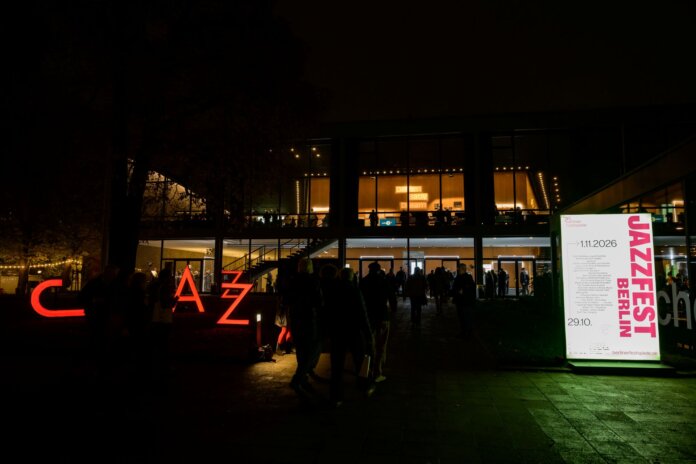


Jazzfest Berlin once again proved to be a privileged vantage point from which to observe the many directions of contemporary jazz and its neighboring territories. Over four days, the 2026 edition offered a particularly wide-ranging program: projects rooted in the musical traditions of other continents, new approaches to composition, radical improvisation, reinterpretations of the jazz language, and opportunities to reflect on the history of the European avant-garde. Rather than a clearly defined aesthetic, what held the program together was a shared willingness to challenge established languages and conventions. The journey culminated in a celebration of the Globe Unity Orchestra’s 60th anniversary, with a memorable closing concert.
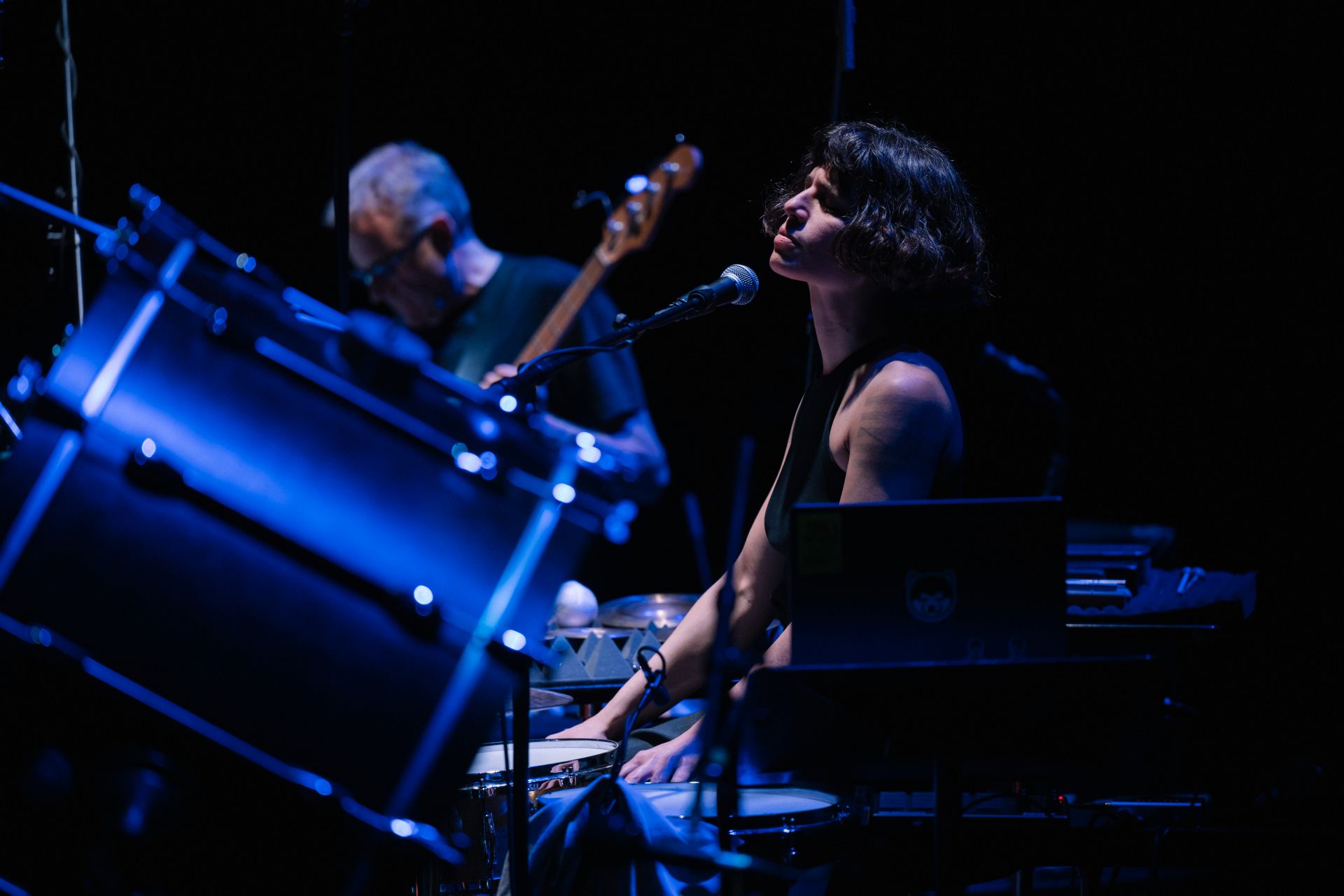
The opening evening immediately revealed the breadth of this approach. The Erosão Percussion Trio, led by Brazilian percussionist and composer Mariá Portugal, offered a kind of contemporary tribute to the sounds of her homeland, drawing particularly on the imagery of the Amazon rainforest. Most striking was the extraordinary variety of instruments at the three musicians’ disposal: from the bass drum to drums of different sizes, along with an extensive assortment of percussion instruments and small metal cymbals, played with mallets and techniques reminiscent of vibraphone playing. This exceptionally broad timbral palette was explored through sophisticated sonic blends, created by the interaction among the three percussion setups and Portugal’s own voice. Rather than simply reproducing naturalistic impressions, the trio sought to translate them into an intricate musical fabric in which rhythms, timbres, and colors overlapped, producing a varied and constantly shifting soundscape.
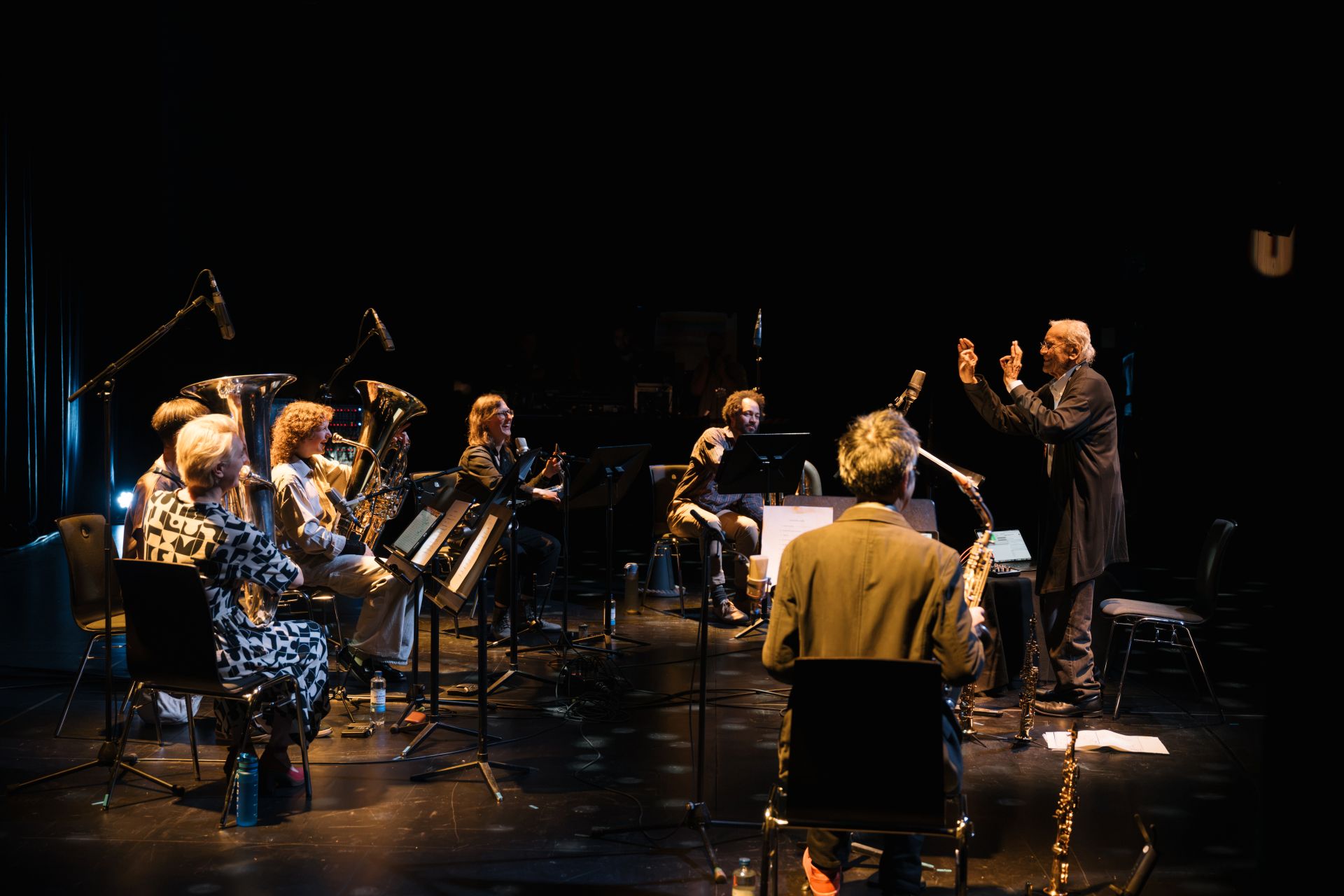
The performance by Anthony Braxton’s septet was quite different, and decidedly more abstract. The American composer and saxophonist presented a new musical system, provisionally known as Air Music, with an ensemble comprising three tubas and four saxophones. The new Composition No. 744, a score running to more than one hundred pages, alternated between different forms of notation, with a marked preference for graphic notation. During the talk preceding the concert, saxophonist Silke Eberhard described how, while leafing through the score, she had encountered passages that reminded her of Jackson Pollock’s paintings.
Another aspect deserves particular attention. Braxton had expressly requested that at least half of the septet’s members be women, a decision that brought renewed attention to the still unresolved issue of gender equity in jazz. The gesture was all the more meaningful coming from an artist who, for more than sixty years, has advocated, through both his music and his teaching, an open, inclusive, and nonhierarchical conception of musical creation.
Onstage, Braxton played very little, restricting himself to brief instrumental contributions and concentrating primarily on conducting and directing the ensemble. The score unfolded through sections that were sometimes extremely short, succeeding one another in a stream of jagged lines that rarely suggested a recognizable melodic design. Unison passages were sporadic, while certain harmonic combinations evoked elements of twelve-tone writing.
Rather than judging the concert according to the usual criteria of immediacy or emotional engagement, it seemed more appropriate to consider what it represented: another chapter in the relentless exploration of a musician who, approaching his 82nd birthday, continues to devise new compositional systems, pushing his language into increasingly unfamiliar territories. One is reminded of the trajectory of certain great painters, such as J. M. W. Turner, whose later works moved toward a progressive dissolution of recognizable forms, anticipating approaches that would not be explored until many decades later. In Braxton’s case, too, the growing complexity and the increasingly hermetic nature of his language seem less the result of a desire to distance himself from the listener than the consequence of an artistic inquiry that recognizes no final destination. His music continues to question itself, expand its vocabulary, and investigate possibilities that, even after such a long and extraordinary career, still appear inexhaustible.
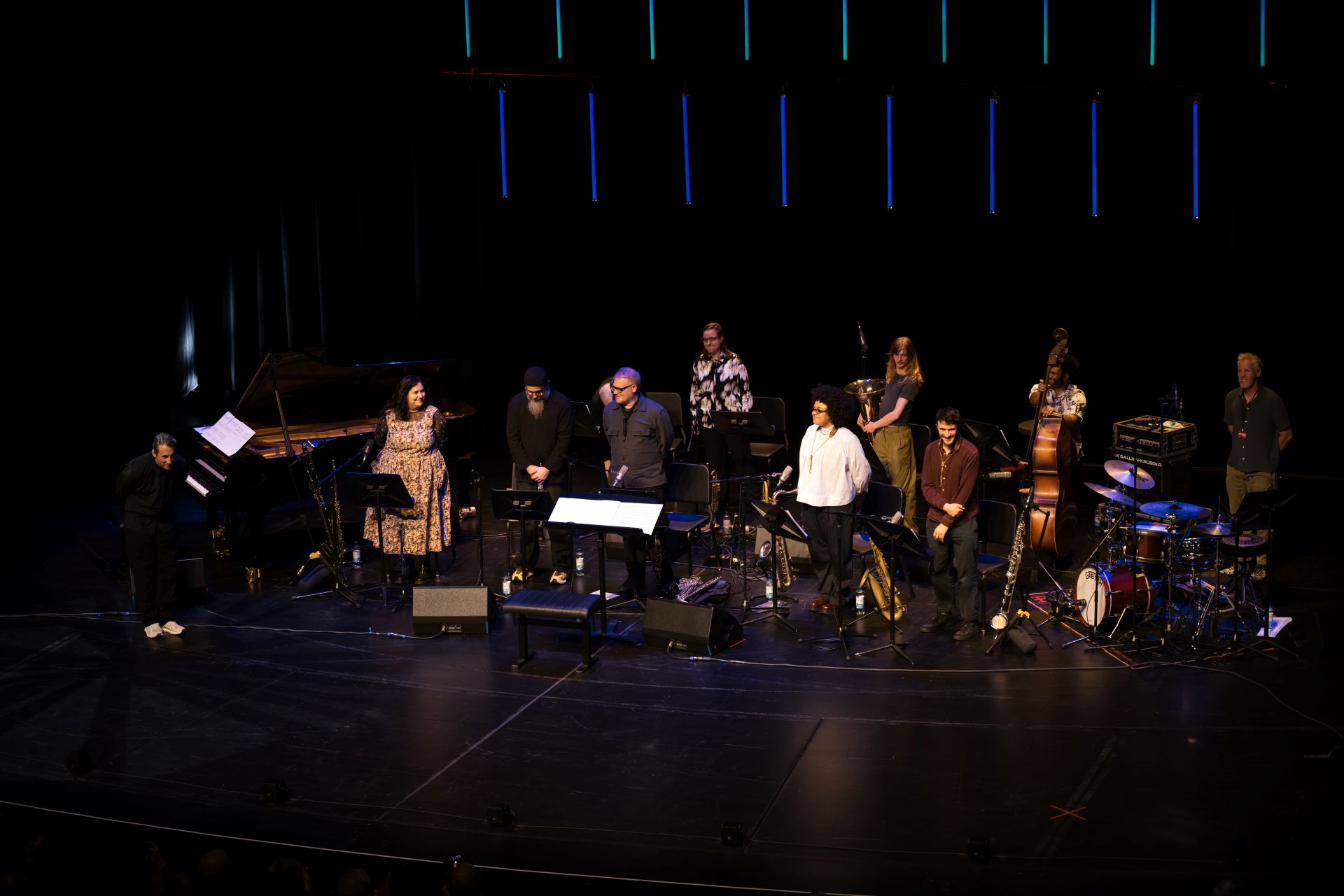
Next came Alexander Hawkins, leading a small orchestra from the piano while also taking on conducting duties. Although his compositions retained a more readily recognizable jazz character than the music heard earlier, they stood out for their structural originality and the meticulous attention devoted to their arrangements. Here, orchestral writing did not merely provide a framework for solo contributions but played a substantial role in shaping the music itself. The concert thus offered an interesting counterpoint to the preceding experiments, demonstrating how musical exploration can also develop through a more direct relationship with the jazz tradition.
The second day once again placed Anthony Braxton at the center of attention. The festival schedule presented a difficult choice: remain at the Haus der Berliner Festspiele for a triple bill featuring Camila Nebbia, Amir ElSaffar, and Immanuel Wilkins, or head to the Jazz Institute Berlin for the concluding performance of the workshop that the American composer had been conducting with students. Curiosity about the direction Braxton’s music might take with a larger ensemble and a work belonging to a different phase of his output ultimately won out.
At the Jazz Institute Berlin, the composer had spent several days working with an ensemble of 25 young musicians on Composition No. 151, a piece premiered in Hamburg in February 1991 by the Creative Music Ensemble Hamburg and performed only sporadically in subsequent years. Compared with the previous evening’s septet, the expanded instrumentation and greater timbral variety made it possible to explore a considerably broader range of musical situations.
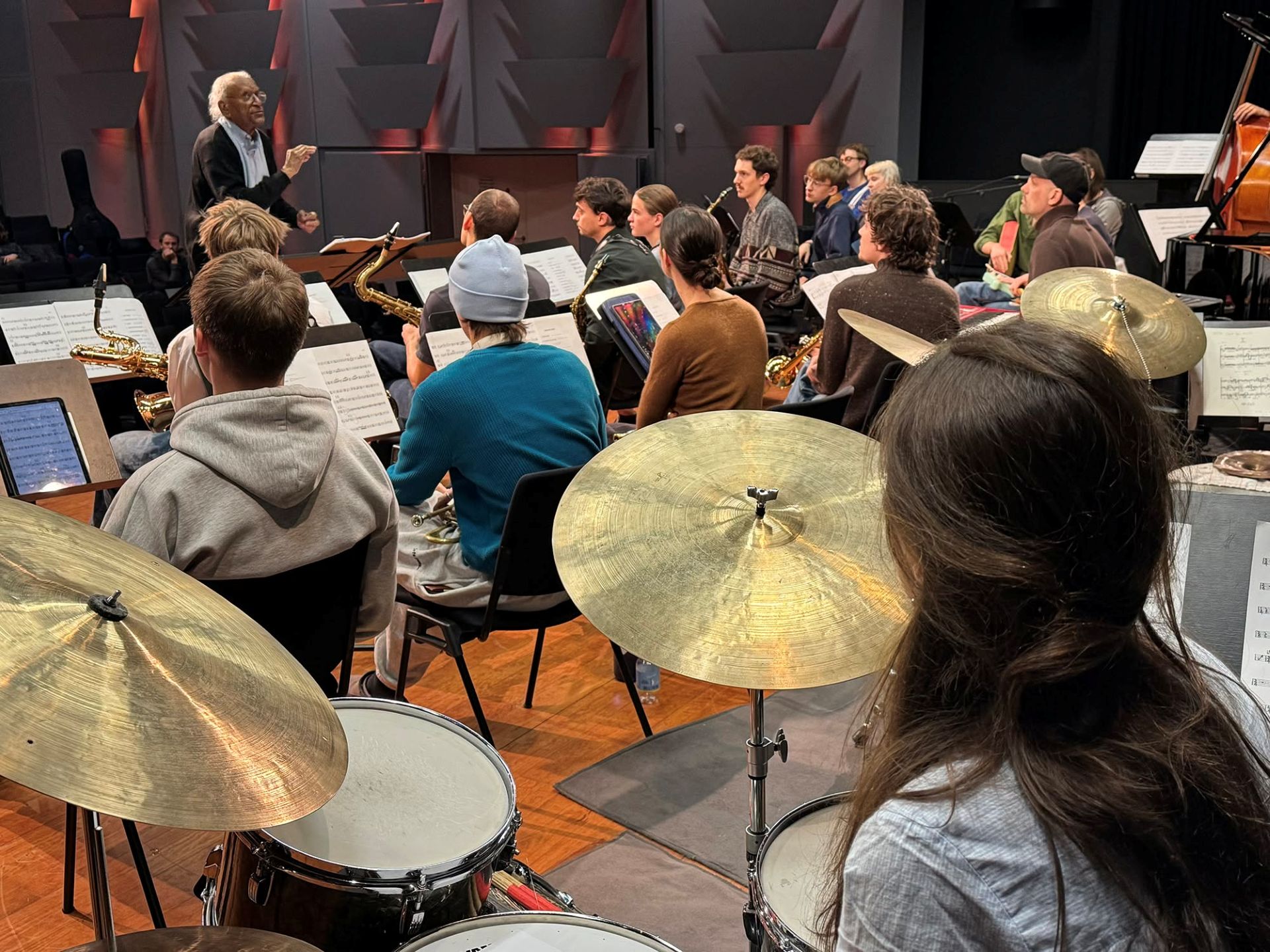
Once again, Braxton devoted very little space to his own instrumental contributions, preferring to concentrate on directing and coordinating the ensemble. Two spoken-word performers, seated and reading the texts prescribed by the composition, added another layer to the musical construction without assuming a dominant role. Instead, the spoken element became part of a carefully structured sonic organism in which every component contributed equally to the overall balance.
Onstage, James Fei played a central role in assisting with and directing the ensemble, while Chris Jonas contributed to the project’s organizational aspects. Yet beyond the complexity of the production, what impressed most was the quality of the work accomplished with the students. The young musicians approached the score with confidence and understanding, demonstrating a clear awareness of the significance of the experience. Particularly telling was the example of Florian Pasche, a saxophonist just seventeen years old, who made the most of every moment he could spend with Braxton, both during the soundcheck and after the concert, seeking advice and encouragement.
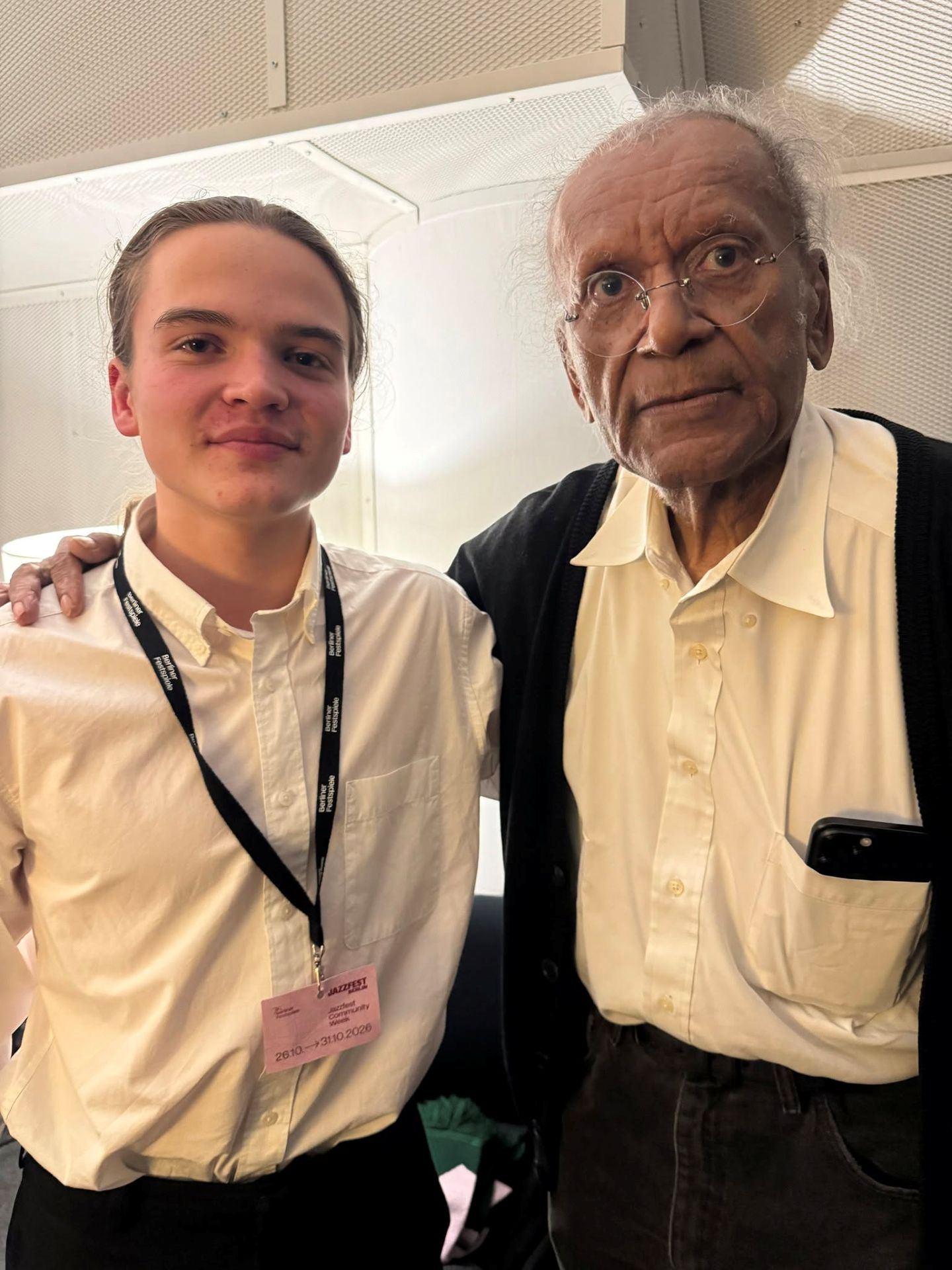
This small episode revealed something about the Chicago-born Maestro that is perhaps too rarely emphasized. Beyond his standing as one of the most important composers in the history of contemporary improvised music, Braxton has been, and remains, a teacher and mentor of extraordinary generosity, capable of inspiring confidence and enthusiasm in younger generations. As he reminded the audience from the stage, these are the musicians that will form the backbone of the nation in the years ahead, and for that very reason they deserve the greatest possible support from everyone.
Some audience members left the hall before the performance ended, perhaps without fully appreciating the historical importance of the event they were witnessing. Yet the concert offered moments of considerable emotional intensity, demonstrating just how valuable Braxton’s repertoire can be as a means of education and artistic growth, even for musicians belonging to generations so far removed from his own.
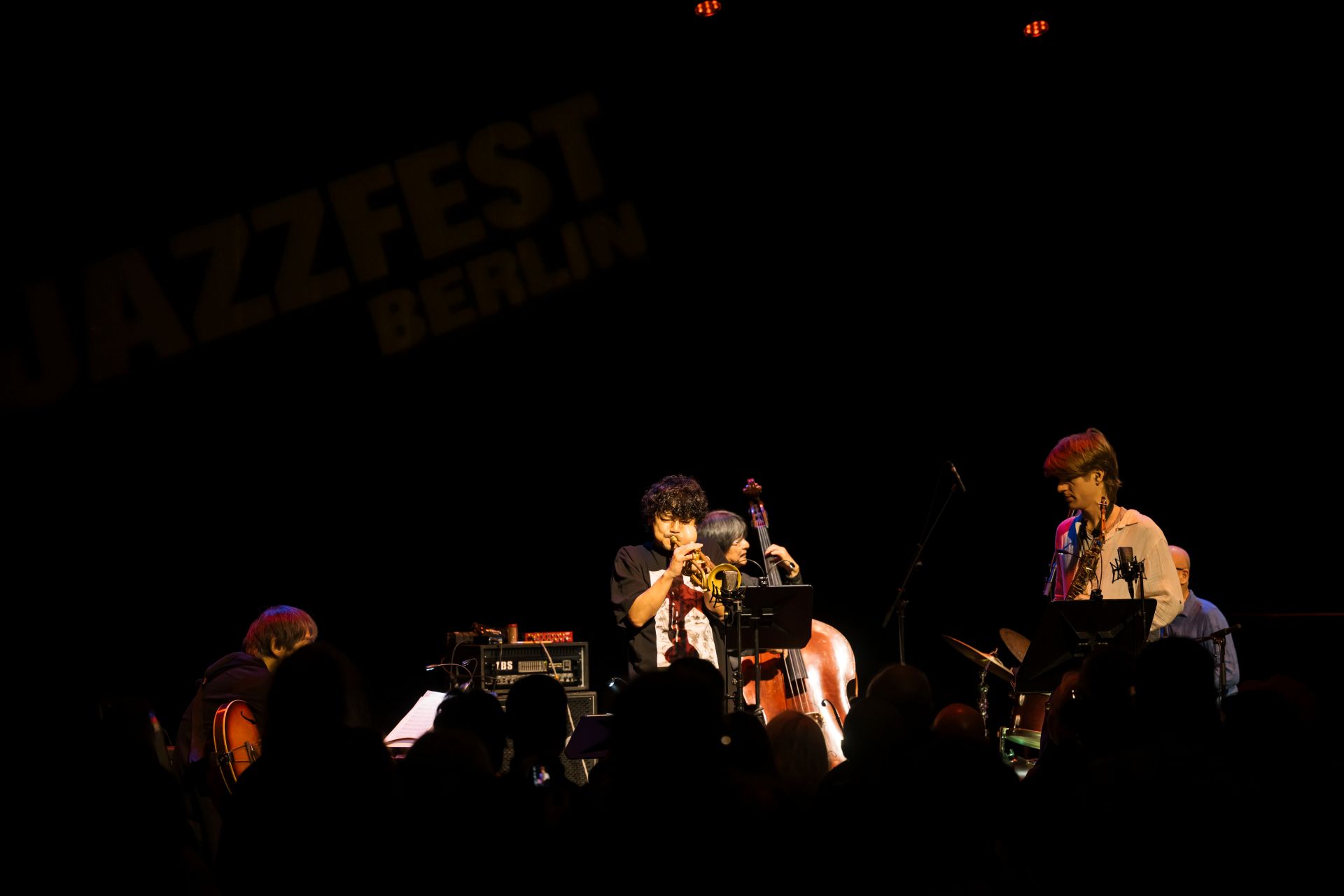
The day concluded on the smaller stage of the Haus der Berliner Festspiele with Otomo Yoshihide’s New Jazz Quintet. Long active at the intersection of jazz, improvisation, and noise, Yoshihide had abandoned the guitar for an extended period to concentrate on turntables before eventually returning to his original instrument more regularly. On this occasion, he offered a tribute to jazz, particularly the hard bop tradition, reimagined through an ensemble in which the electric guitar replaced the piano as the principal harmonic instrument. Extended themes, expansive solo passages, and a well-balanced front line in excellent form, featuring Shinpei Ruike on trumpet and Chris Pitsiokos on alto saxophone, made for a lively and thoroughly enjoyable set. Yoshihide’s guitar helped define the character of the project without any urge to dominate as a soloist. Instead, he left ample room for the other musicians, showing how an established tradition can be reinterpreted without sacrificing a distinctive musical personality.
The third evening reached one of its boldest moments with Christian Lillinger. The German drummer presented Open Form for Society II, the second chapter of a project launched seven years earlier at Jazzfest Berlin itself. The ensemble featured an unusually elaborate instrumental lineup, combining pianos, keyboards, harpsichord, celesta, double basses, and vibraphone, with Lillinger’s drums occupying center stage. Among the keyboard players was Elias Stemeseder, a regular collaborator with the drummer on numerous other projects and a recurring partner in his musical explorations.
A student of Günter “Baby” Sommer, among others, Lillinger has developed, over roughly twenty-five years of intense activity as a bandleader, composer, and producer, a personal language that places him among the leading figures carrying forward the great German improvisational tradition. His work would certainly have earned him a place in the special feature devoted to solo drumming in jazz, published in the June 2026 issue of Musica Jazz. Although his aesthetic differs profoundly from Sommer’s, the two share an extraordinary attention to instrumental gesture, a masterful command of the sticks, and an approach to cymbals that goes far beyond their conventional rhythmic function.
The fluidity and spectacular quality of Lillinger’s movements are integral to his performances. His physical gestures have a powerful visual impact, yet they are never ends in themselves or calculated simply to astonish. Instead, they are consistently directed toward shaping the musical discourse. Even in the most complex passages, the way he moves around the drum kit retains a remarkable naturalness, reflecting a technical mastery that allows him to turn every gesture into a precise sonic event.
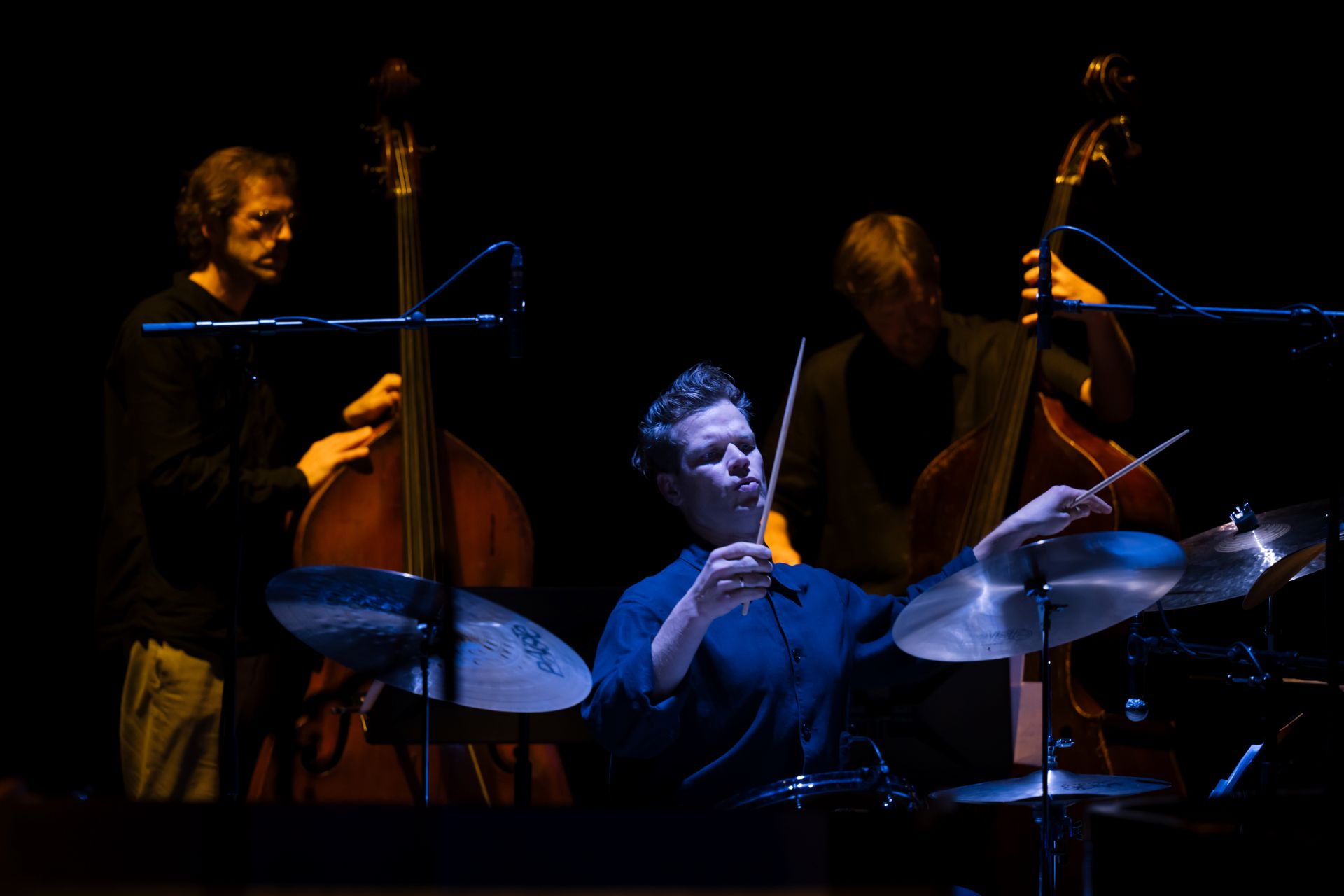
The result was an extremely abstract set in which Lillinger reaffirmed the centrality of the drums even within a context approaching chamber music. His instrument did not simply provide rhythmic support but became the driving force behind the entire musical structure, generating a sonic fabric into which the other musicians introduced their entrances, details, and counterpoints. Particular attention was devoted to timbral qualities, dynamics, and the intricate interplay among the instruments. It was the kind of music likely to divide an audience, but undoubtedly one of the festival’s most daring offerings, remarkable for its ability to develop a personal language that resists easy comparison with existing models.
Next, Tomeka Reid’s quartet offered a different perspective on composition and improvisation. Alongside the cellist, Mary Halvorson on guitar, Jason Roebke on double bass, and Tomas Fujiwara on drums created a musical fabric built primarily on interlocking parts and layered lines. The dialogue among the three string instruments, each with its own timbral identity and distinct role, produced a texture in which the underlying form remained perceptible despite constant transformations. A concert that wasn’t immediately easy to trace back to a single guiding idea, but was interesting exactly because of the care with which the materials were combined and developed.
The return of Rob Mazurek with the Chicago Underground Duo brought the festival back into more overtly psychedelic and visionary territory. Active since the mid-1990s, the project has lost none of its expressive force. Mazurek’s trumpet, drawing on Don Cherry’s legacy without merely reproducing it, became part of a musical flow dominated by a substantial electronic component, prerecorded tracks with occasional techno influences, the ever-present handmade shaker adorned with feathers, and primal screams. The result was a sonic universe at once Dionysian and ancestral, in which the ritual dimension of music intertwined with electronics and an approach to improvisation seemingly determined to dissolve any distinction between the archaic and the contemporary.
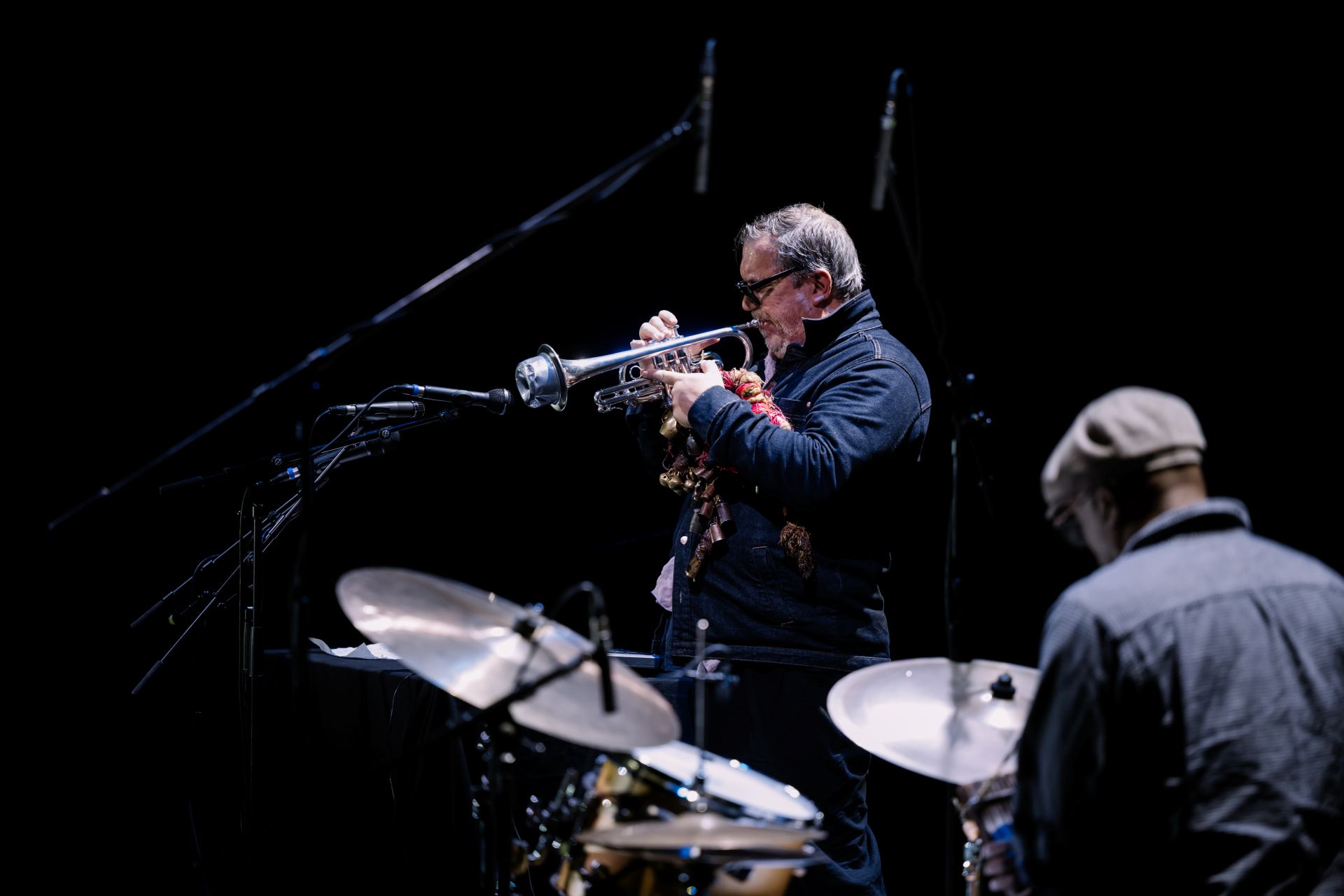
Mazurek also contributed to the visual dimension of the concert through abstract images of his own creation projected onto the backdrop. Within this setting, Chad Taylor’s drumming played an essential role. His energetic ostinatos kept the music moving, providing a stable point of reference within the deliberately tumultuous sonic flow. The interplay between the two musicians seemed less tightly woven than in some of the ensembles with which Taylor has performed in recent years, but the concentration and effectiveness of his playing gave the entire performance a firm foundation. This was hardly a new project, then, but one still capable of operating at a very high level. It should be noted, however, that the duo delivered the only concert of the festival to run well beyond an hour, perhaps stretching its musical argument too far. A more concise performance might ultimately have proved more incisive.
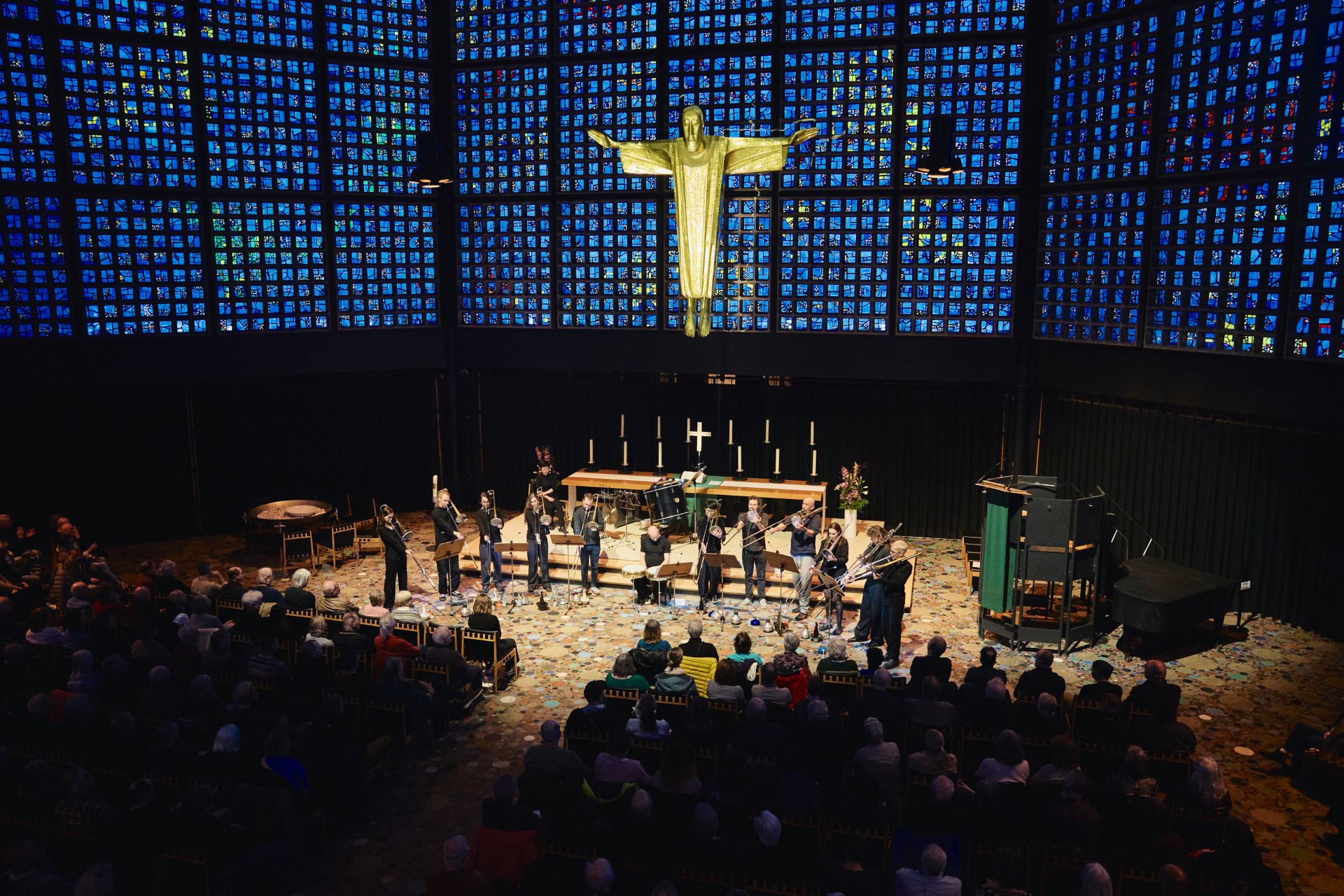
The fourth and final day opened in the evocative surroundings of the Kaiser-Wilhelm-Gedächtniskirche with BONECRUSHER, the unusual ensemble led by trombonist Matthias Muche, presenting Densities – 12 Trombones and Percussion. Built almost entirely around the trombone, with Rie Watanabe contributing percussion, the group explored the timbral possibilities and sonic combinations offered by such an unconventional lineup. Different mutes, overlapping parts, and shifts in register allowed the twelve trombones to produce a surprisingly wide range of colors. The percussion played a decisive role in adding depth and variety to the material, helping shape a succession of contrasting episodes, some more successful than others. It was a project whose principal strengths lay in curiosity and a taste for the unknown, shedding light on an instrumental territory rarely explored with such systematic attention.
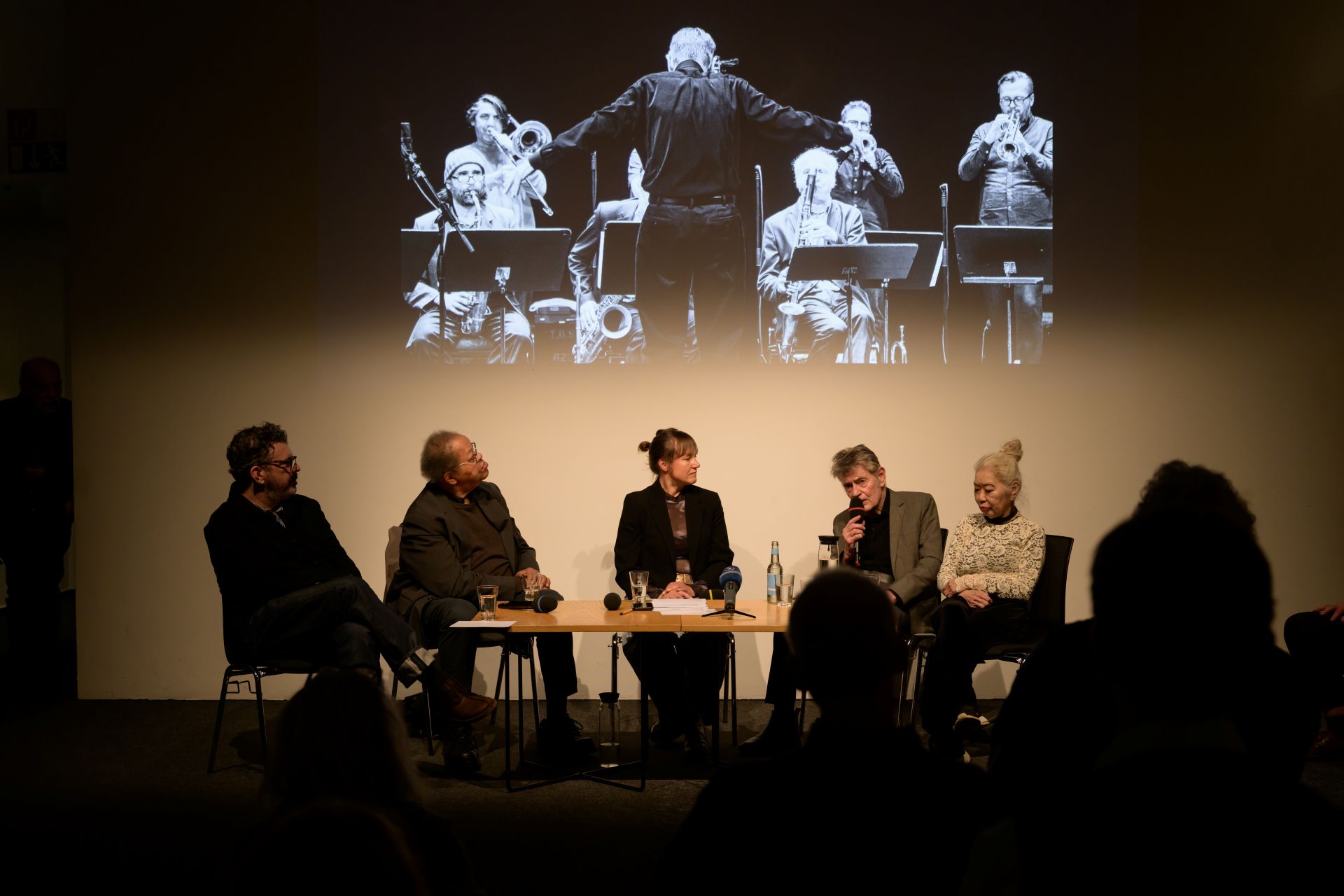
Later that day, the festival also provided an opportunity for historical reflection with a discussion devoted to the origins and history of the Globe Unity Orchestra. Alexander von Schlippenbach, George Lewis, and Aki Takase took part in a conversation with journalist Peter Margasak and artistic director Nadin Deventer. The event also included a presentation of Globe Unity 60, a book by Markus Müller bringing together personal accounts and rare photographic material documenting the history of this seminal ensemble.
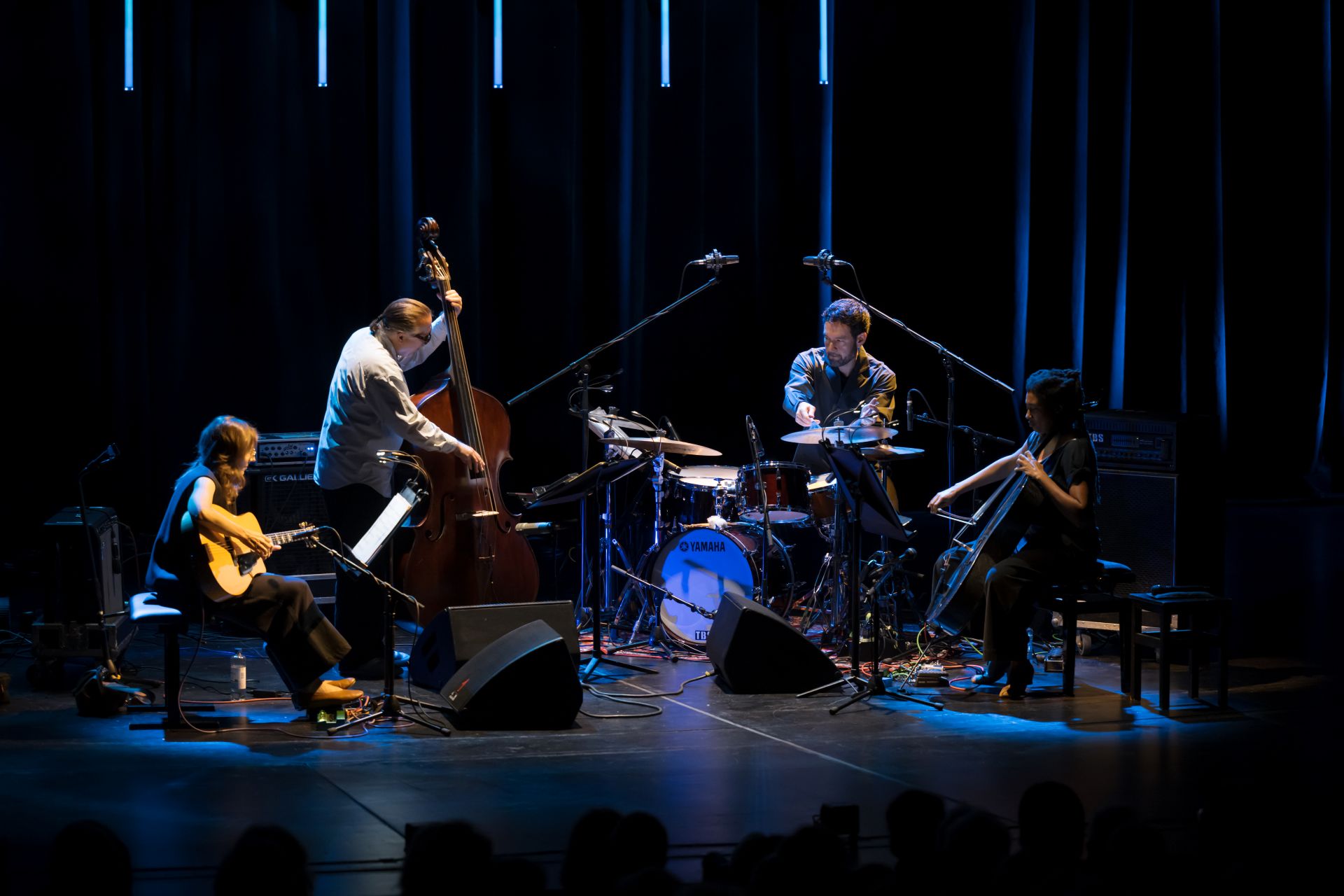
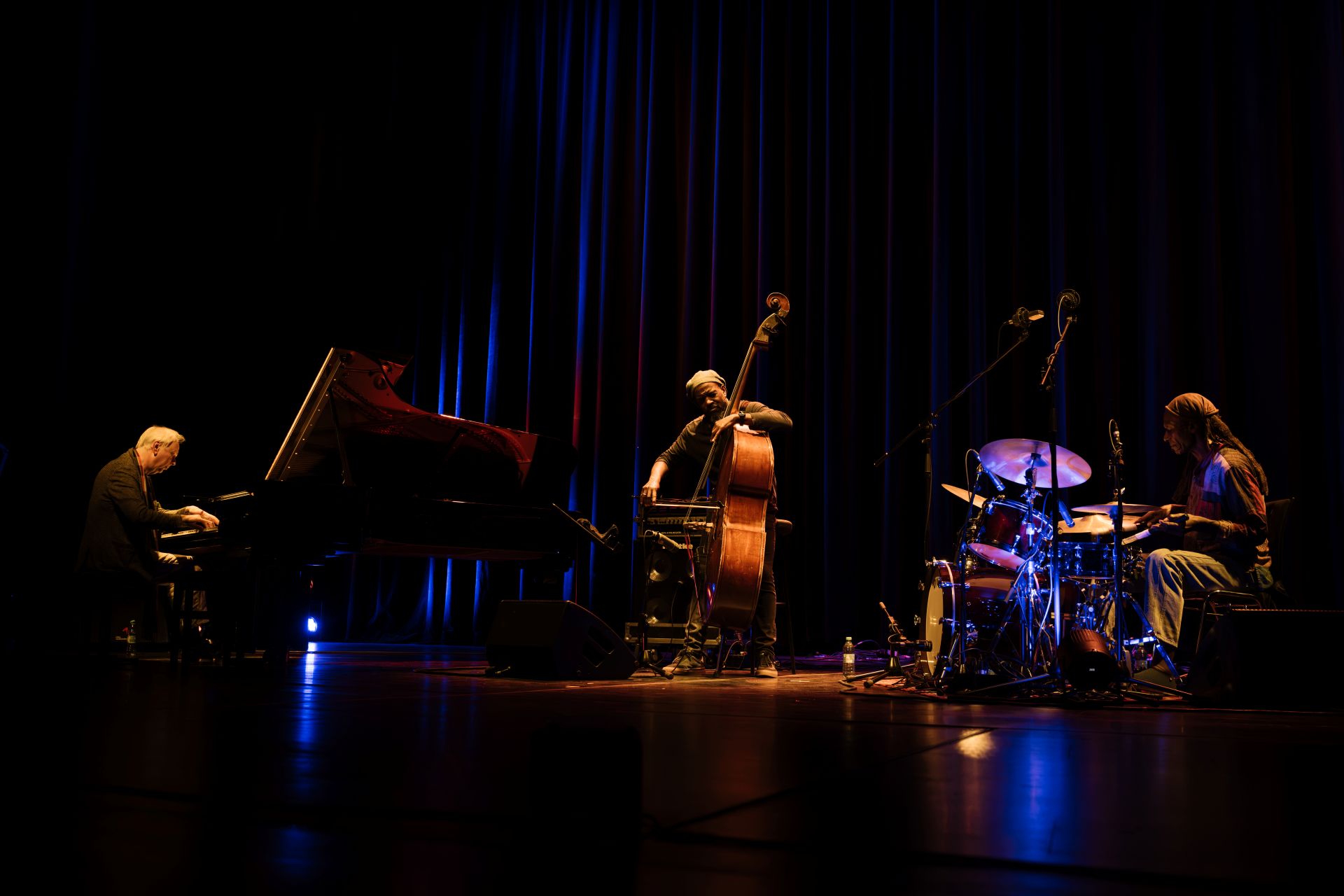
The trio of Georg Graewe, Brad Jones, and Hamid Drake then gave the German premiere of a project that had already been presented in the United States in 2024. Graewe is perhaps less widely recognized than he deserves to be within the European improvised music scene, but his piano playing revealed a clearly defined personality and proved particularly compelling. His tightly woven phrasing and uninterrupted musical flow found two exceptionally experienced partners in Jones and Drake. Both bass and drums maintained a measured approach, avoiding any tendency to overload the music and choosing instead to support and enhance the piano. It was a display of remarkable skill and restraint, and an opportunity to rediscover a musician worthy of considerably greater attention.
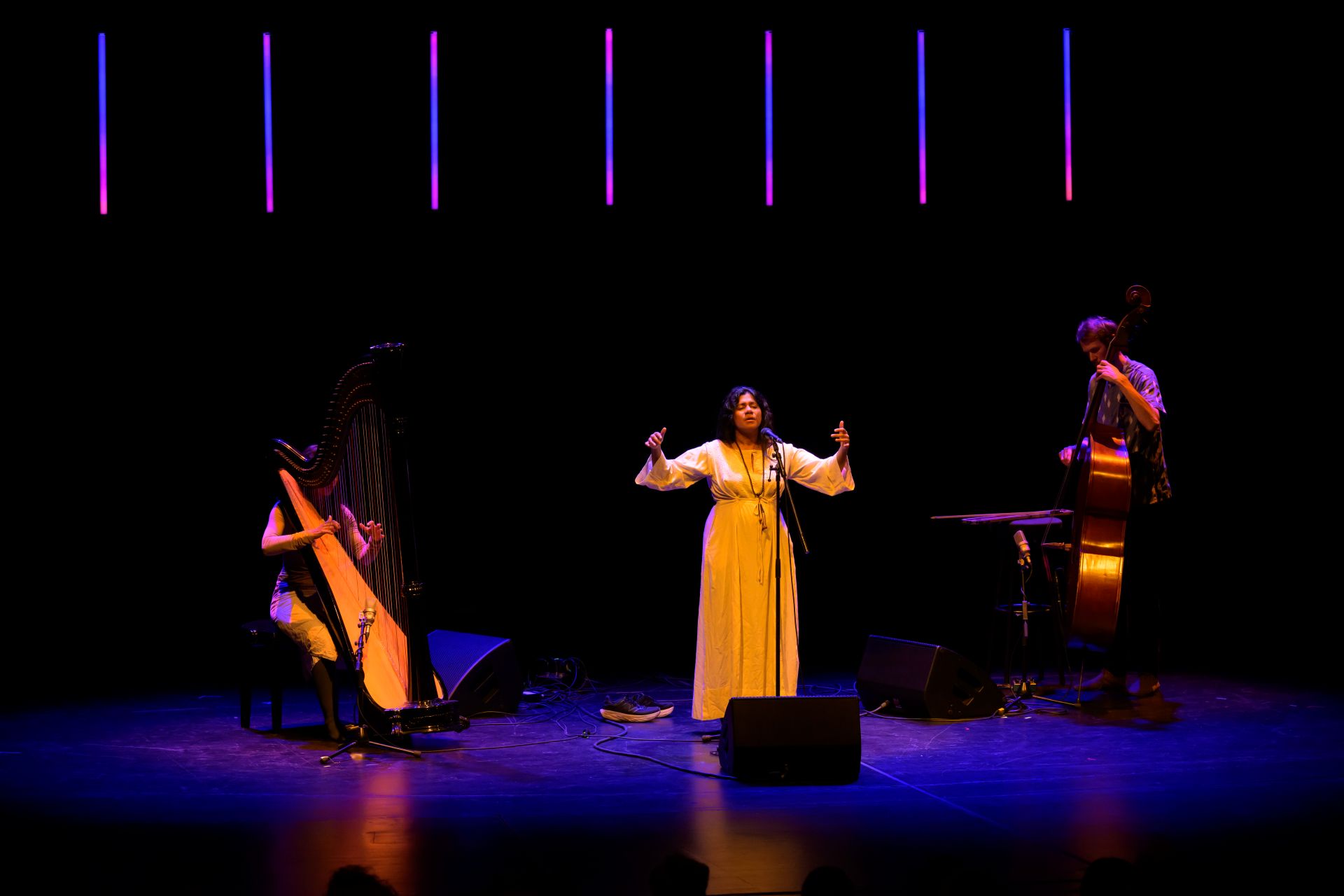
The set by ganavya introduced yet another dimension. The Indian-American singer-songwriter, whose sensibility bears the unmistakable influence of Alice Coltrane, created a delicate, rarefied performance in which her voice intertwined with harp and double bass. The atmosphere, reminiscent in some respects of spiritual jazz, remained largely unchanged throughout the set. The decision to prioritize suspension and continuity of mood produced some evocative moments, although the limited variety of musical situations made the performance less dynamic than several of the festival’s other offerings.
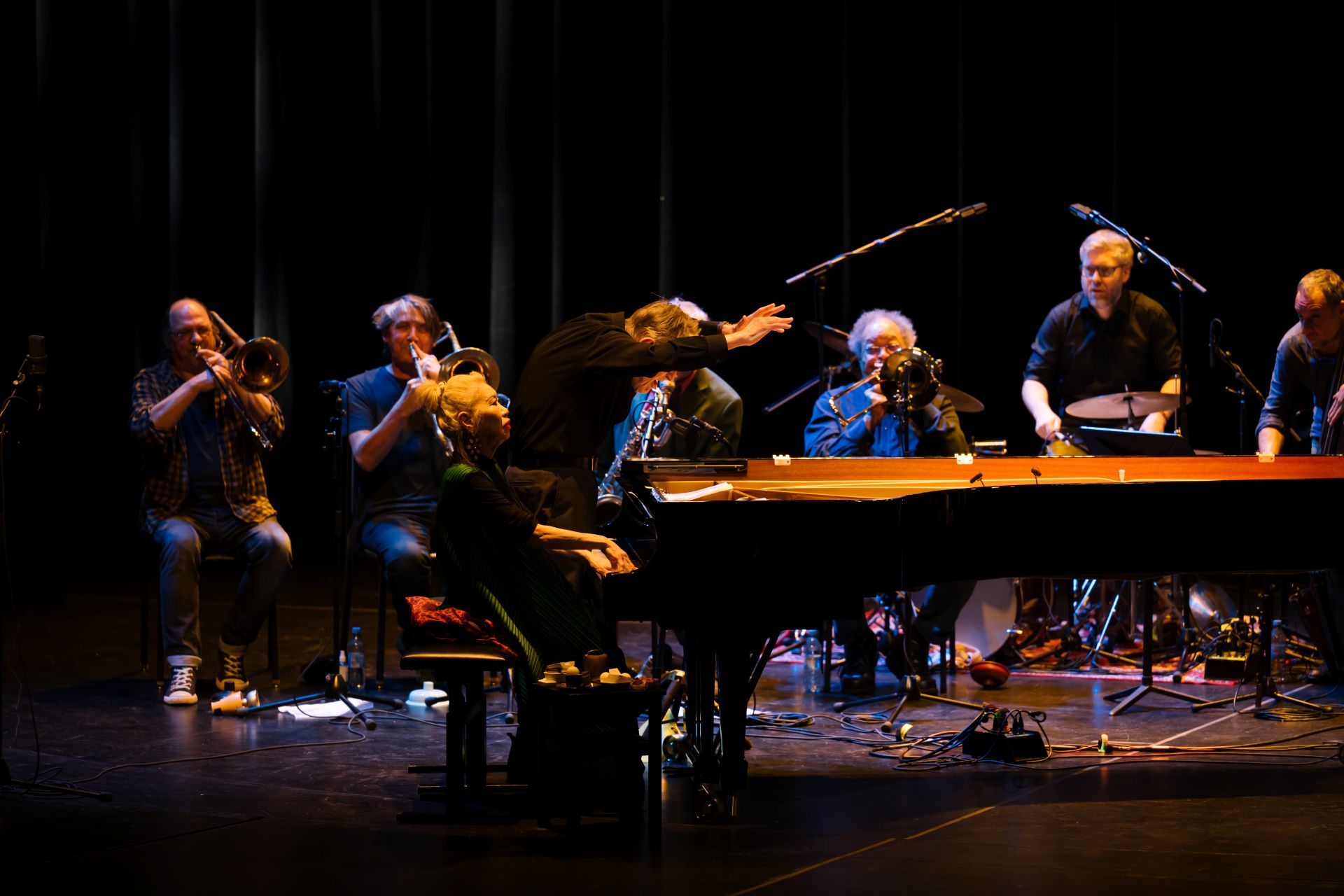
The task of closing the 2026 edition fell to the Globe Unity Orchestra, reunited to celebrate the 60th anniversary of its first appearance at the festival in 1966, when the event was still known as the Berliner Jazztage. It was an important anniversary, but one that went well beyond a simple exercise in commemoration. Alexander von Schlippenbach chose to revisit Apokalyptische Nabelschau (“apocalyptic navel-gazing”), a composition that has been part of the orchestra’s repertoire since at least 2003, placing the emphasis on the quality of the writing and the ensemble’s ability to breathe new life into it.
The lineup brought together several historic figures associated with the orchestra, including Evan Parker, Paul Lytton, George Lewis, Aki Takase, making her first appearance with Globe Unity and also joining Schlippenbach for passages of four-hand piano, and Manfred Schoof, who had recently turned ninety. Schoof’s presence had not been announced in the program, and he and Schlippenbach were the only two original members of the orchestra onstage. Alongside them were musicians who had joined the ensemble at later stages in its history, including Rudi Mahall, Axel Dörner, and Italy’s own Antonio Borghini on double bass.
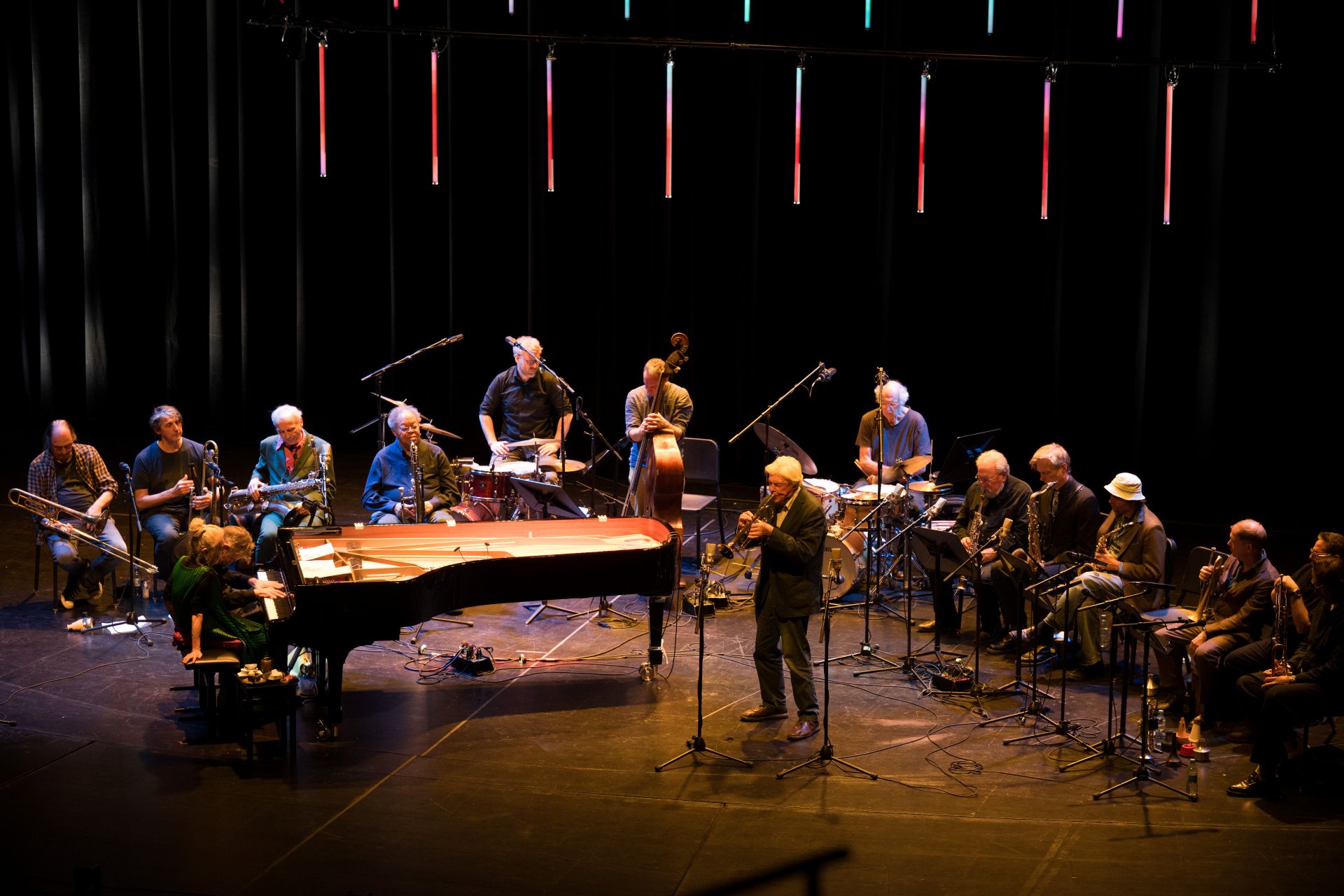
The result was surprisingly rigorous in its construction, with exceptionally precise orchestration and a handling of solo contributions that revealed meticulous attention to the overall sonic design. The various sequences were entrusted in turn to individual players or small groups, with compositional solutions carefully tailored to the particular qualities of the musicians involved.
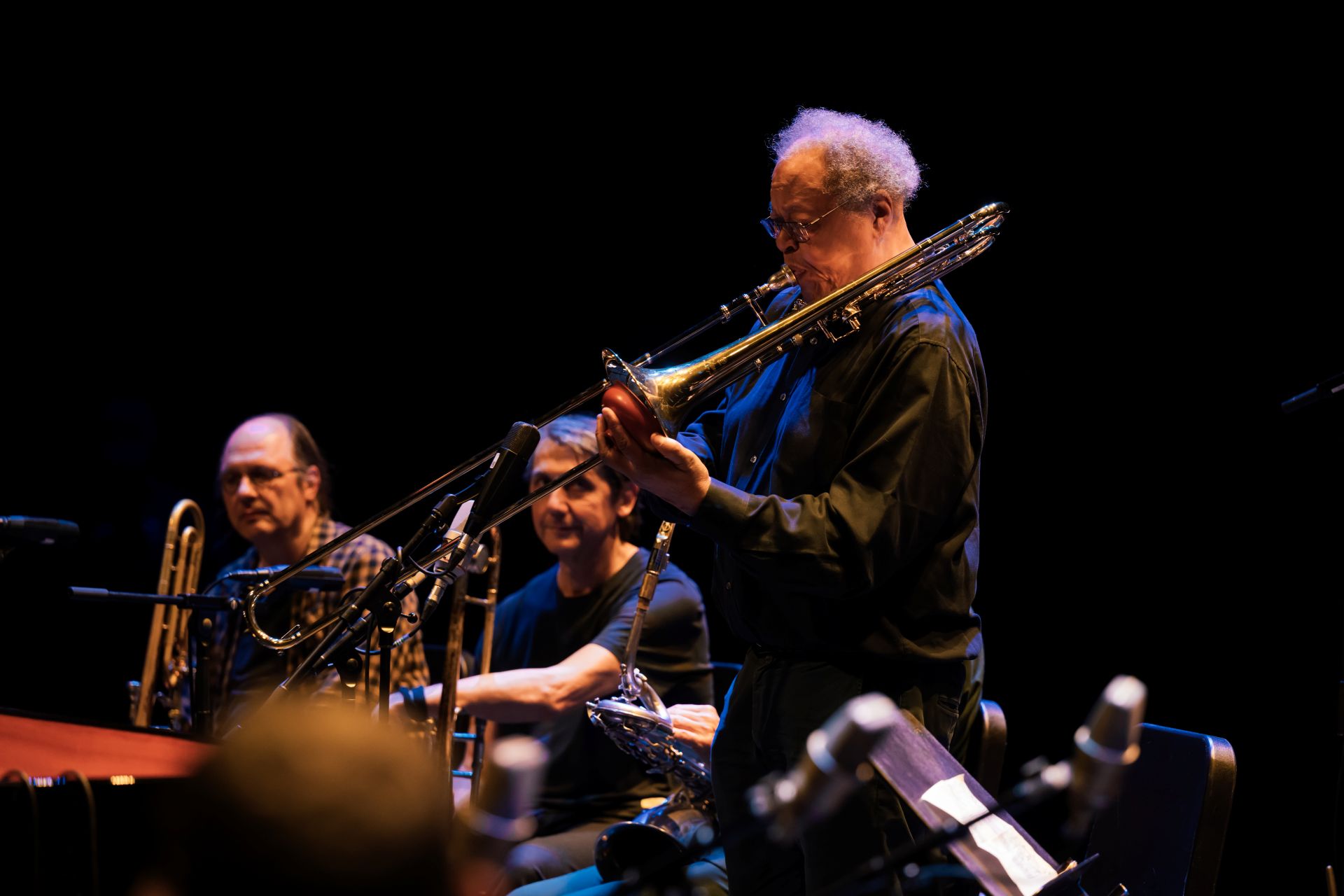
One of the most memorable passages came early in the performance, with a trio featuring Parker, Lytton, and Schlippenbach. The British saxophonist delivered a performance of extraordinary intensity, making extensive use of his celebrated circular breathing technique. Equally impressive was George Lewis’s trombone solo. One of the most distinguished musicians from across the Atlantic ever to have played with the orchestra, Lewis offered an exceptionally clear and coherent musical statement.
Even today, some listeners continue to associate free music with the notion that everything is left to chance, without rules or structures, as though expressive freedom and compositional anarchy were necessarily synonymous. It is a misconception that the history of the music itself has repeatedly disproved. As far back as the March 1978 issue of Musica Jazz, Aldo Gianolio, together with his brother Paolo, analyzed the complex structures underlying a masterpiece such as John Coltrane’s Ascension, demonstrating how music that might initially sound chaotic can actually rest on a rigorous compositional architecture.
The Globe Unity concert offered further proof of this principle. Behind the energy of the collective passages and the apparent unpredictability of their development, form remained constantly present, as did the precise organization of musical materials and orchestral dynamics. Nothing suggested a random succession of sonic events. On the contrary, the composition unfolded as a coherent organism in which the freedom granted to individual musicians occupied a clearly defined place within the overall architecture.
The care devoted to bringing each soloist into focus also called to mind, despite the considerable distance between their musical languages, the tradition of Duke Ellington’s great orchestras. The comparison had little to do with stylistic similarities and everything to do with the way the writing seemed to be shaped around the distinctive qualities of the musicians involved. This approach revealed a side of Globe Unity less closely associated with the historical image of the avant-garde as an explosion of collective energy and more concerned with construction, balance, and the enhancement of individual voices.
The final standing ovation crowned an evening of extraordinary intensity. It was difficult not to think, by contrast, of the orchestra’s first Berlin appearance in 1966, when it played to a half-empty hall and received a far from enthusiastic response from both audiences and critics. Sixty years later, the Globe Unity Orchestra was celebrated as one of the defining achievements in the history of European jazz, and the concert demonstrated just how much strength and vitality its music continues to possess. It also seems likely that the performance will eventually receive a recording release, following the precedent set by the concerts marking the orchestra’s 40th and 50th anniversaries.
Taken as a whole, Jazzfest Berlin 2026 offered a portrait of creative jazz that resisted any attempt at a single, all-encompassing definition. The music moved in widely different directions: from Mariá Portugal’s exploration of timbre to the complexity of Braxton’s newly developed musical system, from Lillinger’s chamber-like abstraction to Mazurek’s visionary sound world, and finally to the Globe Unity Orchestra’s reexamination of its own historical legacy. Not every concert was equally compelling, and some projects proved more convincing than others, but this very diversity of approaches helped give the program its deeper meaning. The festival presented a jazz that continues to question its own boundaries, without abandoning either its memory or its capacity to invent new forms. And the Globe Unity Orchestra provided a particularly fitting and triumphant conclusion.
