
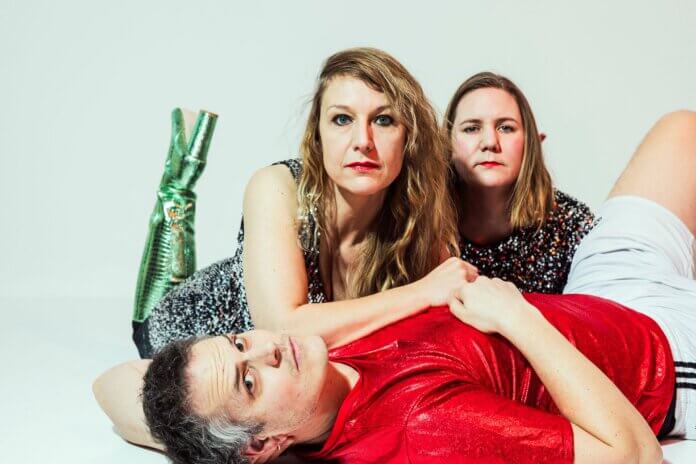


In February 2025, Musica Jazz published several columns by Enzo Capua devoted to Hedvig Mollestad. The occasion was a meeting in New York, where the Norwegian guitarist was appearing as a guest with Cortex, a young band of fellow Norwegians in residence at the Nublu club. It was a setting somewhat removed from her main project, the trio, and the interview was conducted on the fly, between rehearsals and the concert, with Mollestad due to leave for Pennsylvania the following day. That profile accurately captured the essence of an unconventional musician, capable of bringing together Jim Hall and Tony Iommi without making the combination seem forced. But it left her work with the trio largely unexplored, even though it represents one of the central chapters of her career. It was therefore a double pleasure to reconnect with her: first through Bees in the Bonnet, released in May 2025 on Rune Grammofon and hailed by the international press as one of the albums of the year, and then in person as part of the Bergamo Jazz lineup, a festival that, once again this year, confirmed its commitment to bringing to Italy musicians who are otherwise rarely seen here.
Born in Ålesund, on Norway’s west coast, just over forty years ago, Mollestad grew up in a musical family and came to the guitar almost by chance, before realizing that it was her instrument and that she had no intention of playing it the way people might expect. She studied at the Norwegian Academy of Music in Oslo, absorbed the jazz tradition, and at the same time listened to everything: Jimi Hendrix and King Crimson, Miles Davis and Black Sabbath, Jim Hall and Terje Rypdal, the great Norwegian guitarist who, before her, had already shown a remarkable ability to make jazz, psychedelic rock, and chamber music coexist without worrying too much about genre boundaries.
When the Molde Jazz Festival invited Mollestad to form a band in 2009, she brought together Ellen Brekken on electric bass and Ivar Løe Bjørnstad on drums. What began almost by chance as a mainstream jazz trio soon took a different direction and became her permanent group. Seven albums followed in little more than a decade, along with a constant presence on European and North American stages, and a sound that gradually moved closer to rock, rooted in riffs and the power of the rhythm section without ever losing the ability to open up to improvisation whenever the music calls for it.
Bees in the Bonnet is the trio’s eighth album and its first after a four-year break from recording. Six tracks, thirty-seven minutes, with Mollestad’s guitar working through riffs built by accumulation and the rhythm section of Brekken and Bjørnstad holding everything together with almost mechanical precision. In between, there is room for moments of improvisational openness and for at least one episode of an entirely different nature, “Lament,” a ballad dedicated to the guitarist’s father, rooted in jazz and far removed from the rest of the album in both atmosphere and emotional weight. The specialized press hailed it as the most cohesive album of Mollestad’s career, and the one closest to 1970s hard rock, and it appeared on several year-end lists compiled by critics and music magazines.
On March 21 2026, Mollestad’s trio performed in the afternoon at the Auditorium of the Istituto Palazzolo as part of Bergamo Jazz. It was their Lombardy debut and one of the group’s rare appearances in Italy, before an audience that included, alongside the festival regulars, rockers and metalheads who had traveled from different parts of the country specifically to see her. That evening, at the Donizetti Theatre, The Bad Plus took the stage with Chris Potter and Craig Taborn. It was there that we met the trio in the foyer, where they had come as audience members. At the end of the concert, Mollestad did not mince words in describing what she had heard: “Out of this world.” The interview that follows took place in that setting, while the evening was still underway, with the music of the other artists still lingering in the air and the excitement of a debut that will certainly be remembered in the history of the festival.
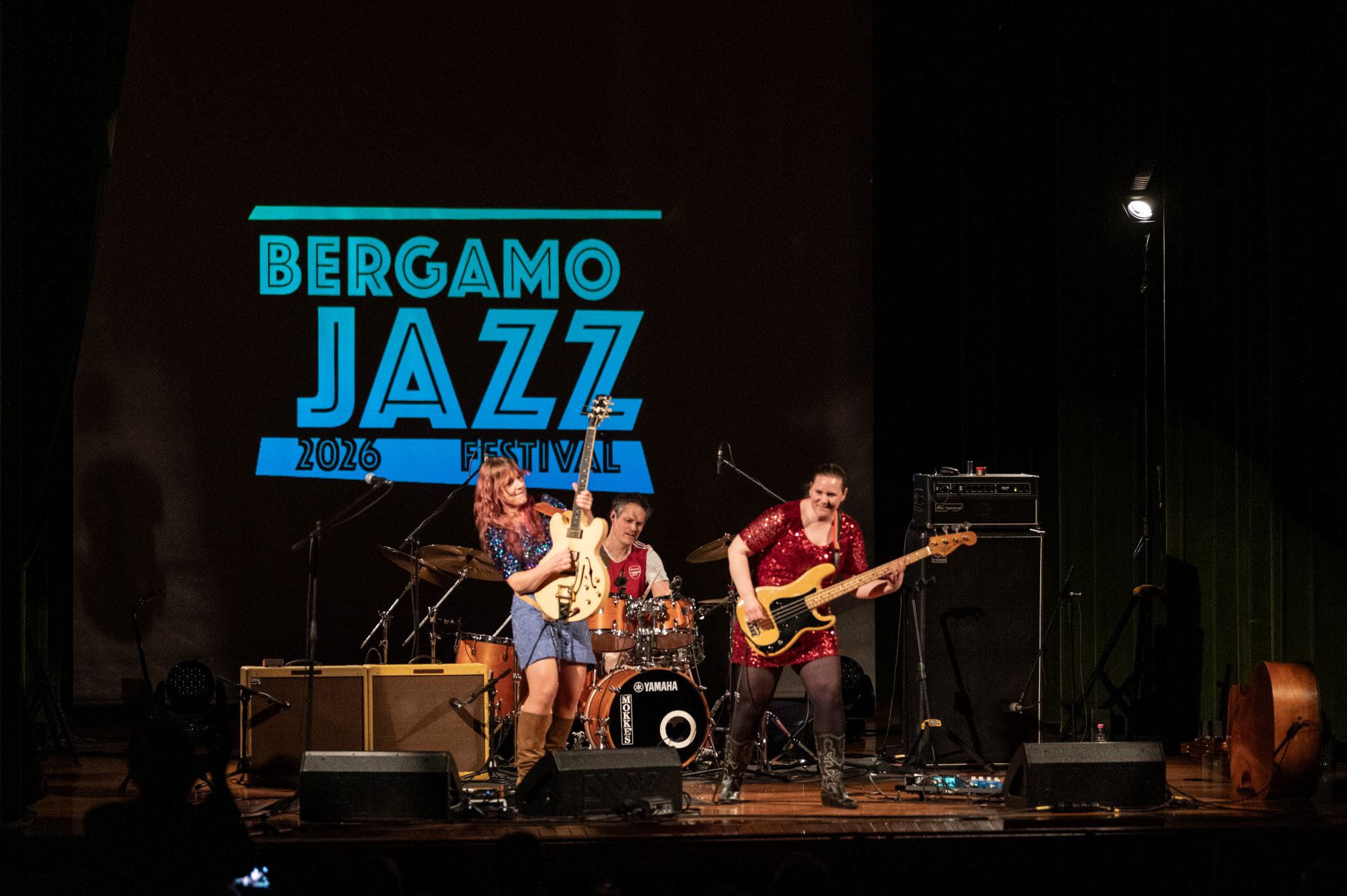
You presented a very intense set here at Bergamo Jazz, and the audience responded strongly. What was the concert like for you from the stage?
It was fantastic. You never know what to expect, especially when you’re playing somewhere for the first time and you don’t know whether the audience knows your music. But the reception here was really warm, and the level of attention was very high. It was overwhelming.
For someone hearing you for the first time, what is the idea behind the trio?
We simply try to make good music. It has to be stimulating to play and interesting to listen to live. There’s not much more to it: just playing good music.
How did the trio come together, and how has it evolved over time?
We started in 2009–10, when we were invited to form a band for the Molde Jazz Festival. At first, we played things that were closer to traditional, more mainstream jazz. Then we came up with a piece built around a riff, and we realized that direction worked better for us. Over the past fifteen years, we’ve gone through several phases. We’re musicians with jazz backgrounds, but we listen to a lot of other music as well.
What are your main influences?
We come from different backgrounds: folk, classical music, rock, free improvisation, but also mainstream jazz. We know and love the jazz tradition. At the same time, we listen to everything, from Jim Hall to Black Sabbath.
The concert focused on your latest album, Bees in the Bonnet, which has been very well received by both critics and audiences. How did the album come about?
The starting point is always the same: making new music. We start playing, ideas emerge, and we build from there. A lot of the material is influenced by our concerts. We really love playing live, and the stage is definitely where we feel most at home. Over the years, our music has become more rhythmic, more physical, and heavier. This is probably our “heaviest” album yet.
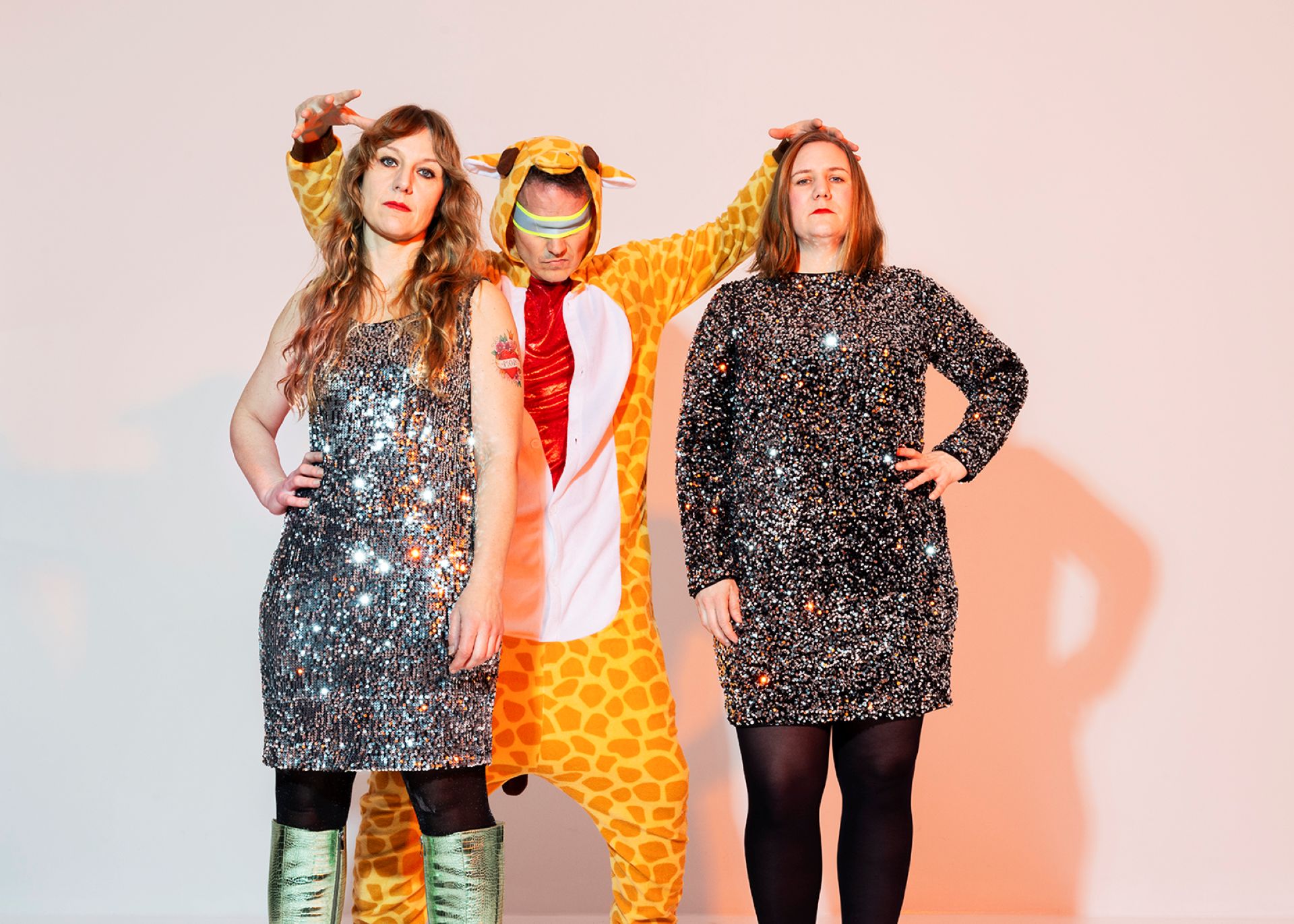
Is the compositional process collaborative?
Yes. Everyone brings in ideas, sometimes complete pieces and sometimes just simple starting points. Then we work on them together: we take things away, add things, transform them. An idea becomes something much bigger when it passes through all three of us. Some pieces grow out of structures that are already defined, while others begin with minimal cells that we develop collectively, sometimes using compositional techniques closer to classical music. Improvisation, however, always remains part of the process.
Listening to the concert, I had the impression that riffs and the rhythmic dimension dominate your music. Is that an accurate reading?
If that’s what you heard, then it’s accurate. Everyone perceives things differently, but yes, we love working with riffs and grooves.
Are you already thinking about what comes next after this album?
We’ll be going back into the studio in September, so we’re writing new music now. In the beginning, we were more tense in the studio, but today there’s much more mutual trust. We don’t rigidly plan a particular direction: the goal is simply to make better music than we did before. And then we want to play a lot of live shows. That’s what we enjoy most.
And Italy?
We love it. We’d love to come back often. The audiences are attentive, and the festivals are very professionally organized. And then there’s the food, the cities, the language: everything is very inspiring.
Who are your influences today?
There are so many, probably hundreds. Even the musicians playing here at the festival are extraordinary. We listen to everything: jazz, rock, pop. If the music works, if it grabs you physically, then it’s the right music.
