
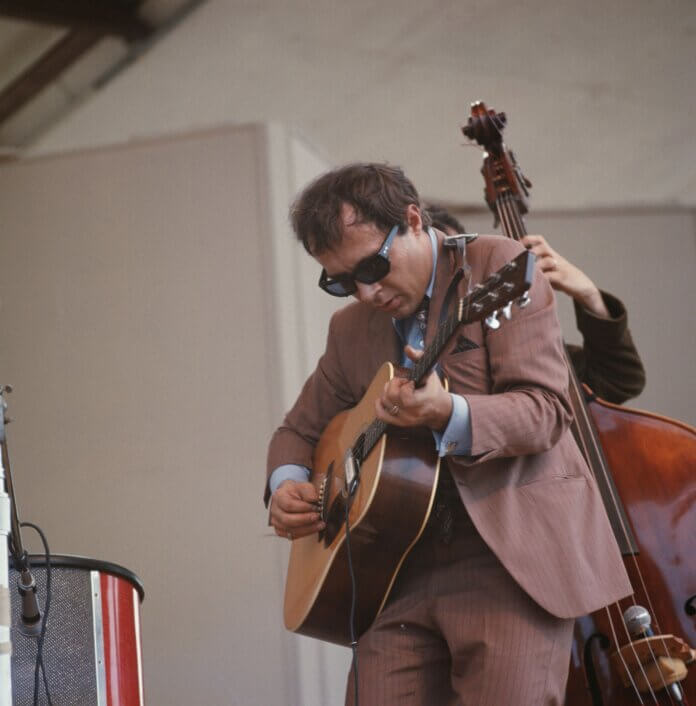


“His music was fantastic and captivating. The feedback from Gábor’s guitar wasn’t uncontrolled like Jimi Hendrix’s, but resembled the drone characteristic of Indian music. I was spellbound listening to him.” This is how Carlos Santana described the Hungarian guitarist Gábor Szabó, whose acknowledged influence on Santana led the latter to record his “Gypsy Queen” in 1970 for the landmark album Abraxas. Szabó (1936–1982) occupies a rather distinctive place in the history of jazz. Despite an extensive recording career spanning two decades, both as a leader and as a member of other musicians’ groups, his name gradually faded into relative obscurity after his death.
Szabó developed a passion for jazz at an early age, partly as an act of defiance against the communist regime that prohibited its dissemination. His exposure to the music came through the handful of records that found their way onto the black market in his native Budapest and through listening to Voice of America. The decisive turning point in his life came in the fall of 1956, when Soviet tanks entered Budapest to suppress the fledgling process of liberalization initiated by Prime Minister Imre Nagy. The twenty-year-old Gábor fled with his girlfriend at the time and a friend, managing to cross the Austrian border under difficult and adventurous circumstances. A few months later, he moved to the United States, but his first encounter with the long-dreamed-of land of opportunity proved anything but easy, both for him and for his parents, who soon joined him in San Bernardino, California.
California’s flourishing music scene was highly competitive, and the young, self-taught guitarist had yet to acquire the technical skills necessary to establish himself within it. Moreover, as Szabó recalled in several interviews, many of his American fellow musicians initially seemed far more interested in the political reasons behind his flight from Hungary than in any meaningful musical exchange. Bookings for the group he had formed, Three Strings, were scarce, and making ends meet was a struggle. These daily hardships stirred his pride and strengthened his determination: “When I saw my father and mother taking the lowest-paying jobs imaginable to support themselves in California, it made me believe in my music and strive to become a successful guitarist.”
He took a job as a janitor to support himself while saving enough money to enroll at the Berklee School of Music in Boston, where he began studying in 1958, taking courses in composition and arranging as well. There, he had the opportunity to establish relationships and share experiences with young musicians from across the world. That same year, he was selected to join the International Youth Band, which performed at the Newport Jazz Festival. Incidentally, the ensemble included several musicians who would become prominent figures in European jazz in the years that followed: German trombonist Albert Mangelsdorff, Bosnian trumpeter Duško Gojković, Swedish saxophonist Bernt Rosengren, English saxophonist Ronnie Ross, Swiss pianist George Gruntz, and Italian drummer Gil Cuppini. At Newport, Szabó also had the opportunity to play with Louis Armstrong and met drummer Chico Hamilton, with whom he would work extensively a few years later.
Having returned to Los Angeles and married in the meantime, Szabó had to divide his time between music, still a part-time occupation, and his work as a real estate agent. When he met Hamilton again, the drummer invited him to join his quintet. His initial experience with the group, however, was unsuccessful, as Szabó himself recalled: “At first, I tried to imitate the style of American jazz guitarists, and I played badly. So on the third day I was fired. A year later, though, I was asked back. This time, instead of trying to copy the way other people played, I followed my own musical instincts.”
The year Szabó was referring to was 1961, which marked the beginning of a five-year collaboration that would serve as a launching pad for his career. The disappointing experience of the previous year had taught him a valuable lesson. From that point on, he began to develop an original and immediately recognizable style, distinguished by a dry, clean tone, clear and economical phrasing, and a pronounced melodic sensibility. Although grounded in the syntax and vocabulary of jazz, his approach differed considerably from that of American guitarists. It owed something to Django Reinhardt but was also deeply rooted in the heritage of Hungarian folk music, with its predominantly pentatonic scales, a tradition extensively studied by composers such as Béla Bartók and Zoltán Kodály.
Chico Hamilton himself would later describe Szabó as “a formidable soloist and a great accompanist with excellent time. He knew when to play and when not to.”
Szabó recorded no fewer than eight albums with Hamilton over the course of five years, the most significant of which date from 1962–1963: Drumfusion (Columbia), Transfusion (Studio West), Passin’ Thru (Impulse!), A Different Journey (Reprise), and Man from Two Worlds (Impulse!), in that order. The quintet featured Charles Lloyd on tenor saxophone and flute, Garnett Brown (on the first album only) or George Bohanon on trombone, and Albert Stinson on double bass. The ensemble played a vibrant, dynamic repertoire largely consisting of Lloyd’s compositions and consequently far removed from the orthodoxies and elegant stylistic conventions of West Coast jazz. In this setting, Szabó developed at a remarkable pace, earning recognition from Down Beat as guitarist of the year in 1964.
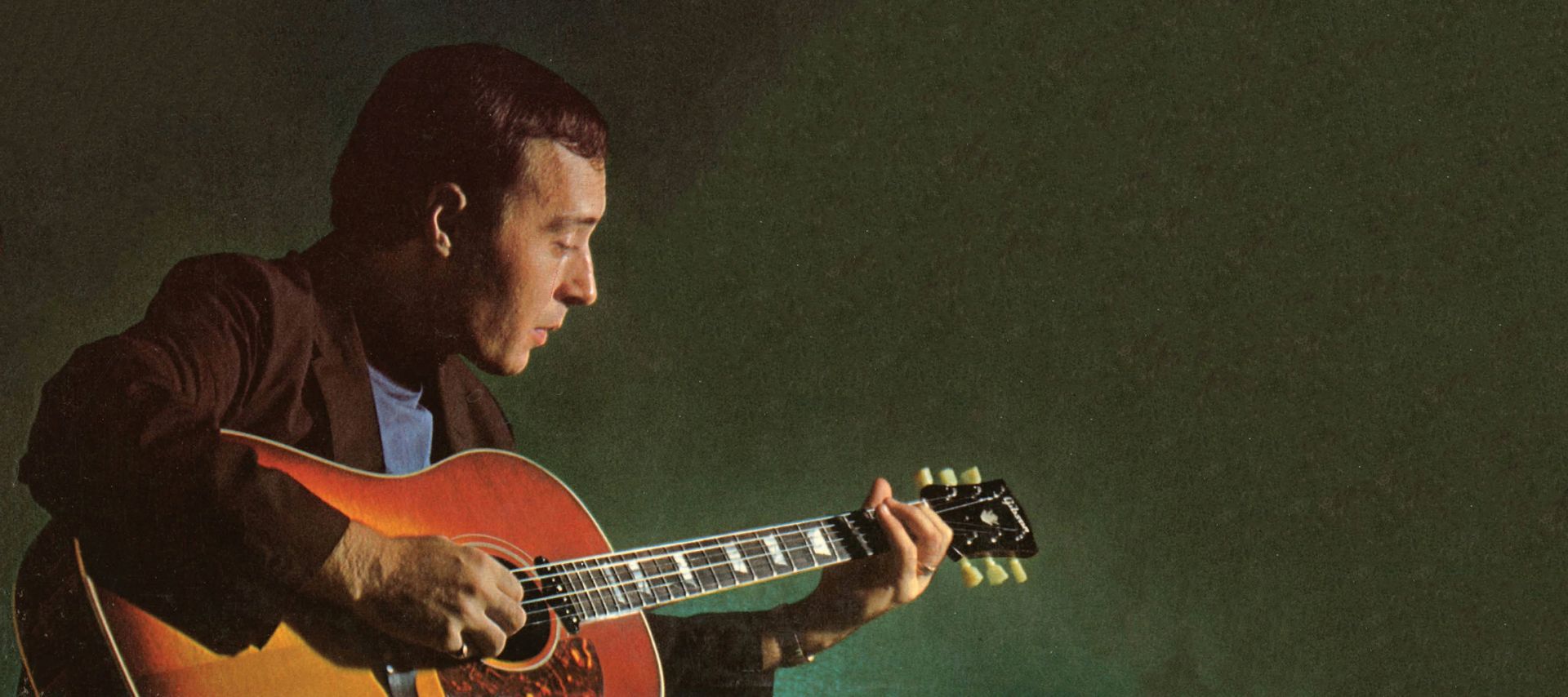
The year 1966 was particularly productive for Szabó. He began collaborating with vibraphonist Gary McFarland, a partnership that resulted in two albums for Impulse!, Gypsy ’66 and Simpático, featuring, among others, Barry Galbraith and Sam Brown on guitar, Sadao Watanabe on flute, Albert Stinson and Richard Davis on double bass, and Grady Tate on drums. Both albums adopted a deliberately lighter and – without wishing to attach any derogatory meaning to the term – more commercial approach, a choice dictated by market considerations. More precisely, the former was released under Szabó’s name, while the latter was jointly credited but bore McFarland’s unmistakable stamp.
During the second half of the 1960s, a number of jazz musicians began drawing inspiration from the popular music of the day, thereby broadening the repertoire of jazz standards in the years that followed. Gypsy ’66, for instance, contains versions of Lennon–McCartney’s “Yesterday” and “If I Fell,” as well as Burt Bacharach’s “Walk On By” and “The Last One to Be Loved,” while Simpático includes interpretations of two other Beatles songs, “Norwegian Wood” and “The Word.”
The tendency to juxtapose original compositions, standards, and reinterpretations of popular songs continued in Szabó’s subsequent recordings, on which he emerged as a leader in his own right. Spellbinder (Impulse!, 1966) – recorded with Hamilton, Ron Carter on double bass, and percussionists Willie Bobo and Victor Pantoja – features versions of “Witchcraft” and “Autumn Leaves,” alongside Sonny Bono’s “Bang Bang (My Baby Shot Me Down)” and Ervin Drake’s “It Was a Very Good Year,” made famous by Frank Sinatra, as well as the aforementioned “Gypsy Queen,” subsequently recorded by Santana.
Released by Impulse! in 1967 but recorded in August 1966, Jazz Raga also finds Szabó playing the sitar, reflecting the growing popularity of Ravi Shankar in the Western world at the time, thanks in part to the adoption of the instrument by George Harrison of the Beatles and Brian Jones of the Rolling Stones. The titles of several of the guitarist’s compositions leave little doubt about the source of his inspiration: “Mizrab” (which would become one of his signature pieces), “Krishna,” and “Ravi.” Alongside these were McFarland’s “Raga Doll” and even the Rolling Stones’ “Paint It Black,” as well as jazz standards such as “Summertime” and “Caravan.” For this session, Szabó was joined by second guitarist Bob Bushnell, bassist Johnny Gregg, and drummer Bernard “Pretty” Purdie, who would become a major figure in soul, R&B, and funk thanks to his unmistakable groove and characteristic shuffle.
Also dating from 1967 and released on Impulse! are The Sorcerer and More Sorcery, recorded live with Jimmy Stewart (guitar), fellow Hungarian Lajos Kabók (double bass), Marty Morell or Bill Goodwin (drums), and Hal Gordon (percussion). Both albums offer compelling examples of a musical aesthetic founded on economy and clarity of phrasing, as well as a fascination with melody that embraces original compositions while revisiting previously explored musical territories.
On the one hand, there is the Brazilian music of Antônio Carlos Jobim (“Corcovado,” also known as “Quiet Nights of Quiet Stars”), but also that of Roberto Menescal and Ronaldo Bôscoli, the composers of “O Barquinho” (“Little Boat”), a song made famous by João Gilberto and Elis Regina. On the other, there is an eclectic selection of popular songs, including “The Beat Goes On” (Sonny Bono again!); Francis Lai’s “Stronger Than Us,” from the soundtrack to Claude Lelouch’s film A Man and a Woman; and Jule Styne’s “People,” from the musical Funny Girl, as performed by Barbra Streisand. The years 1966–1967 were therefore decisive in establishing Szabó’s wider popularity and improving his financial circumstances, albeit to a limited extent.
From that point on and throughout the 1970s, Szabó’s recording output was prolific but uneven, although it included several albums of considerable merit and interest. In 1970, the Skye label released Lena & Gábor, the result of a collaboration with Lena Horne and Gary McFarland, who was responsible for the arrangements. The singer and guitarist were backed by an outstanding group comprising Cornell Dupree and Eric Gale (guitars), Richard Tee (organ), Chuck Rainey (bass), and Grady Tate (drums).
Another fruitful partnership was that with R&B singer and guitarist Bobby Womack, documented on High Contrast (Blue Thumb, 1971). In addition to the guitars of the two protagonists, the album features Wolfgang Melz or Phil Upchurch on bass and the versatile drummer Jim Keltner.
Between 1972 and 1973, Szabó recorded two albums for CTI: Mizrab, with Bob James (piano and arrangements), Ron Carter (bass), Billy Cobham or Jack DeJohnette (drums), and Ralph MacDonald (percussion); and Rambler, with Bob James, Mike Wofford (electric piano), Wolfgang Melz (bass), and Bobby Morin (drums). Also for Creed Taylor’s label, he joined James, Carter, DeJohnette, and MacDonald on Paul Desmond’s Skylark.
Unfortunately, by then Szabó had developed an addiction to alcohol and heroin that would ultimately take a fatal toll on his health. To compound his misfortune, he enrolled in a Scientology rehabilitation program that, during the second half of the 1970s, eventually drained his finances, prompting him to file a million-dollar lawsuit against the organization led by L. Ron Hubbard.
In 1974, eighteen years after his departure, Szabó returned to Hungary for a visit, during which he also had the opportunity to appear on television. He returned in 1978 and again in 1981, the latter time for good. In Hungary, he was also able to perform live and released his final album, Femme Fatale, on the local Pepita label, having recorded it two years earlier in the United States. Although it adhered rather conventionally to the stylistic formulas of so-called fusion, the album retained his unmistakable guitar style and was graced by a superb duet with Chick Corea on “Out of the Night,” written by the pianist.
Toward the end of 1981, Szabó’s health deteriorated considerably, eventually requiring hospitalization. The guitarist died in Budapest in February 1982 from liver and kidney complications. He had yet to turn forty-six. And so, in the city of his birth, from which he had fled twenty-five years earlier, ended the journey of a remarkable musician who had fought to assert his own identity. Borrowing the title of an album by Chico Hamilton’s quintet on which he had played a prominent role, Man from Two Worlds, one might aptly describe him as a man of two worlds.
