
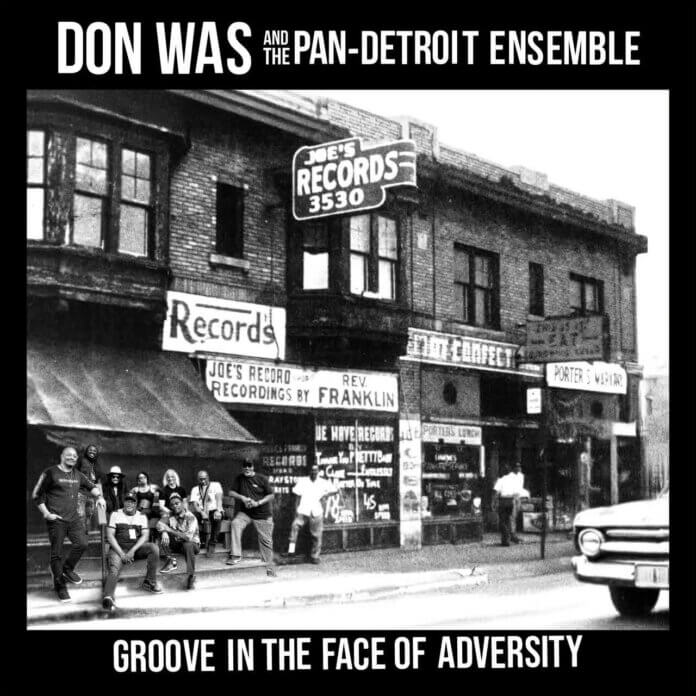
ARTIST
Don Was & The Pan-Detroit Ensemble
ALBUM TITLE
“Groove in the Face of Adversity”
LABEL
Mack Avenue
______________________________________________________________
Detroit is a city that has lost everything: industry, prosperity, security, and glory. But not its rhythm. It is the pulse that makes it a crossroads where techno mixes with funk and soul blends with rock. It is the same heartbeat that survives collapse and never stops moving the body. That pulse, that beat, that groove has long had a name: Don Was. With Groove in the Face of Adversity, the bassist and producer delivers his most personal album yet: six tracks, a band of top-tier professionals, and a sound that carries half a century of collective memory. Anyone expecting the jazz explorations of the new millennium, the experiments of young African-American innovators, or the refined modern Blue Note aesthetic may be disappointed at first but will soon change their minds.
After a lifetime behind the console working with Bob Dylan, Bonnie Raitt, the Rolling Stones, John Mayer, Gregory Porter, Immanuel Wilkins, Joel Ross, and countless others, Don Was returns home to his natural element: the bass, pulsing like the heart of a wounded yet living city. He approaches it with the sensitivity and class of a true master, and notably, this album is not released on Blue Note, as he easily could have done, but on Mack Avenue.
It is a dedication to Detroit, the city where soul fell in love with rock, where the fury of the blues was fueled by the noise of pistons, and where gospel found its secular echo in the roar of an engine. Detroit was the cradle of Motown, the MC5, Bob Seger, Iggy Pop, and Marvin Gaye; a place where the body was sublimated through dance. Don Was knows this, and his Pan-Detroit Ensemble is not just a band: it is the city playing music. The groove remains when words fail. That is why the album is titled Groove in the Face of Adversity, and why it opens with Midnight Marauders, an urban funk track. The bass moves deep, while saxophone and keyboards sketch the contours of the city: after-work parties and whispered prayers, sweat and orange sunsets glowing on factory warehouses.
There is an American sound rarely acknowledged in jazz, yet Don Was brings it to the forefront with ease. It is the frontier where soul meets rock, the melting pot where the Doobie Brothers cross paths with the Temptations, Boz Scaggs greets Al Green, and Michael McDonald’s voice holds a fragile equilibrium between black and white. It is the no man’s land of blue-eyed soul, a non-genre that is more a feeling than a category. Detroit was one of its laboratories. Here, perhaps more than anywhere else, the line between soul and rock never existed. Bob Seger and Mitch Ryder were brothers to Marvin Gaye and Stevie Wonder. Glenn Frey played R&B in bars before forming the Eagles, and young Donald Fagenson, the future Don Was, grew up listening to them all.
This album vibrates with that dual belonging. It has the polished production of the Doobie Brothers and the grit of Funkadelic. It carries the harmonic finesse of Hall & Oates and the industrial ruggedness of the MC5. It is America squared, the America that does not distinguish and certainly is not voting for Trump. Don Was does not simply reference influences; he synthesises the intelligence of Steely Dan and the romanticism of Boz Scaggs with the spirituality of Curtis Mayfield and the power of James Jamerson’s bass line. Jamerson, perhaps his deepest influence. The result is music with no era but with groove.
With Nubian Lady, the album ascends further, the flute and bass engaging like two old friends reunited after years. The most striking surprise, in my opinion, is I Ain’t Got Nothin’ but Time, Hank Williams’s 1946 classic. The band shows its full class here, transforming the tune with an almost gospel tenderness. Was’s bass settles into a walking pulse, and when the horns enter, resistance is futile: the head nods, the body sways.
Curtis Mayfield’s This Is My Country becomes a hymn of belonging anew, elevated by Steffanie Christ’ian’s commanding vocals. She sounds like the spiritual daughter of Chaka Khan and Tina Turner. Next comes You Asked, I Came, an old Don Was piece from 1994 (on the Backbeat soundtrack), followed by Cameo’s Isane, a visceral funk workout that closes one of the most compelling albums of recent years. Listening to it, you understand that Detroit is the America that invented modern music yet never profited from it: the America that created Motown’s harmonic perfection and garage rock’s raging noise. Don Was has crafted an album that speaks for this city.
When our editor recommended the album to me, knowing my admiration for the bassist, I thought: if music like this is made and played with such integrity, it will never fade. Then I returned to Forever’s a Long, Long Time, a 1951 Hank Williams song that Don reimagined nearly thirty years ago with his Was Orchestra (the precursor to this group), with Herbie Hancock, Terence Blanchard, and the late Sweet Pea Atkinson on vocals. A wave of nostalgia washed over me.
– Nicola Gaeta
DISTRIBUTED BY
www.mackavenuerecords.com
LINEUP
John Douglas (trumpet), Vincent Chandler (trumpet), Dave McMurray (flute, alto saxophone, tenor saxophone), Luis Resto (keyboard), Wayne Gerard (guitar), Don Was (electric bass), Jeff Canaday (drums), Mahindi Masai (percussion), Steffanie Christ’ian (vocals).
RECORDING DATE
Detroit, 2025
