
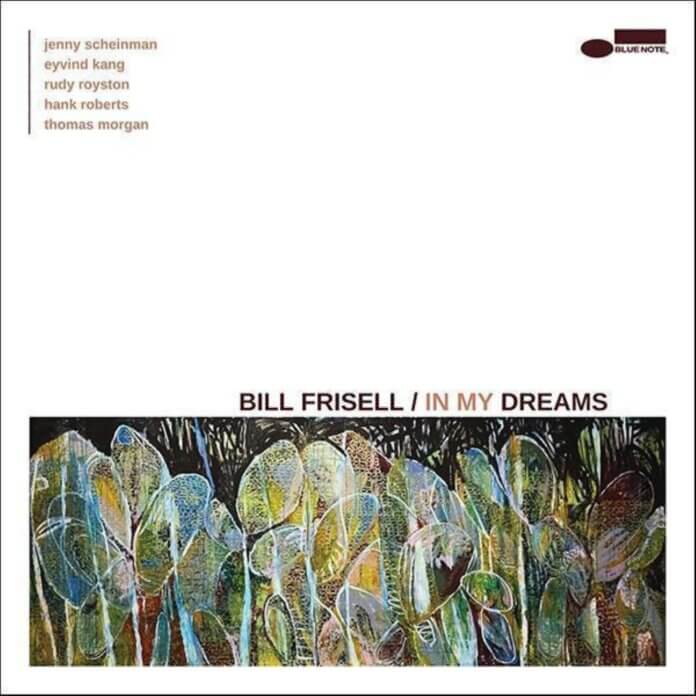


ARTIST
Bill Frisell
ALBUM TITLE
“In My Dreams”
LABEL
Blue Note
______________________________________________________________
Much anticipated, In My Dreams arrives as a celebration of Frisell’s seventy-fifth birthday, which he marked on 18 March 2026. The guitarist once again combines newly written material with reimagined repertoire, while bringing together his longstanding trio with Thomas Morgan and Rudy Royston and the string voices of Jenny Scheinman, Eyvind Kang and Hank Roberts, collaborators with whom he has shared a musical journey spanning decades. By assembling musicians who, despite their long association with him, have never previously appeared together in this configuration, Frisell remains faithful to a principle he has upheld with remarkable consistency: musical creation as a collective endeavour.
This human and personal dimension is indispensable to him, to the point of prompting the observation: “Music, for me, is about the chemical reaction that happens between people, the give and take.” Alongside this stands his familiar expressive universe – restless, suspended between reality and dream, and characterised by a kind of structural polycausality. It emerges from a multiplicity of interests and from a curiosity that moves in a continuous spiral, developing pathways that may appear meandering or inconclusive, yet ultimately generate meaning and musical form. This creative process is profoundly American, and Frisell’s explicit acknowledgement of Charles Ives as a source of inspiration is certainly no coincidence. It points toward a distinctly twentieth-century conception of engaging with complexity as something multiple, simultaneous and ever-present.
Within his vast creative storehouse, Frisell gathers themes, materials and sounds of the most diverse origins, unifying them through a deeply personal vision. Part of that vision is a dreamlike transcendence – openly referenced in the presentation of the project, which recalls an old dream that became foundational to his perception of reality. Equally central are a melodic tenderness that evokes a slightly estranged world, a displaced perspective, cinematic suggestions and a finely textured sensibility tinged with melancholy. Alongside these qualities are darker territories, at times unsettling: ironic gestures that offer little reassurance, a floating and suspended sound world with an almost ethereal circularity, and an evocation of American provincial life that might bring Stephen King to mind, were the comparison not liable to seem irreverent.
There is, in short – and rightly so, given the years that have passed and the artistic history that has been built – an authorial voice so firmly established that it appears almost independent of context. The album possesses a powerful dimension of remembrance and re-evocation, expressed both through the human element, in the renewed collaboration among musicians brought together in this sextet, and through the musical material itself, revisited according to Frisell’s familiar practice of reclaiming and reshaping repertoire.
The recording process, largely live but supplemented by substantial post-production work, contributes – together with the musicians’ deep mutual understanding – to a pervasive sense of intimacy and communicative connection. The music could almost sustain itself entirely on these terms, speaking only to listeners willing to receive it with gratitude. One could love it for that reason alone, for this particular alchemy. Yet it also retains a powerful capacity to attract and captivate.
Among the revisited pieces, it is impossible not to mention “Isfahan” and “When We Go”. The former serves as a deeply moving tribute to Billy Strayhorn, allowing Frisell to reveal the full breadth of a guitar dramaturgy that is both masterful and utterly unostentatious. The latter revisits material from much earlier in his career – even reaching back to Rambler, his 1985 ECM release – and perfectly illustrates the extraordinary completeness of his expressive palette from the very beginning.
Among the new compositions, our admittedly subjective choice for special mention is above all the magnificent title track, notable for its sense of restless anticipation within the cinematic dimension already described. Equally deserving of attention is “Curtis (A Year and a Day)”, dedicated to the late trombonist Curtis Fowlkes – a piece that opens up multiple musical worlds and features extraordinary contributions from Scheinman. Yet the album as a whole maintains an exceptionally high level throughout, displaying craftsmanship of the most refined order.
The sextet itself is equally impressive, operating through the mirror-like interplay of its two constituent trios and making the most of every possible timbral combination. Faced with such an elastic and sophisticated chamber texture, it is essential to single out Rudy Royston, a masterful architect of dynamic nuance, capable of punctuating, supporting, connecting and even melodicising the music in ways that only great drummers can.
This was an album long awaited by Frisell’s admirers, who hoped to hear him once again engage with a larger and more extensively orchestrated ensemble – while still remaining capable of conjuring the simple enchantment of “Hard Times”.
The wait has not been in vain. One may confidently say that the birthday celebrant has offered a wonderful gift to all his friends, old and new.
Sandro Cerini
DISTRIBUTED BY
Universal
LINEUP
Bill Frisell (guitar), Thomas Morgan (double bass), Rudy Royston (drums), Jenny Scheinman (violin), Eyvind Kang (viola), Hank Roberts (cello)
RECORDING DATE
New Haven, Brooklyn and Denver between February and April 2025.
