
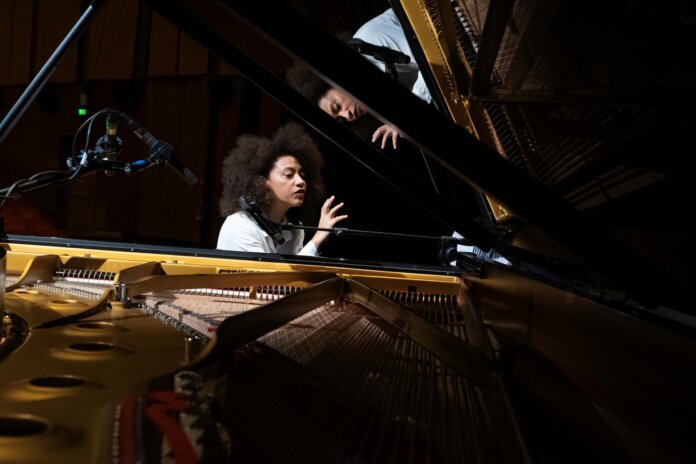


From the rhythmic roots of Cuba to the syntax of contemporary jazz. In an exclusive interview conducted in the quiet of Rome’s Sala Petrassi, Jany McPherson discusses her artistic journey, her collaboration with John McLaughlin, and the timbral exploration underlying A Long Way.
Following her sold-out concert on 22 November at Ladbroke’s in London as part of the EFG London Jazz Festival, we asked her how she experienced that evening.
It was a surprising evening. Even though my English isn’t perfect, when I sing I enter another dimension; my voice spontaneously finds its place, and the audience perceives it instantly. I had prepared some notes to explain the genesis of the songs – a sort of listening guide – and this created a direct and authentic connection with the audience. I received a warm welcome, and the long final applause was a true moment of emotional interaction between me and the audience.
During your concerts, you share the stories behind the songs. Why do you feel the need to do this?
For me, storytelling is an integral part of music. It opens a door and invites the audience into my creative process. When I share this context, people’s perception of the voicings, dynamics and construction of the melody changes too. Listening becomes more profound. I also feel less alone on stage because improvisation arises in dialogue with the audience.
What is the soul of your music? How much of your Cuban heritage is reflected in your music?
Above all, I bring the rhythm – that percussive matrix which forms part of my identity. This rhythm recurs in the patterns I use as a foundation for improvisation and in the rhythmic overlays that emerge spontaneously when I play. The melody, on the other hand, comes from a mysterious place. I feel like a receptor, receiving harmonic ideas and melodic lines, which I then try to give a coherent form. In the real world, of course, copyright is fundamental. However, deep down, I know there is a greater source – a space where musical ideas float freely. I welcome these ideas, organise them, and transform them into a sonic narrative.
Your influences range from classic jazz and Caribbean rhythms to Songo and 1940s Cuban music, as well as Italian song. How do they coexist in your musical language?
I grew up immersed in Cuban music because that’s what I mostly heard around me. At the same time, though, I received a strong emotional education through Brazilian telenovelas and their soundtracks, featuring artists such as Chico Buarque, Caetano Veloso and Ivan Lins. That melodic style, so natural and singable, became part of me very early on. My classical training provided me with structure, but the Caribbean rhythm remains central. Within me, the influences of Songo coexist with forms close to the bolero, grafted onto singable structures, and the tradition of 1940s Cuban music. Then there were the greats of American vocal jazz – Ella Fitzgerald, Sarah Vaughan and Billie Holiday – who taught me fundamental things, such as the freedom of phrasing and how to embody a melody. When I arrived in Europe, I discovered Pino Daniele, who had a huge influence on me, and Mina, whom I adore. They have shaped my relationship with words and singing. I grew up with a wide range of diverse influences from far-flung places, and today they all coexist naturally in my music.
A Long Way is your latest work, an album of original songs. What musical exploration lies behind this project?
A Long Way stems from a very specific exploration. I felt the need to create a dialogue between contemporary jazz and my Cuban roots, striking a balance between composition and expressive freedom. Each track begins with a thematic idea or initial motif that serves as a core, which is then developed through harmonic work, modulations and careful exploration of timbre. The album is conceived as a palette of dynamic nuances and diverse atmospheres, where more instinctive moments alternate with sections featuring a more defined composition. This is how my creative process works: emotion comes first, and technique follows to give form and meaning to the emotion.
Your long collaboration with John McLaughlin marked an important phase in your career. What is the greatest lesson he taught you?
With John, every day is a workshop. The way he thinks about music, the freedom with which he approaches rhythm and the rigour with which he constructs the musical discourse mean that being by his side is a constant learning experience. But the most valuable lesson concerns the essence. He told me: “When you play, you must play from the soul, not imitate someone else.” He taught me the value of simplicity. This principle applies in music as well as in life. There’s no need for gratuitous virtuosity – what’s needed is authenticity. Playing as yourself, with your own sound. It’s something I carry with me every time I step onto a stage.
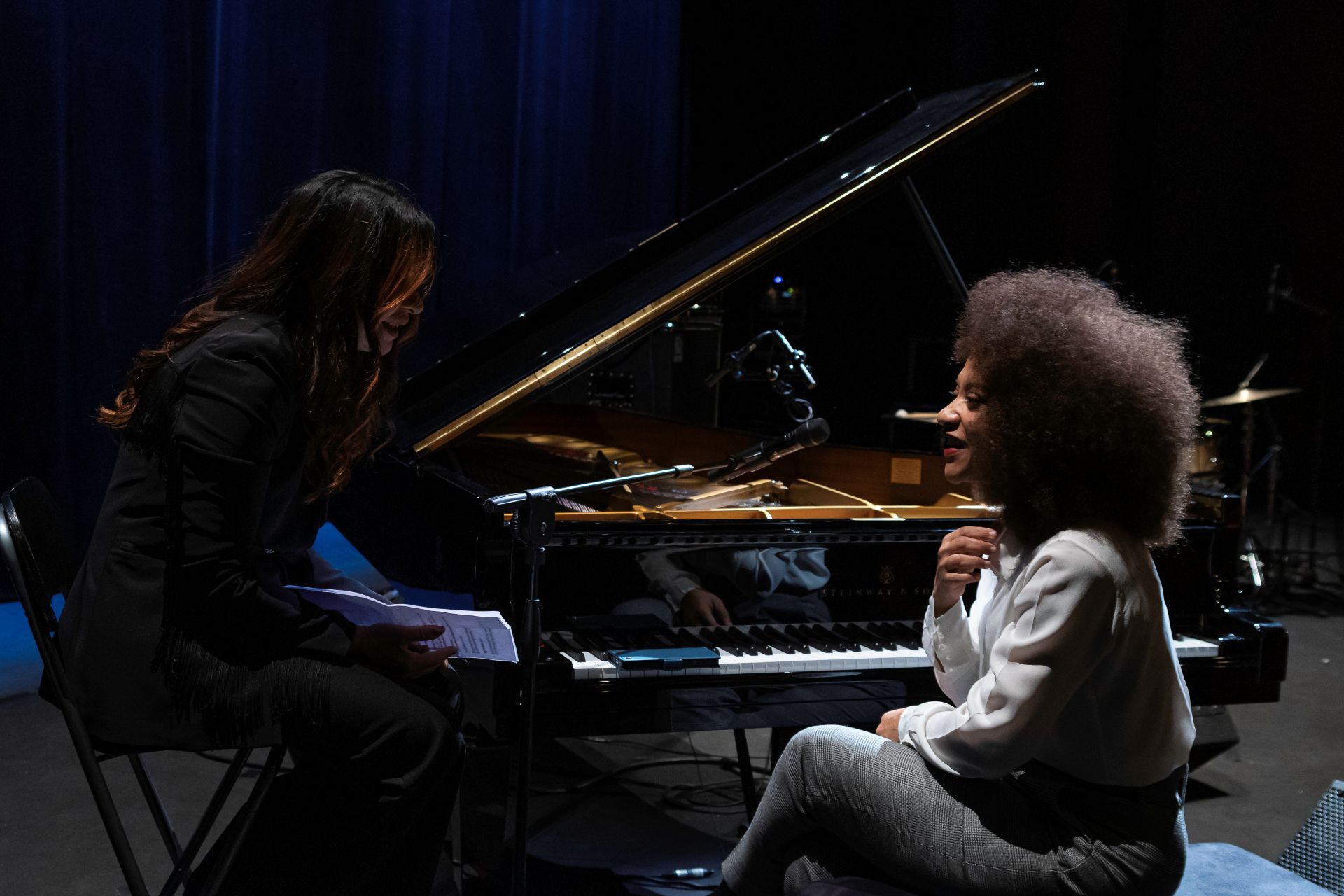
How do you perceive contemporary jazz?
It’s a vast, constantly evolving landscape. Technical standards are very high, and there’s a great deal of curiosity surrounding the world’s musical traditions, new forms of composition and a variety of influences ranging from modal jazz to electronic music and urban styles. I don’t define myself as a “pure” jazz musician. I see myself more as a pianist and composer who uses jazz as a language rather than a boundary. For me, jazz remains a space of freedom, an open territory where tradition and innovation can coexist.
What do you hope to bring to the audience tonight?
Love and warmth. This is the final concert of 2025, and I want to leave the audience feeling light and connected to something beautiful. If even one person goes home with something that continues to resonate within them – inner peace or an authentic emotion – then I will have done my job.
After the 2025 tour concludes, you will return to Italy in 2026 with new dates in Viterbo, Altamura and Palermo. What is your relationship with Italy?
It is a country that has given the world an immense amount of art, music and architecture. Its cultural history is extraordinary, and it continues to be a source of inspiration. I feel at home here; I feel welcomed, listened to and understood. There is a deep aesthetic sensibility and natural attention to beauty here, which I feel is very close to my own way of being and making music.
Can music still be a unifying force in a world torn by conflict?
We are living in a time of great upheaval, both political and spiritual. Tensions are everywhere. For me, music is a reminder that each of us has a space of peace within us. When I perform, I aim to create that space and that suspended moment in time where people can listen to one another, rediscover their inner balance and reconnect with their soul. If this happens, even if only for a few minutes, then music has fulfilled its deepest purpose.
Are you working on a new project at the moment?
Right now, my muses are on holiday! I have ideas, motifs and harmonic sketches, but they aren’t fully formed yet. After A Long Way, I felt the need to let things settle. The ideas will return when the time is right.
What music do you listen to in your spare time?
I listen to Stevie Wonder, great Brazilian classics and Pino Daniele. But sometimes I listen to silence, too. It’s important to understand what happens inside us when the music stops.
What is your favourite hobby?
Doing nothing. Relaxing on the couch!
A few hours later, Jany delivers a performance with Tony Sgro on double bass and Yoann Serra on drums that confirms her as one of the most original voices in contemporary jazz. Her music is intense – it pulses and tells a story.
by Amelia Mancini
