
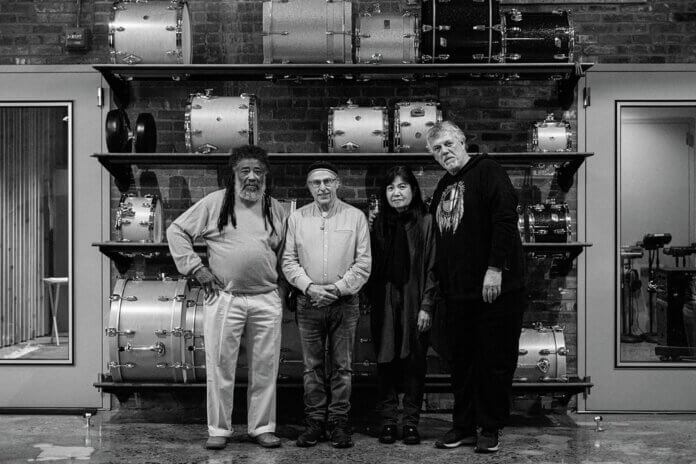


On the occasion of a double concert in Milan (first at the Soho Café and then at the Long Song Books&Café), we caught up with the versatile American double bass player to talk about his career, his latest album with Wadada Leo Smith and his future projects.
Hi Joe, is this the first time you’ve given an interview to Musica Jazz?
I think so! I’ve done interviews for German, French and Austrian magazines, but never for an Italian one. So I think it’s the right time to do one for Musica Jazz.
I know you’re about to turn seventy, it seems like a good way to celebrate this milestone.
Yes, it’s a special birthday and I want to enjoy it to the fullest, you’re absolutely right.
The first thing I’d like to ask you about is your beginnings as a musician at the turn of the seventies and eighties. What kind of years were those?
I graduated from high school in 1973, and then I went to Berklee for two years, until 1975. Then I dropped out of college because I wanted to be a musician and I wasn’t interested in pursuing non-musical studies. So we moved to Amherst, Massachusetts, with a handful of other musicians we knew from Berklee, because we knew that Max Roach and Archie Shepp were teaching there at the time. The others and I thought: “Why stay at Berklee? Let’s go where Max and Archie are and try to hang out with them and take their classes. So five of us went to Amherst to join them. We were all very young, between eighteen and twenty, trying to figure out how to become professional musicians. And this is where I learned my first big lesson: One day Max came into the classroom, looked at us all and said: “Get out of here! You’re never going to learn anything here! Pack up your instruments and go to New York, that’s where you have to be if you want to make a living playing this music. Don’t tell anybody at the university, but if you really want to make it, you have to go there.”
So in retrospect, Max, your idea to move to Amherst wasn’t so farsighted after all.
No! Not at all! But in the end, within a few years, we all managed to move to the Big Apple, which was and still is a fundamental destination for any musician. Chicago has its scene, California too, but to be in New York is something special for those in our profession. In France everyone goes to Paris, in Italy everyone goes to Milan and in Germany everyone goes to Berlin.
Before coming to New York, I spent some time in New Haven, Connecticut, where I first met Wadada Leo Smith in the early eighties. At the time, Wadada and Bobby Naughton had founded an organization based on principles similar to those of the AACM called the Creative Musicians Improvisors Forum, which included other local musicians. One day I found a flyer announcing that they were looking for new members. I didn’t know Wadada, but I knew who Bobby Naughton was, and I knew other members of the organization like Gerry Hemingway and Wes Brown, and I wanted to get in touch with these people. So I called Leo (he wasn’t called Wadada yet) and we set up an interview that would be useful for me to join the organization.
I remember that this kind of interview took place at Leo Smith’s house, all the members were there that day, and apart from me they would look at a couple of other candidates. Bobby Naughton did all the talking, while Leo didn’t say a word the whole time, and that always struck me as an interesting element. He would sit by the front door while Bobby grilled me with questions and challenging speeches. He wanted people to take him seriously: “This isn’t something we do part-time, this has to be our life. And I thought to myself: “Man, they’re serious, but maybe they’re a little too radical, I want to be free to go and do what I want, I don’t know if this association is really for me”. At that point – the interview was over, I was on my way out – I ran into Leo, who looked me in the eye and said: “We need members”. Without saying anything else. And that was all I wanted to hear so I could respond: “OK, I want to be a part of it. So I joined the association, and one of the tracks on my latest album is called We Need Members, in memory of that fundamental episode in my career. Many of the songs on the album refer to encounters I’ve had with Wadada over time, to the feelings I’ve experienced while studying and learning with him. At that time we organized many concerts with Leo and Bobby. We had an orchestra, the Creative Improvisators Musicians Orchestra, with which we also recorded an album, “The Sky Cries the Blues,” the only one released by our association. On one side there was a composition by Leo, on the other side there was one by Bobby Naughton and one by Gerry Hemingway. In my opinion it’s an extraordinary record that unfortunately has never been reissued.
When was the band formed?
The record is from 1982, but I joined a couple of years before that, so I’d say between late 1979 and 1980.
And how long did it last?
Until 1985.
So your collaboration at that time was only documented on one record?
Actually, apart from the experience with the orchestra, I had the opportunity to record another album with Leo Smith during those years, produced by Chuck Nessa: “Procession of the Great Ancestry”. The inspiration for my “Eyes on the Horizon” is based on the music of that album. I took some concepts from that recording session and used his influences. It’s an interesting story: I was studying with Leo at the time and he was preparing the material for this album. So I would go to his house once a week to rehearse the new repertoire that he was going to record in Chicago. We worked on these pieces for six months and they were very challenging for a bass player. The music had a lot of harmonies that had to be learned and played, but that’s why I was there. Two days before leaving for Chicago, Leo asked me if I would be interested in going with him, and I enthusiastically said yes. So we arrived by car with Leo and Bobby, and the others were rehearsing in the basement of a bank. Malachi Favors had been contacted to do the session, but for some reason he couldn’t make it at the last minute, so Leo turned to me and said: “Well done, Fonda, you made it! All of this happened thanks to a good dose of luck and the wisdom of Leo, who decided to take me along as a possible backup. I knew the music very well and it’s still one of my favorite records. I’m still very young on these recordings, and you can feel it in some passages, but there’s something very special about these performances.
This is more or less what happened in the eighties, after which I moved to New York permanently in 1990, although I had visited occasionally in the previous years.
So if I understand correctly, “Procession of The Great Ancestry” is the last album you recorded with Wadada before the recent “Eyes on the Horizon”.
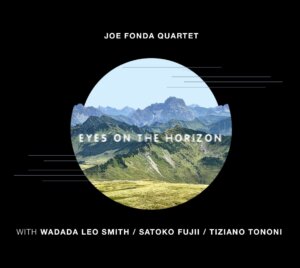
That’s right. We’ve stayed in touch over the last forty years, but after the band disbanded, we never got a chance to play together again. I’ve been thinking about dedicating a project to him for a long time, because he was a very important influence on me. I have to give credit to Fabrizio Perissinotto of Long Song Records. I had already recorded an album with Satoko Fujii for his label. When I mentioned the idea of doing something with Wadada to him, he accepted the proposal with enthusiasm. So, thanks to Fabrizio’s love for music, we were able to make this recording. Sometimes I think he loves this music more than many of the musicians who play it. When I showed the sheet music to Wadada and asked him if he would like to be a guest on the album, he said, “Sure!
If I’m not mistaken, you’ve made other records with Fabrizio.
Yes! You know, Fabrizio, Tiziano Tononi and I grew up in the same era and have very similar musical tastes. One of the bands we loved the most was the Allman Brothers. One day Fabrizio and Tiziano came to New York to record an album with Herb Robertson and Steve Swell. They needed a bass player and Herb suggested me. We went out to dinner that night and while we were talking I asked them (I don’t remember if it was Fabrizio or Tiziano) what was their favorite record of all time. One of them answered: “Live at Fillmore East” by the Allman Brothers. I blurted out: “Wow! That’s one of my favorite records too, I still love it! Then I added that Jaimoe (one of the two Allman Brothers drummers) was one of my best friends, but they didn’t believe me! So I picked up the phone and called him live. Fabrizio was over the moon, Jaimoe was a hero to him. As soon as I hung up, he immediately suggested that we do something with Jaimoe. That’s how it all started. So we asked Jaimoe if he would be willing to come to Milan to make a record. And he did come and he brought a couple of Texas guitarists with him.
So we formed the J&F band with other Italian musicians. We made four records together, all very good, but if I had to choose one, I would say the last one: Star Motel: An American Music Experience. Among other things, I think it’s the last album Jiaimoe recorded, he doesn’t play much these days. We did all this for Fabrizio’s Long Song, but there are others: some with the Japanese pianist Satoko Fujii, both as a duo and as a trio with Gianni Mimmo, a very talented saxophonist and improviser from your country.
All this was possible thanks to Herb Robertson, who recommended you to Fabrizio and Tiziano that day in New York.
You’re right. If Herb hadn’t mentioned my name, all these opportunities wouldn’t have come about. When I go back to New York, I have to buy him dinner or something! I owe him [unfortunately, Joe won’t be able to keep his promise: Herb Robertson died the day after this interview, ed.].
Now I’d like to talk about your experiences in Anthony Braxton’s groups.
With pleasure.
According to some discographies, your collaboration began in 1981, documented on the mysterious “Elegy for a Goose”, a record that would feature Braxton and Charlie Mariano as co-leaders. Is that true?
I never made a record with Charlie Mariano, someone else asked me the same question. They probably didn’t remember who the bass player was and put my name down. I knew Mariano, but I never played with him or Braxton. Maybe they thought they could sell more copies with my name in the credits! [laughs] So I can’t talk about that recording because I wasn’t there.
So how did it go with Braxton?
The first time I played with Anthony was for the Charlie Parker project in 1993, when we recorded at the WDR studio in Cologne and then in Zurich. Werner Uehlinger’s Hat Hut released it as a double CD. I remember getting the call from Anthony, and we immediately went to a studio in Switzerland to rehearse the repertoire for about a week. We recorded so much music! Anthony likes to have all his music documented, so he went to Switzerland to get the tapes from that session and released them in their entirety on a 12 CD box set for his label, Braxton House. I love this music, it was a fantastic experience with great musicians: Paul Smoker on trumpet, Ari Brown on sax, Misha Mengelberg on piano, Pheeroan akLaff and Han Bennink on drums, Anthony and me. It’s a beautiful combination of Anthony’s musical theories with Charlie Parker’s repertoire.
Were you familiar with Braxton’s approach to standards before you participated in these recordings?
Yes! I had his record with Tete Montoliu, NHOP and Albert “Tootie” Heath. Do you remember it? It’s one of the first ones I heard. But I got to know him around 1973 through the Arista records: “Five Pieces” from 1975 is one of my favorites. I also loved everything he did with the Circle, what a band! I must have worn out at least three copies of their ECM record, the live one in Paris, I listened to it all the time. So, yes, I was familiar with his music. And I can tell you a story.
I was living in Middletown, Connecticut, where Wesleyan University is, and Braxton was teaching there at the time. I was commuting back and forth to New York because my wife and kids didn’t want to live outside the city. One day I ran into Anthony on the street and he invited me to a rehearsal. Anthony sat down at the piano, opened the Real Book and, if I remember correctly, we played There Will Never Be Another You. Even though he was at the piano, after a moment he began to direct the music with the dynamics typical of his own language. But I was familiar with this kind of situation, having heard him do it so many times, and I managed to keep up with him for the duration of the piece. We were moving outside the form, but only in a way that only Braxton could do. When we finished, he looked at me and said, “You know exactly where I’m going!” And I replied, “Of course I do, Anthony, I’ve been listening to you for so long!” That moment cemented our relationship and we worked together for twelve years.
After the Charlie Parker project, Anthony embarked on a new musical adventure that he called Ghost Trance Music. It started out as a quartet with Kevin Norton, Ted Reichman, me and him. He’s an incredible composer: for every concert he brought a new score with original elements, we never played the same music twice. In twelve years, we recorded about twenty albums with only his original compositions. He is an absolute genius! I learned so much from him, as I did from Wadada, and playing with Braxton opened many doors for my career. I am grateful for the opportunity to have worked with Anthony for so long.
I recently interviewed Rufus Reid – who recorded two albums of standards with Anthony for Magenta – and he told me that he was never comfortable with Braxton’s approach to classical material and that he felt like a fish out of water in that musical context. I imagine you feel differently.
I took lessons from Rufus, he’s one of the great bass players and I learned a lot from him. I can understand that I don’t understand Anthony’s musical history. For me and for others, it’s easier to understand where Anthony is coming from and where he’s going musically, and it’s all connected. Anthony knows the form and he never gets lost: when the bridge comes, he’s right there in the piece. I also played in his piano quartet with Marty Ehrlich and Pheeroan akLaff, and we played mostly standards. And Anthony never got lost in the form, never! Even if he didn’t use the original chord but put in a substitution, he always knew exactly where he was. The form was always there, no matter what he was playing. Everything he did had a very strong connection to the tradition. It’s just that he had his own personal approach to it, as you said. Rufus couldn’t hear or understand that way of understanding music.
Now I wanted to talk about Nu Band, a group that is not very well known in Italy, but that has certainly left its mark.
It’s true, we only played once in Italy. The line-up of the band has changed a few times over the years as some members have died. In the beginning it was me, Mark Whitecage on alto sax, Lou Grassi on drums and Roy Campbell Jr. on trumpet. The idea to form the band came from Lou and Roy. Roy Campbell Jr. especially needed to play with new people: at that time he was working a lot with William Parker and his circle of collaborators. That’s why I think they chose me and Mark. We knew each other, but we hadn’t played together that much. The first record we made was called “Live at the Bop Shop”, released on Clean Feed in 2001. The funny thing is that’s the only record I was on that sold out. It was a success! (laughs).
It was interesting to see how Roy and Mark developed their language over time. As time went on, there was more of a collective approach to the band. There were solos by individuals, but they integrated beautifully into the sound of the band. It often seemed as if you were listening to a single musician, a single mind. The way Roy and Mark crossed their boundaries was one of the most interesting aspects of this group. Lou and I were a well-oiled rhythm section and each member brought their own original compositions to the table. Again, we were a true collective.
Unfortunately, Roy died one day and we weren’t sure if we wanted to go on. In the end we decided to go on and brought in another trumpet player: Thomas Heberer. The music changed immediately as Thomas brought a different kind of personality to the group. After about a year, Thomas and Mark hit it off, just like they had with Roy, but for different musical reasons. We carried on for a while, but after a while Mark Whitecage also left us due to an incurable illness. After that we decided to get together and see what to do, as it was impossible to replace Mark. So we agreed to continue, but in a completely new direction. So we thought of hiring the guitarist Kenny Wessel, a regular collaborator of Ornette Coleman. He lived in the same building as Lou and we had known each other for a long time. As a result, today – the band still exists – the music has changed again, we have a single breath and a harmonic instrument, and with the patterns hatched by the guitar everything is very different. But we are still active! We should rename this version of the group “The New New Nu Band”. We recorded all our last albums for Not Two Records.
Has the music of Max Roach’s pianoless quartet influenced the sound of the band?
Strictly speaking I would say no, but it’s also true that every pianoless quartet in history has influenced the sound of our group.
I also noticed that there is an Archie Shepp album on which you also play. It was recorded live in Milan a few years ago, it’s called “Phat Jam in Milano”. So you finally got to play with one of your first mentors.
I first met Archie when I was twenty and played with him occasionally over the years thanks to Stephen McCraven, one of my best friends and father of Makaya, who always mentioned my name to Archie when they needed a bass player for dates in Massachusetts. When we recorded the album you’re referring to, I was touring with rapper Napoleon Maddox, and Archie was added as a special guest for the Milan date only. Oliver Lake and Hamid Drake were there as well. It was such a great concert that Archie decided to release it on his own label. I remember he kept asking me at the time: “Hey Joe, what key is this song in?” He’s a hero of mine and nobody else has his sound on sax.
Can you tell us something about your future projects?
Yes, but first I’d like to talk about other people who are important to me. For example, I’ve been playing with Barry Altschul for a long time.
Tell us about that.
I’ve been playing in his 3Dom Factor with Jon Irabagon for ten years, but I was also part of the OGJB Quartet with Oliver Lake and Graham Haynes. Unfortunately Oliver can’t play anymore and so the group is no longer active, but we did a couple of records for the Finnish TUM label of which I’m very proud. Oliver was another source of inspiration for me, while as for Barry, I’ve known him musically since the days of Circle. We’ve played a lot together and we’re doing a nice European tour in May, although there are no Italian dates planned at the moment.
Do you have anything else in the pipeline?
I’ve just finished a European tour with two very interesting musicians: Silke Eberhard and Emil Gros. We’ve renamed ourselves the Josilemi Trio, combining the initials of our names. It was time for me to start a project with musical partners younger than myself. So I found Silke surfing the net and immediately contacted her to collaborate. Oliver Lake is one of her idols and it’s very inspiring to play with her because she manages to make this connection transparent without being a literal reproduction of the original. As for Emil, I’ve known him since he was a kid.
Then I recently heard my old friend Michael Jeffrey Stevens, with whom I used to play in the Fonda/Stevens group, and after not playing for almost ten years, we decided to get the band back together, so we’ll be playing concerts soon.
I have two other projects in New York: Joe Fonda & Bass of Operation with Michael Rabinowitz, Jeff Lederer, Harvey Sorgen, who just released an album for the Polish label Fundacja Słuchaj, and the other is called Joe Fonda from the Source, also a quartet, but with a different musical concept. The first has more of a chamber music feel, while the second, which has yet to be recorded, is closer to R&B and funk. That’s where I come from musically, as a bass player I like to keep time. I like to play free, but I also like to create a groove.
Instead, I’d like to finish our conversation by talking about “Eyes on the Horizon” with Wadada as a special guest.
It all started with the desire to write and record a repertoire dedicated to Wadada Leo Smith, who, as I’ve told you at length, was a fundamental figure in my training. Each of the titles of the pieces refers to a direct experience I had with Wadada. For example, the first piece is called Inspiration Opus #1 because he was and is a great source of inspiration. We Need Members Opus #4 refers to the episode I mentioned earlier. Like No Other is dedicated to our old colleague Bobby Naughton, a unique individual, no one else was like him, hence the title. It’s a duet, Wadada and I, a bass solo and a trumpet solo, but Wadada’s performance was so profound that I could hardly hold back the tears of emotion. And I could go on. I’m very proud of this work and I hope it will be appreciated. Wadada himself complimented me on the quality of the writing and said he was proud of me, and I was very happy to hear that.
Did you leave more room for written music or improvisation on the album?
I’d say it’s sixty percent written music and forty percent improvised. I didn’t want it to be a completely spontaneous session. For this project, it was necessary to write specific music, as Wadada always encouraged me to do.
How did you choose the other two participants, Satoko Fujii and Tiziano Tononi?
Fabrizio suggested them both. Satoko was already known to me and Wadada, while Tiziano and I have been working together for a few years now and I really appreciate him as a musician. Wadada and Tiziano didn’t know each other, but there were connections, so I thought they were all the right elements for this project.
Are you thinking about a second volume or would you like to present this group live?
I really hope there is someone out there who wants to present it live. It would be ideal at a jazz festival: Wadada is very busy, but despite his age he still wants to get involved. As for Volume 2, who knows? Maybe in four or five years, or maybe just a couple, who knows? But you’ve given me a good idea to think about for the future!
Now I gotta run, I’m going to Blue Note for George Cables’ set.
Great! Give him my regards! We only played together once, at Barry Altschul’s house for his birthday party, but I have wonderful memories of that evening. Tell him!
