
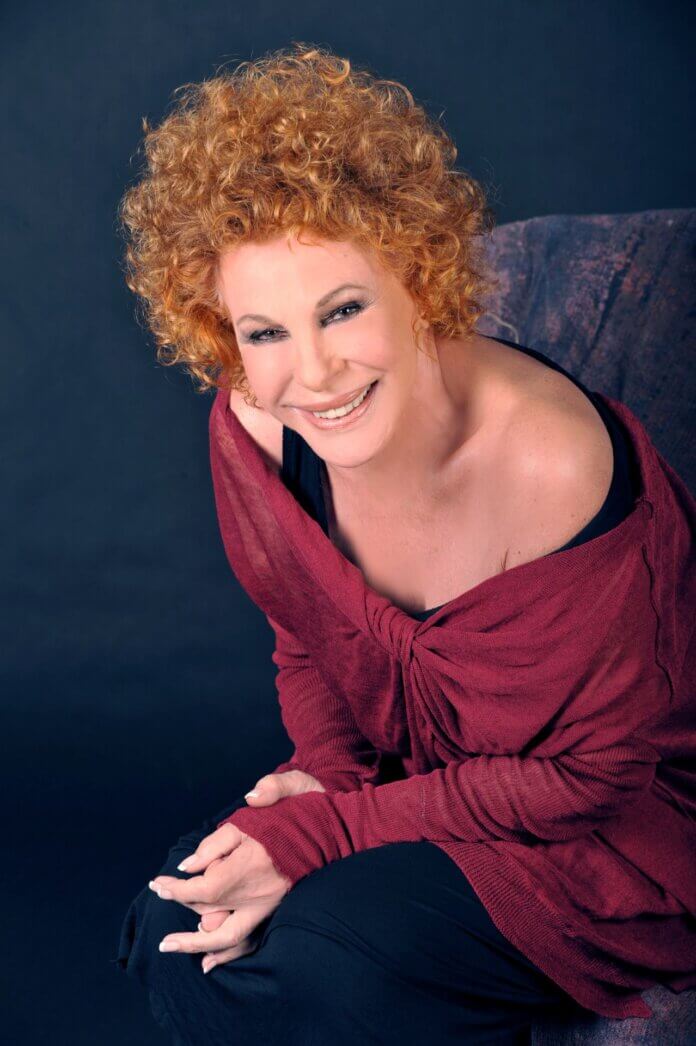


Free, ironic and, above all, undisciplined, Ornella Vanoni was a fragile yet indomitable presence. She passed away quietly at the age of 91 during the night between November 21 and 22, following cardiac arrest. She had recently celebrated her birthday and left this world as she would have wished, without suffering. A sudden illness while seated in an armchair in her Brera home led to cardiac arrest and, almost imperceptibly, she slipped away on tiptoe, lightly and with swing. In an instant, she returned to spirit and voice, that silky, nocturnal timbre scented with smoke, always veiled in shadow and melancholy.
With her passing, we lose a woman who won everyone over with her frank, unmistakably Milanese manner, sometimes aloof, always direct. In recent years she spoke of death as a familiar presence, something she did not fear. She had even organised her own funeral. With bitter irony she remarked, “I understand everything about life now that I have to die!” Then she added, “The coffin must be cheap, because it will burn anyway. Then throw me into the sea. I’d prefer Venice, but do as you wish. I already have the dress, it’s by Dior. And I asked Paolo Fresu to play at my funeral.”
The trumpeter from Berchidda, her dear friend, could only fulfil her wish. The two had first met in the early 1990s at Tangram, a legendary Milanese club in the Porta Ticinese area that no longer exists. From that encounter grew a special bond. Fresu recently described her with words that sound like a perfect artistic portrait: “Ornella is the emotion of life, hers and ours. She is capable of placing loneliness, passion, self-love and love for others, pathos and poetry at the centre, things that might yet save the world. She is an artist who shattered the fragile boundary between art and life, turning the stage into her home, a place where she welcomes and dispenses human feeling. Just like a jazz musician.”
Indeed, over the course of an eclectic and seemingly endless career spanning some seventy years, Vanoni experienced pain and glory, disappointment and triumph, falls and resurrections. It all began with Senza fine, the masterpiece Gino Paoli tailored for her to narrate their love story, and continued through enduring classics of Italian song such as Innamorati a Milano and L’appuntamento. Yet her passion for jazz, made especially visible in recent years through her close relationship with Fresu, is only the latest chapter in a much longer love affair. It began at the very start of her career, when swing was a vital source of inspiration for many Italian singers and songwriters.
Ornella knew and loved the Great American Songbook, just as Paoli did. By temperament and elective affinity, she was inspired by Billie Holiday, whose expressive essentiality left a deep mark on her own style. Among the many trajectories of her artistic journey, jazz and Brazilian music occupy a central place, not so much for their quantity as for their quality. Fresu fondly recalled a performance in Bologna last March: “She sang The Man I Love, arranged by Celso Valli. She sounded like Lady Day.”
Among the great improvisers she worked with was Gerry Mulligan, who played with her on the 1983 album Uomini and accompanied her live on several occasions. Vanoni also shared a close friendship with Zoot Sims. More curious, international and cosmopolitan than her eternal rival Mina in her artistic choices, she paid an explicit tribute to the language of jazz a few years later with the album Ornella &…, conceived and realised with the help of her friend Sergio Bardotti.
Her twenty-fifth studio album, recorded in New York, features Italian songs from different eras, including Il mondo, La donna cannone, …E penso a te and Ma l’amore no, interpreted alongside an extraordinary cast of musicians: Herbie Hancock, George Benson, Gil Evans, Lee Konitz, Michael Brecker, Randy Brecker, Steve Gadd and Ron Carter. It was an elegant, singular gesture, without precedent in the Italian pop landscape.
Alongside her affinity with jazz improvisers, Vanoni always nurtured a deep love for Brazilian music. A decade earlier she had recorded what is often considered her masterpiece in this field: La voglia, la pazzia, l’incoscienza, l’allegria, born from her collaboration with two giants of MPB, Vinícius de Moraes and Toquinho. It is no coincidence that only a few months ago the São Paulo guitarist and singer described her in these pages as “the Italian artist with the most Brazilian voice and rhythm”.
For Ornella, jazz was not a stylistic label but an interpretive posture, an attitude based on phrasing, the use of silence and the art of subtraction, all in service of the emotional depth of the text. Over time, Brazil became a kind of utopian homeland of the heart for her. When Argilla was released in 1997, and later reissued in 2018 by Fresu’s Tǔk, these two worlds found an ideal point of convergence. Between songs by the “tribalists” Marisa Monte and Carlinhos Brown, the contributions of Italian improvisers such as Tino Tracanna and Furio Di Castri, and standards like Cole Porter’s Every Time We Say Goodbye, Vanoni’s singing and acting reach a form of expressive perfection.
Ciao, Ornella. We will miss you.

