
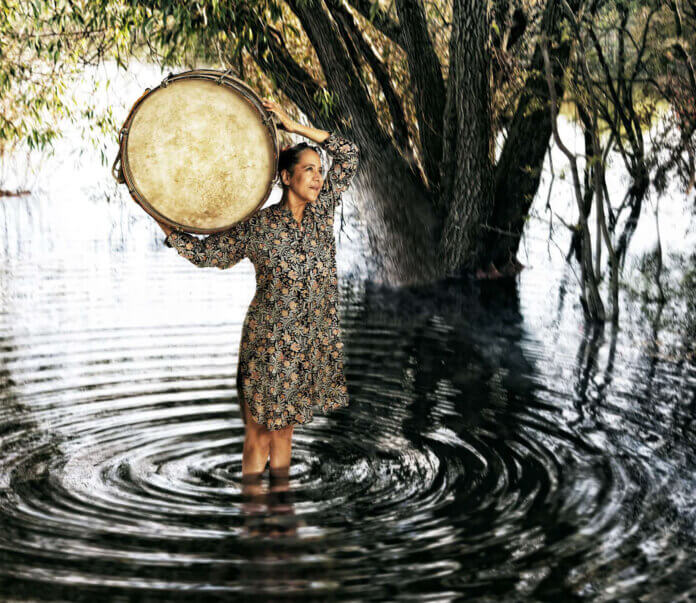
Marilyn Mazur once explained the criteria she used to hire musicians. One of these was that she chose people who could bring their own personal sensibilities, ideas, moods and languages to her music, rather than simply perform it. She added, “I want them to feel at home.” This phrase best captures the essence of the percussionist and drummer, who passed away on 12 December after a brief illness. Her artistic “mission” was to bring together music, percussion, song and dance – as has always been the case with humankind since the dawn of time – to highlight their communal spirit: playing together, welcoming and embracing. Marilyn wanted some of her groups to be “a true musical family”.
Defining what she did as “jazz” is reductive, but if we view her as a leading figure moving through the world of jazz, we can say that no one else conveyed the deepest meaning of “being a woman” with such conviction and warmth. One might think of Billie Holiday, but that is an entirely different case, since the singer’s troubled life is so evident in her work. Even in a role traditionally assigned to percussionists – that of accompanists – Mazur consistently brought a blend of frenzy and wisdom, alongside a distinctly feminine quality.
Furthermore, Marilyn broke the male dominance among “versatile” jazz percussionists – that is, those capable of performing on a wide variety of instruments. Notably, her counterpart in the realm of classical music is also a woman: the deaf Scottish musician Evelyn Glennie. Mazur had a collection of instruments gathered from around the world, and for each concert she would arrange the necessary ones on a veritable scaffold. It should be emphasised that she did not limit herself to keeping the beat or providing colour by choice. Everything she drew from her forest of percussion instruments on stage, with a full sense of space, was intended to form an immense womb in which the other musicians were welcomed and could feel “at home”. This can also be appreciated in recordings, where the visual element of the stage disappears and one is left face to face with the music.
This was not entirely possible in certain rare situations, for example during the 1985–86 and 1988 tours with Miles Davis’s band, where she shared the rhythmic foundation with a drummer and sometimes a second percussionist, and also had to engage with a funk-oriented context.
It was precisely this period that marked her international breakthrough, facilitated by the trumpeter. During those years, she also performed in the bands of Wayne Shorter – where Terri Lyne Carrington, another woman, was on drums – and Gil Evans. Marilyn met Miles in Copenhagen while recording “Aura” (1985), a big band suite composed by her friend Palle Mikkelborg, for which the “divine one” was the trumpet soloist. He held her in such high regard that, once she had finished her part during concerts, he would invite her to emerge from her “den” of instruments, join him at the front of the stage and take her applause.
Born in New York on 18 January 1955 to an African American father and a mother of Polish descent – from whom she took her surname – Marilyn moved to Denmark with her family in 1961. She thus placed her talent at the service of three jazz giants. Yet she had the courage to give it all up, including Miles. She wanted to return to Europe and work independently. She wanted to compose – she had studied harmony and knew how to write for percussion ensembles, big bands and symphony orchestras – and to form new ensembles, experimenting with other musicians, even those with less international visibility. She considered encounters, whatever they might be, the fundamental path for continuing her artistic growth. Above all, she wanted to deepen the ultimate meaning of a musician’s work. She performed in numerous contexts, many of which she created herself.
At a certain point, however, she made an exception and significantly reduced her activity as a bandleader when Jan Garbarek called her. With him she toured the world for fourteen years, from 1991 to 2004. Between them, a bond unlike any other formed on European soil. They both drew on jazz only to move beyond it, searching for other musical idioms until they arrived at something difficult to classify yet intensely magical. In my opinion, the touring quartet with Mazur, bassist Eberhard Weber and keyboardist-pianist Rainer Brüninghaus was the most exciting group Garbarek formed after his more adventurous early years. Recordings and live videos remain from that period. Listening to them, one often has the impression that the backbone of the music lies precisely in the saxophone–percussion dialogue between Garbarek and Mazur, much as it did in Coltrane’s quartet with Elvin Jones. It was therefore entirely natural that in 2005, when the percussionist granted herself a rare solo recording project – the splendid album Elixir – she chose to include a series of duets with the saxophonist, who also plays flute here. He enhanced her inclination toward melody and mystery.
The album consists of twenty-one short pieces that can be “opened” like a book of poetry: each possesses an ancestral evocative power and a precise structure that reaches the essence of things. Mazur used to say that her compositional ideas came more readily while walking in nature than while sitting at the piano. Elixir conveys this clearly. Each track stands on its own: thundering drums, metallic resonances, scenes evoking the forest or the East, and echoes of those folk dances that Mazur often drew upon.
Miles Davis encouraged her to dance while playing, something she did naturally, as physicality was another defining aspect of Mazur’s art. Even during her formative years, dance was as important as music. Later, in some of the groups she founded, beginning with the all-female musical theatre company Primi Band (1978), dance remained a cornerstone of the performances and sometimes included a professional dancer on stage. Apart from the few occasions when she played the drum kit, Mazur spent the entire concert standing and in constant motion. Even though she used only sticks or her hands, working primarily with her arms, her entire body – head, feet, legs and even her mouth – was involved in the act of making music. In short, she danced.
This physical dimension also carries a feminine aspect: every woman must, by nature, come to terms with her body and its transformations from adolescence onwards. In the early 2000s, Mazur revived the “primitive” spirit of Primi Band by forming the electrifying all-female group Percussion Paradise, which performed music for percussion and voices alone. The two projects were united by the idea that women share a sensibility and engage in a unique exchange of experiences, as has been the case since the dawn of humanity. At the same time, Mazur combined this with the conviction that gender divisions must be overcome, particularly in a musical evolution that requires a constant exchange between feminine and masculine energies.
To appreciate Marilyn Mazur’s greatness, we have a substantial legacy of albums and videos recorded in a wide variety of contexts. Notable examples include the fairy-tale trio with Mikkelborg and Jakob Bro (Strand); the adventurous sonic explorations of the long-running all-star ensemble Future Song (Live Reflections); Spirit Cave, a quartet with a distinctly electronic edge; Special 4, featuring the voice of Norma Winstone; and the more jazz-oriented Celestial Circle, with John Taylor, Anders Jormin and Josefine Cronholm (see the eponymous album).
Since 2015 there has been Shamania – a telling name – yet another spectacular all-female ensemble featuring wind instruments, percussion and voices. It includes the outstanding pianist Makiko Hirabayashi on the album Rerooting. Moreover, according to an intriguing hypothesis put forward by some anthropologists, chiefly Dean Falk, music itself may be considered a female invention, born from “maternese” or baby talk, a universal language also found among other animal species.
From the moment Homo became erectus, mothers were forced to put their young down while gathering food, as the infants would have hindered them. Yet they maintained acoustic contact through vocalisations, lullabies and elongated vowel sounds to soothe them during separation. Marilyn Mazur’s music evokes that atavistic experience. After all, she herself seemed soothing – she smiled almost constantly.
