

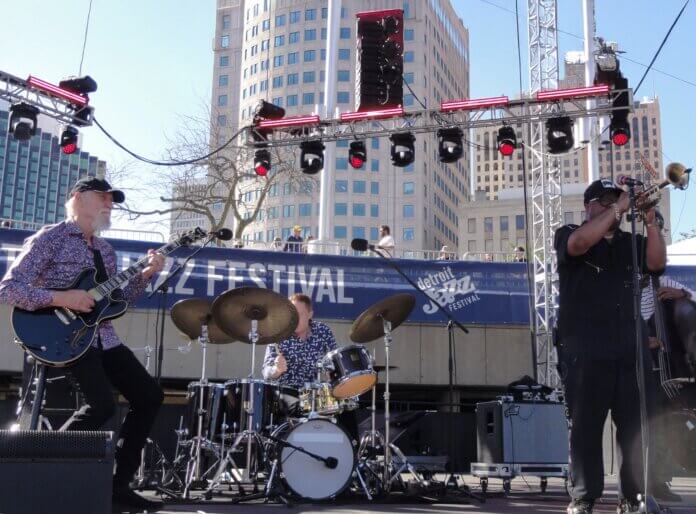


The long Labour Day weekend, which includes the first Monday in September (the American counterpart to Europe’s 1 May), is traditionally the final holiday of the season in the United States and marks the end of summer. During those four days, at least three major jazz festivals take place simultaneously in Washington, Chicago and Detroit. The latter two are free to attend, yet Detroit distinguishes itself each year with its lavish programme, the warmth of its citizens and, above all, the quality of its concerts, many of which feature truly original projects. Enthusiasts surely know this, but it bears repeating that Detroit is also the home of Motown – the soul and rhythm ’n’ blues label that launched the careers of Marvin Gaye, Stevie Wonder, Smokey Robinson, Diana Ross, the Jackson 5 and the Four Tops, among many others. We have written about Motown several times before, even visiting its historic headquarters, now a museum. But Detroit has also given jazz outstanding musicians such as Milt Jackson, Joe Henderson, Geri Allen and Tommy Flanagan. The ‘Motor City’ – so called because of its central role in the American automotive industry – is in fact one of the foremost capitals of African-American music. Its predominantly Black population follows the major and minor cultural events that underpin this status with remarkable passion.
Immersing yourself in the city’s jazz festival feels like stepping into a warm bath: an infusion of musical nourishment and soul-refreshing energy that reconnects us with the joyful, vibrant spirit of jazz over those four late-August days. The fact that it has been the most popular free jazz event in America since its founding in 1980 makes it unique, and as artistic director Chris Collins often says, it remains a true annual miracle. As one might imagine, organising an event of this scale – with four stages running simultaneously at considerable expense – without charging admission is no easy undertaking. Yet the Detroit Jazz Festival re-emerges each year stronger than before, thanks to the dedication of its organisers and the support of numerous sponsors. Perhaps there is something here for our part of the world to reflect upon.
This year’s edition featured at least two notable guests: Jason Moran, who presented three different projects as artist in residence, and Maria Schneider with her magnificent orchestra. Moran approached his three performances in entirely distinct ways: an intimate dialogue between jazz and poetry with techno DJ Jeff Mills and poet Jessica Care Moore; a tribute to Duke Ellington with the young musicians of the local Collegiate Jazz Orchestra; and, finally, his trio Bandwagon with two special guests – bassist and singer Meshell Ndegeocello and trumpeter Akili Bradley. The first project opened with a splendid solo piano rendition of John Coltrane’s After the Rain, intense and moving in its languid cadence. When Mills joined, the music took on a quasi-repetitive rhythmic dimension that was, at times, gripping and avoided the overused acoustic–electronic hybrids that so often attempt to sound forcibly ‘contemporary’. It was a combination that worked and ventured into fresh territory. The same could not be said of Jessica Care Moore’s contribution: despite the poet’s sincere attempt to forge something poignant with her voice and the piano’s accompaniment, the result remained cold, distant and emotionally disengaging.
The Ellington project with the youth orchestra, by contrast, was exceptional. The music itself is sublime, of course, but Moran’s imaginative approach to the arrangements, combined with the Collegiate Orchestra’s professionalism, produced what was arguably the masterpiece of the entire festival. The project had already been presented in Italy, at the Turin festival, but the repertoire and the arrangements were entirely different, as was the orchestra. Moran was so thrilled by the performance that he asked the musicians to play Braggin’ in Brass twice – a 1930s gem with a complex structure, performed masterfully here. By comparison, the meeting of Moran’s trio with Meshell Ndegeocello was less successful. Conceived as a modern celebration of Fats Waller’s music, it instead devolved into a monotonous lament sung by Ndegeocello and delivered with a certain dullness by the trio. Only the contributions of the gifted Akili Bradley, whose trumpet playing displayed sharpness, precision and a compelling presence, managed to salvage what was otherwise a misfire. Hearing masterpieces such as Ain’t Misbehavin’ and Honeysuckle Rose stripped of their joy and turned into weary complaints was a disappointment. As a result, the collaboration between Moran and Ndegeocello cannot be counted among the festival’s triumphs. One might gently suggest that Moran continue tending the jazz terrain – a field in which he excels – and that Ndegeocello perhaps revisit the spirited funk sound that first distinguished her. Bradley, meanwhile, appears destined for a bright future, provided she remains on course, for her talent is rare.
Maria Schneider was luminous and enthralling as always, leading an orchestra that included familiar collaborators such as Gary Versace, Dave Pietro and Scott Robinson, alongside several first-rate local musicians. Schneider’s music represents one of the most beautiful developments in jazz over the past thirty years – airy and free of clichés, structurally sophisticated yet grounded in harmonic and melodic clarity. She is a living marvel, rightly celebrated. In Detroit, in addition to presenting recent works (and announcing an upcoming album titled American Crow), Schneider revisited pieces from her early recordings, including Coming About (from the 1996 album of the same name) and Green Piece, dedicated to her mentor Gil Evans and included on her 1994 debut Evanescence.
The originality of the Minnesota-born composer was already evident in those early pieces, yet they retain all their beauty and expansiveness in their more mature form. Among today’s soloists, Dave Pietro on alto saxophone has reached a sublime level through his work in Schneider’s orchestra. It is often said that musicians give their best under her direction, a hallmark of great composers and arrangers. Think of Duke Ellington, Charles Mingus or, of course, Gil Evans – just a few among many. For a young woman born in the small Midwestern town of Windom, population 600 at the time, where jazz was heard only occasionally on the radio, her ascent remains nothing short of miraculous.
Elsewhere in the programme, both saxophonist Lakecia Benjamin and pianist Connie Han enjoyed considerable success. Yet one might suggest they devote more attention to the music they wish to offer rather than to their stage presence. Hiromi, another star from Japan, remains hyperbolic at the piano; an audience member aptly likened her to a merciless machine gun. Two delightful surprises provided welcome balance: French singer Tatiana Eva-Marie (of Swiss origin) and Zambra, an ensemble of five original and highly skilled performers. Mademoiselle Tatiana is charming and often playfully theatrical. Her repertoire, performed with precision and flair by her band, ranges from Django Reinhardt–inspired gypsy jazz to classic chansons by Charles Trenet and Edith Piaf. Her versions of La Mer and La Vie en Rose are lovely and refreshingly unvarnished, and her rendition of Nuages is extraordinary – a beautifully rendered tribute to the great gypsy guitarist.
Zambra, by contrast, impressed for entirely different reasons: the originality of their all-string instrumentation (oud, guitar, double bass, cello and violin), the breadth of their repertoire – from Middle Eastern melodies and folk to reimagined rock – and the remarkable skills of each musician. Their version of Led Zeppelin’s Going to California was nothing short of phenomenal. We would be eager to hear this group again, perhaps in Europe, because beneath their joyful stylistic blend lies a musical sensibility of uncommon refinement.
Finally, there is Kris Davis, a pianist and composer who has established herself as one of the most innovative voices in jazz today. Her immaculate technique and brilliant command of rhythm place her among the rare artists who always merit attention and respect. There are few like her – very few. Alongside Schneider, she is among the women who are bringing new prestige to jazz today – chapeau.
